
search-icon
Goodbye to the Galapagos

The last day of research brought us to Urvina Bay on the west side of Isabela Island. In passing from Pueto Ayora around the southern end of Isabela, we followed the same route that Darwin took aboard the Beagle in 1835. In his book The Voyage of the Beagle, he wrote how the signs of recent volcanic activity were everywhere in these young western islands:

SEPTEMBER 29, 1835. We doubled the south-west extremity of Albemarle [Isabela] Island, and the next day were nearly becalmed between it and Narborough [Fernandina] Island. Both are covered with immense deluges of black naked lava, which have flowed either over the rims of the great caldrons, like pitch over the rim of a pot in which it has been boiled, or have burst forth from smaller orifices on the flanks; in their descent they have spread over miles of the sea-coast. On both of these islands eruptions are known to have taken place; and in Albemarle we saw a small jet of smoke curling from the summit of one of the great craters.
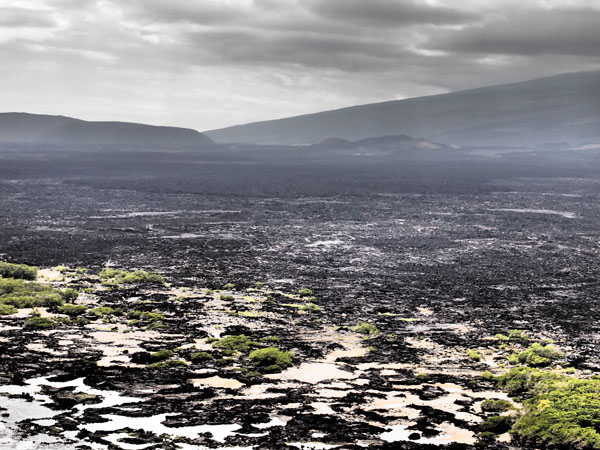
Urvina Bay, Isabela Island
Lava flow at Urvina Bay, Isabela Island

Urvina is between Darwin and Alcedo Volcanoes, across the Canal Bolívar from Fernandina. It was just another cove in 1835, but that changed dramatically a little over a century later. In 1954, the crew of a passing ship noticed a strange new white beach at Urvina. On closer investigation they found an entire stretch of shoreline—coral, fish, and all—had been suddenly lifted six meters above sea level by volcanic pressure underneath. It had happened so recently that fish were still flapping in puddles of seawater.
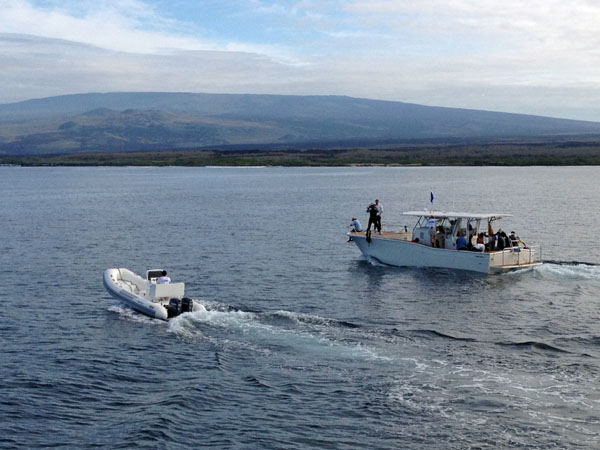
The Calcutta and a tender head out to the Urvina dive sites

Now Urvina is a popular visitor landing site, with the strange sight of large coral skeletons sitting on dry land surrounded by the bones of marine animals and the shells of dozens of sea turtles. On the shallow morning dive, we saw a both Porites and Psammocora corals, along with a seahorse and a sea turtle feeding on the abundant algae beds. Most of the group came up shivering from the second, deeper dive, which was colder thanks to the upwelling current from the west. This deeper area probably gets too cold to support corals during certain times of year, when the water temperature drops below 15C. (The shallower area never gets that cold, hence the small populations of coral closer  to shore.)
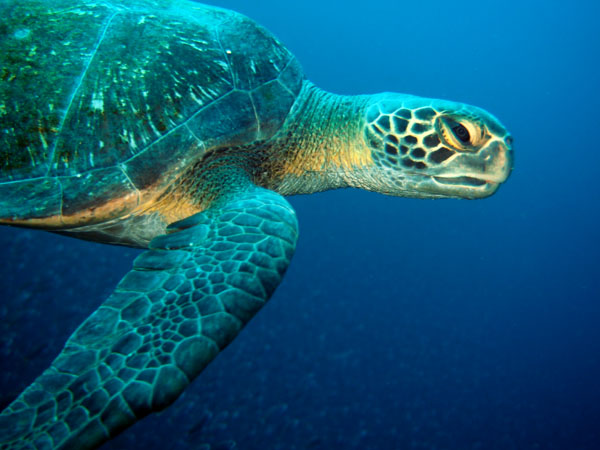
At Urvina Bay we saw a green sea turtle like this munching on algae
At Urvina Bay, we saw a green sea turtle like this munching on algae

Then it was time to clean, sort and dry gear, and pack up as the Golden Shadow motored overnight to Baltra and the airport. The general feeling on board is that this was a successful mission, especially the extended stay at Wolf and Darwin. (Not many research ships have the resources to anchor there with so many people and gear for a solid week.) As Peter said yesterday, even though the coral communities in the southern Galapagos Islands have a long way to go to reach their pre-’82/83 conditions, the corals around the northern islands seem to be recovering, slowly, but surely. In terms of their long-term survival, future El Niño events could make all the difference.

As we leave Urvina, the ship now has a long Pacific crossing ahead as the Global Reef Expedition continues this fall in French Polynesia. Thanks for following our mission to the Galapagos. Tune in soon for the next leg of our round-the-world journey.

(Photos/Images by: 1 & 3 Sam Purkis, 2 Julian Smith)

To follow along and see more photos, please visit us on Facebook! You can also follow the expedition on our Global Reef Expedition page, where there is more information about our research and team members.
Related Posts

From Dialogue to Action: Ocean Foundations Gather in Stockholm

What can philanthropy accomplish when foundations working across ocean science, conservation, and sustainable development come together around a shared purpose?

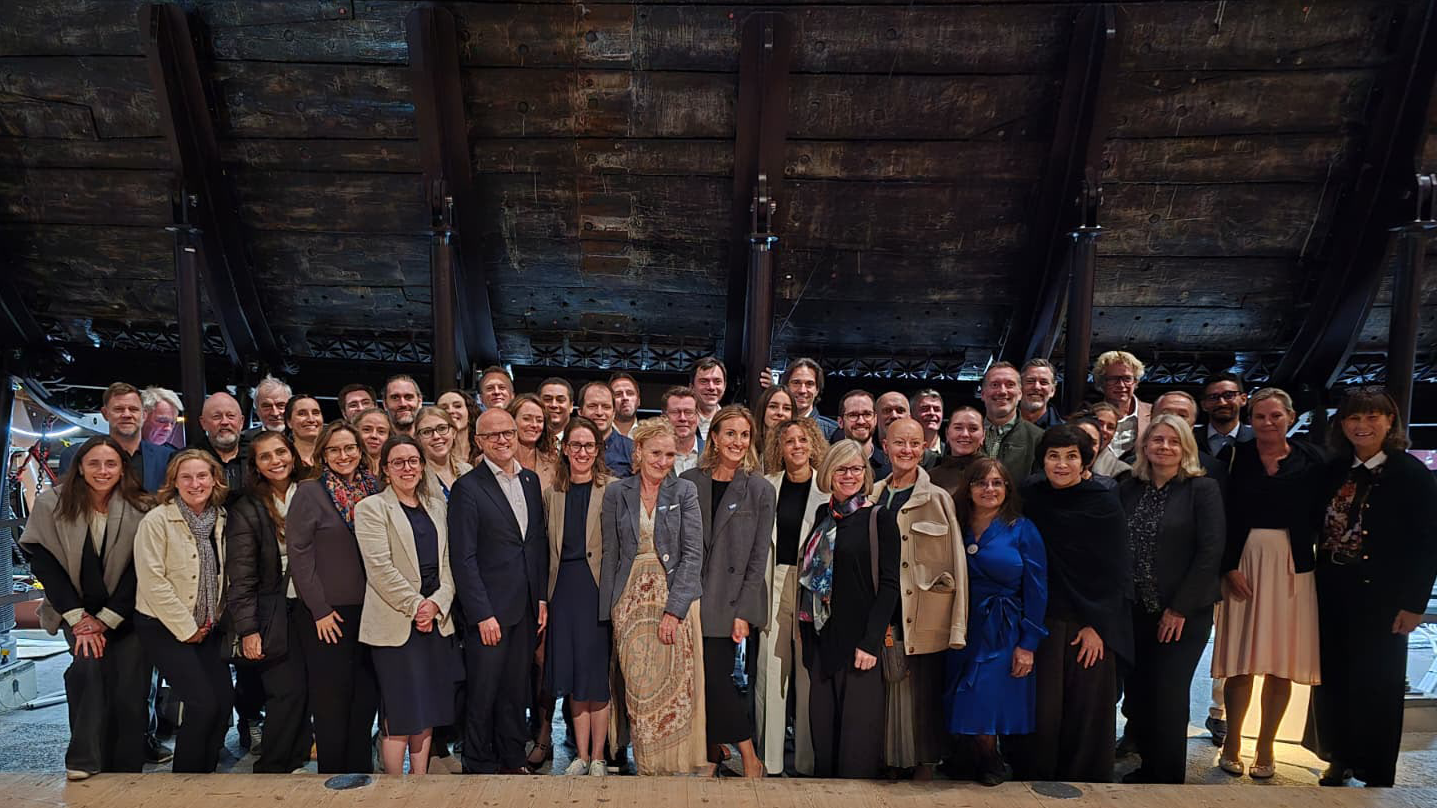
That question was at the heart of the 6th UN Ocean Decade Foundations Dialogue, held September 7–9 in Stockholm, Sweden. The Khaled bin Sultan Living Oceans Foundation joined philanthropic organizations from around the world for three days of discussion, collaboration, and planning focused on accelerating progress during the second half of the UN Decade of Ocean Science for Sustainable Development.

Facilitated by UNESCO’s Intergovernmental Oceanographic Commission (IOC), the UN Ocean Decade Foundations Dialogue is a growing network of more than 30 philanthropic organizations committed to advancing ocean science, collaboration, and action. Since its creation within the framework of the Ocean Decade, the Dialogue has provided foundations with a space to exchange ideas, develop partnerships, and explore how philanthropy can help advance a healthy and resilient ocean.

Hosted by the Voice of the Ocean Foundation (VOTO), this year’s gathering began with From Depth to Action, an Opening Forum that brought nearly 100 leaders from the Swedish and international ocean community together at…

Read More

Meet IFAN: Helping Bring Navigate with Care to the Next Generation

If you’ve ever seen a lighthouse flashing from the shore or a brightly colored buoy bobbing in the water, you’ve seen Aids to Navigation at work.

Aids to Navigation, often called AtoNs, help mariners navigate safely. They can mark channels, warn of hazards, help vessels determine their position, and provide other information people need to make safe decisions on the water. Around the world, these systems help guide everything from small recreational boats to large commercial or container ships. 

But safe navigation isn’t only about protecting vessels and the people aboard them. The choices mariners make can also affect the animals and ecosystems beneath and around them.

That connection between maritime safety and ocean conservation is at the heart of this year’s Science Without Borders® Challenge—and of our partnership with this year’s theme sponsor, the International Foundation for Aids to Navigation (IFAN).

Read More
Privacy Overview

This website uses cookies so that we can provide you with the best user experience possible. Cookie information is stored in your browser and performs functions such as recognising you when you return to our website and helping our team to understand which sections of the website you find most interesting and useful.  You can view our complete Privacy Policy here.

Strictly Necessary Cookies

Most of our cookies are used to improve website security and reduce spam. These cookies should be enabled at all times. They also enable us to save your preferences for cookie settings.

3rd Party Cookies

This website uses Google Analytics to collect anonymous information such as the number of visitors to the site, and the most popular pages. Keeping this cookie enabled helps us to improve our website.