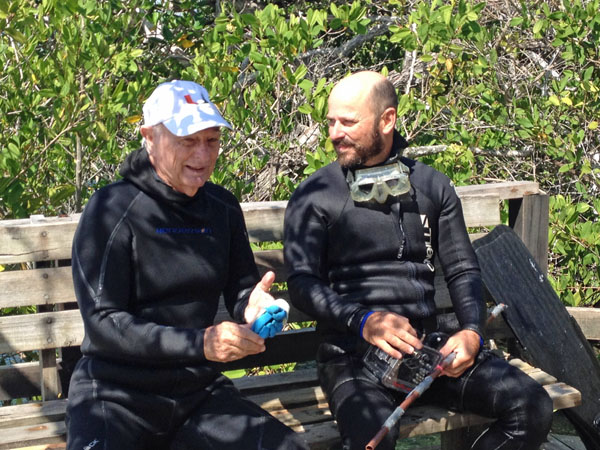
Peter Glynn, Professor of Marine Biology and Fisheries at the University of Miami, was one of the first scientists to study the coral reefs of the Galapagos. He’s the head of the U. Miami team on board the Golden Shadow, which includes four of his former students: Iliana Baums, Derek Manzello, Tyler Smith and Joshua Feingold.
How did you first get involved in studying the coral reefs in the Galapagos?
In 1974, Jerry Wellington was here with the Peace Corps surveying marine habitats for the Galapagos National Park. I was staff scientist at the Smithsonian Tropical Research Institute in Panama. When I got wind he was finding coral reefs, I hooked up with him and in 1975 we put together an expedition to survey all the coral reef habitats.
It must have been a completely different place back then.
Oh yes. There were just a few families living in Puerto Ayora. The only vehicle was a WWII jeep left over from one of U.S. Army bases—it would just chug along the sandy path to the Darwin Station and back. There was maybe one restaurant, one hotel for guests. The planes flying from mainland were always overbooked; you might get bumped and have to stay a couple more days.
The Darwin Station had a very nice research boat called the Beagle 3, but eventually they couldn’t support her and sold her. Then we had to hire out some of the fishing boats [for research]. Sometimes they were pleasant cruises, sometimes not!
The reefs have changed drastically since then.
The 1982-83 El Niño just about wiped them out. Overall mortality in some of our long-term plots was approaching 95 or 98%. It was fairly instantaneous; seawater temperatures were up 1-2 degrees C above their long-term mean values for 2 to 3 months, then the corals began to bleach. In 3 to 4 months, a majority of them had died.
Some of the coral colonies we observed during that initial bleaching event were hundreds of years old, Porites and Pavona colonies 3 or 4 meters high. That suggested to us that it was an unusual event. The survey work we were doing at Punta Pitt on this trip, we were looking for those colonies, but couldn’t find any sign. It’s likely after they died they slowly disintegrated and disappeared.
Was it traumatic to see happen?
I wasn’t here, but my colleague Gary Robinson was. It also occurred in Panama, Costa Rica, and Colombia. I was going up and down the coast, surveying the affected areas. Essentially the entire equatorial eastern Pacific between 10 degrees north and 1 degree south experienced the same high mortality. Then, in 1997-98 we had another severe El Niño that oceanographers claim was equal in intensity to ‘82-83. So, there were two very severe events within 15 years.
What have you seen on this trip?
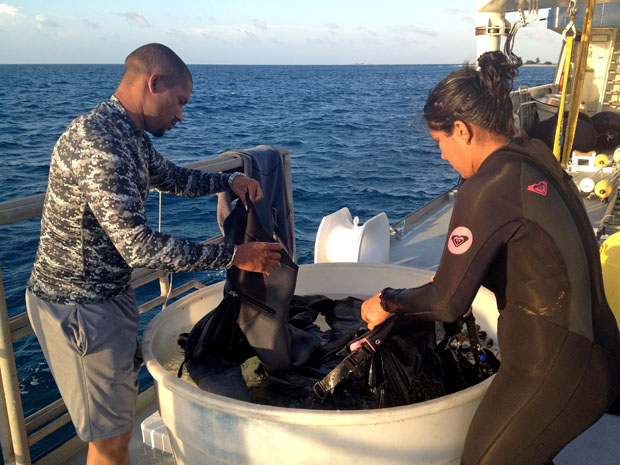
Our general impression is the reef communities at Marchena, Wolf and Darwin are showing signs of improvement. That’s encouraging. The southern islands, though, are showing very little in the way of recovery to pre-1982-83 levels.
What do you think the future holds for corals in the Galapagos and elsewhere?
More recovery, possibly, in the short term. Recovery is patchy—it occurs in some areas and not others. There are some reef areas in the equatorial eastern Pacific that are recovering, which is suggestive of resilience. In Panama, the reefs are showing much better recovery than we see here. In the long term, though, I’m not very optimistic. I’m just wondering if we’re pressuring our resources beyond the point where they can keep providing what we need.
When will you be back next?
I’ve probably been here 20 or 25 times since 1975. I have a proposal in with the National Science Foundation for three years of work, along with some colleagues and students. We may well come here next year or the year after. I am pushing 80!
(Photos/Images by: 1-2 Julian Smith, 3 Sam Purkis)
To follow along and see more photos, please visit us on Facebook! You can also follow the expedition on our Global Reef Expedition page, where there is more information about our research and team members.