search-icon
Rugged Reefs

Sitting at 25 m (82 ft) wrapped in a completely tangled metallic chain that would make Mr. T envious, I often ask, “What have I gotten myself into?” Indeed, one may wonder why anyone would want to take a long, easily tangled brass chain to the depths of Australia’s Great Barrier Reef (GBR).
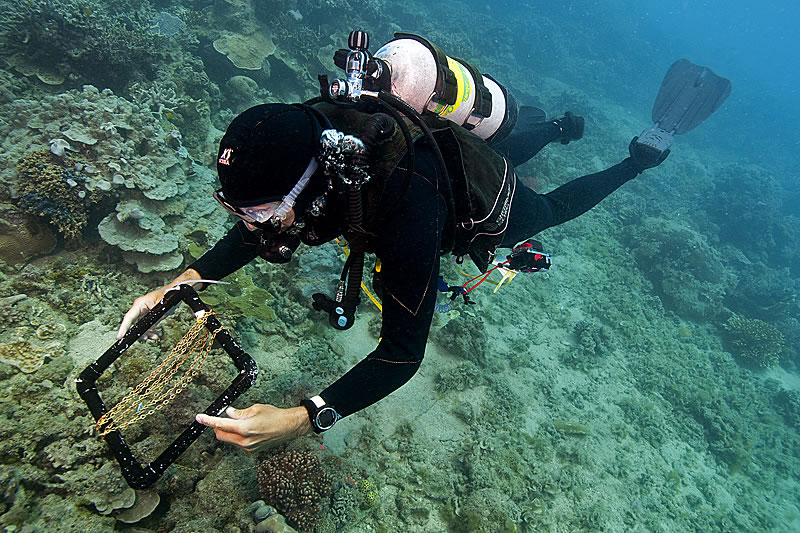
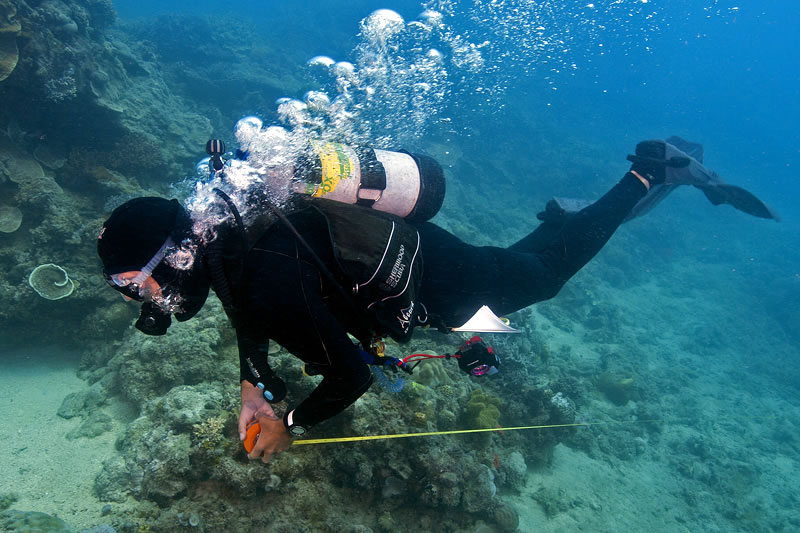
Scientific diver laying out the chain to measure reef rugosity.Scientific diver running out the transect tape to measure reef rugosity.
Laying out the chain and running out the transect tape.

It turns out that there is a particularly good reason, and it is rooted in the fact that many healthy coral reefs are not smooth, scoured structures (though they can be), but instead wrinkly masses of calcium carbonate covered by a thin veneer of life. The cracks and crevices between, for instance, coral bommies, or even within certain species of branching corals (e.g., staghorn coral thickets), provide myriad locations for thousands of species of fish and marine invertebrates (e.g., sponges, tunicates, and molluscs) to hide and/or permanently reside. It’s no surprise, then, that reefs with greater degrees of structural complexity tend to be associated with higher levels of both vertebrate and invertebrate diversity.
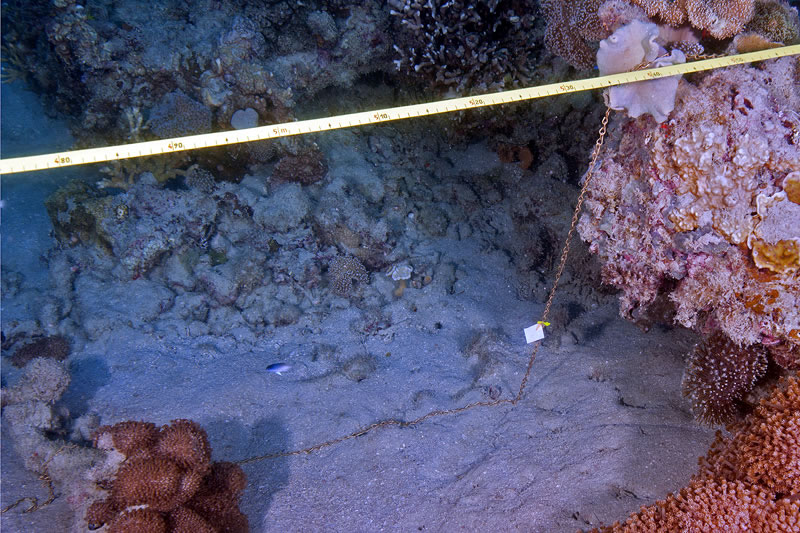
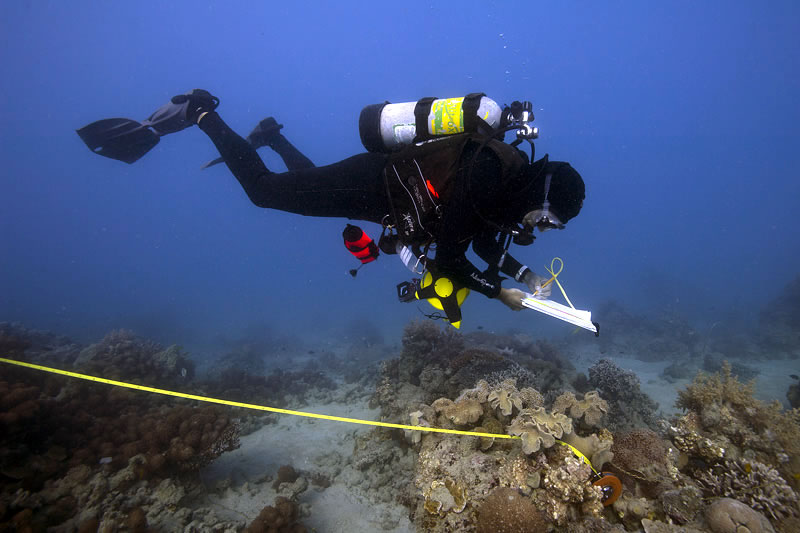
The difference between the transect and the chain shows reef rugosity.Measuring Reef Rugosity of the Great Barrier Reef
The difference between the tape measure and the chain shows reef rugosity.

By carefully laying down chain across the bottom and comparing the distance the chain covers to the linear distance (i.e., “as the crow flies” or “as the fish swims,” as the case may be) between two points, one can calculate a reef rugosity index, which serves as a proxy for how rugged the reef is. These reef rugosity measurements comprise one piece of the puzzle with respect to how the Living Oceans Foundation’s coral reef survey team is attempting to characterize each of ~180 reef sites to be visited across the Great Barrier Reef, Earth’s largest barrier reef ecosystem.
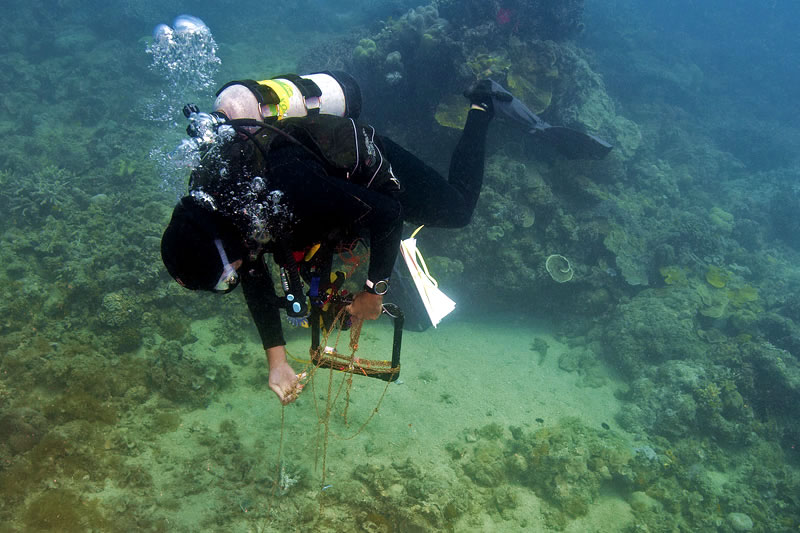
Scientific diver with tangled chain.
Not everything always goes as planned.

Photos by Ken Marks.
Related Posts

2025-2026 B.A.M. Student Voices

Throughout the Bahamas Awareness of Mangroves (B.A.M.) and Jamaica Awareness of Mangroves in Nature (J.A.M.I.N.) programs, we evaluate each phase of the mangrove education and restoration process to better understand how students are learning, growing, and connecting with their coastal environments.

Before the programs begin, students share what they already know about mangroves and how they feel about them. As the program progresses, we continue to gather feedback to see how their knowledge evolves from identifying mangrove species and understanding food webs to recognizing the role mangroves play in coastal protection and climate change mitigation.

But the surveys go beyond science content.

We also ask students…

Read More

Ten Years of B.A.M.: Rooted in Partnership, Growing in Purpose

Ten years ago, the Bahamas Awareness of Mangroves (B.A.M.) program began with a simple but meaningful commitment: to connect Bahamian students with the mangrove ecosystems that shape and protect their island home.

Since 2015, B.A.M. has been implemented in partnership with Friends of the Environment, whose dedication to environmental stewardship in Abaco has made this program possible year after year. Together, we have worked alongside Patrick J. Bethel High School and Forest Heights Academy to bring hands-on mangrove science into classrooms and out into the field.

What makes ten years remarkable is not just longevity — it is consistency…

Read More