Expedition Log: BIOT – Day 8
Within the first few days of surveying in Chagos, our fish and benthic surveyors have had multiple encounters with large and often pregnant tawny nurse sharks (Nebrius ferrugineus).
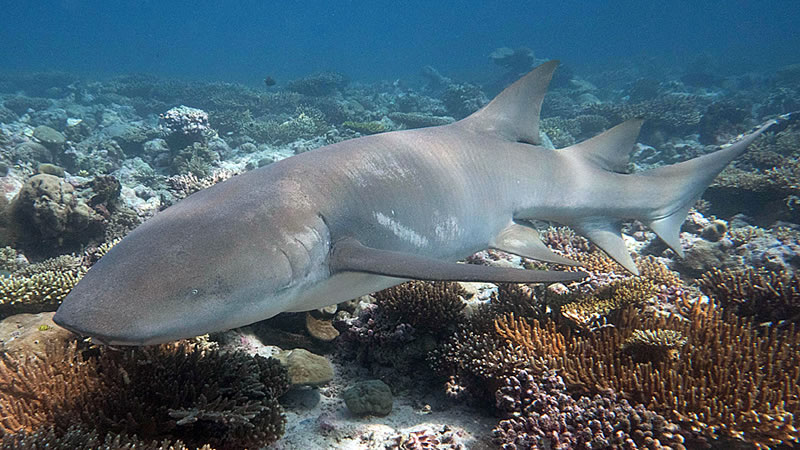
Tawny nurse shark swims over the reef.
With their cylindrical body and broad, flattened head, the tawny nurse shark is quite similar in appearance to the nurse shark (Ginglymostoma cirratum) but can be distinguished by its pointed-tipped dorsal fins and narrow, sickle-shaped pectoral fins.
Given that tawny nurse shark pups are born at an average length of between 40 to 60cm, it was clear that these large females were pregnant by their distinctively bulging stomach. The tawny nurse shark is the only member of the carpet shark family which exhibits intrauterine cannibalism; once the pups have used up their yolk supply, they will feed on other eggs within the uterus.
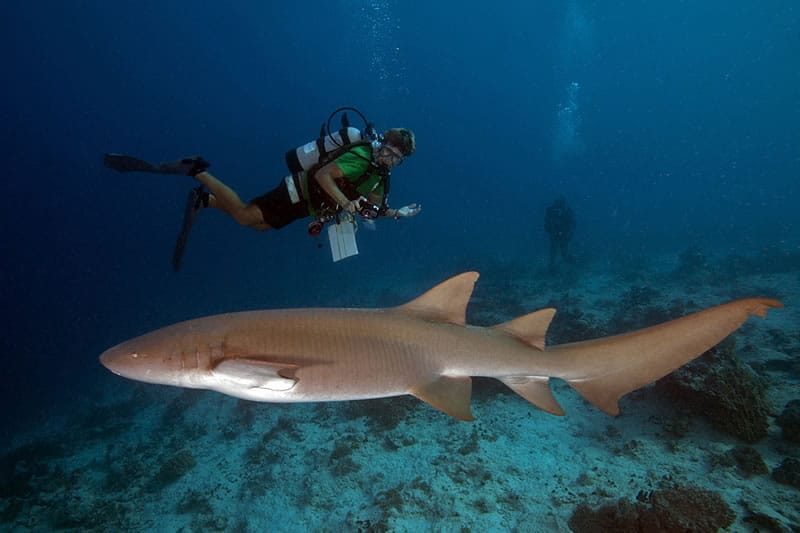
Attracted by our presence on the reef, a large pregnant female comes over to inspect us.
On one occasion, a large individual swam directly over our fish transect line, giving us a good estimate of the length which was close to 3m (the maximum recorded length of the tawny nurse shark is 3.2 m). Several of these large females have been observed swimming with the company of a single juvenile (~1 m) which may be a year old pup of hers.
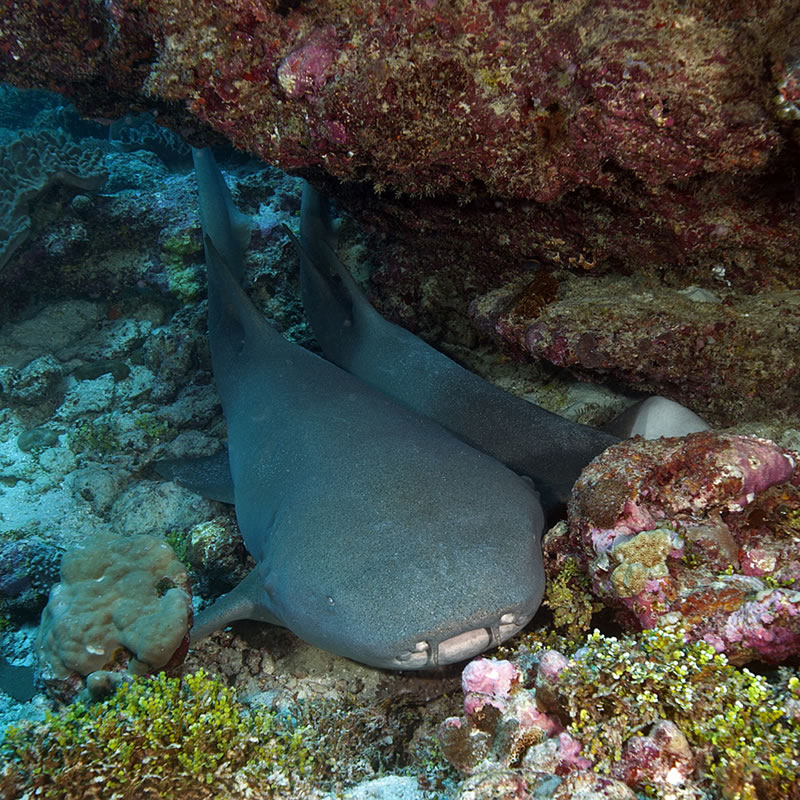
Larger female resting under a ledge with a single smaller juvenile.
Nocturnal by nature, the tawny nurse shark is most commonly seen during the day resting in caves or under ledges. By night, these predators use their large pharynx as a powerful suction pump to rapidly suck in reef organisms from inside holes and crevices. Food of this shark includes corals, crabs, lobsters and other crustaceans, sea urchins, and reef fish including surgeonfish (Acanthuridae), queenfish (Carangidae) and rabbitfish (Siganidas). These sharks may be one of the few animals that specializes in preying upon octopus, which may explain the timid nature of the abundant octopus we have observed hiding in reef crevices.
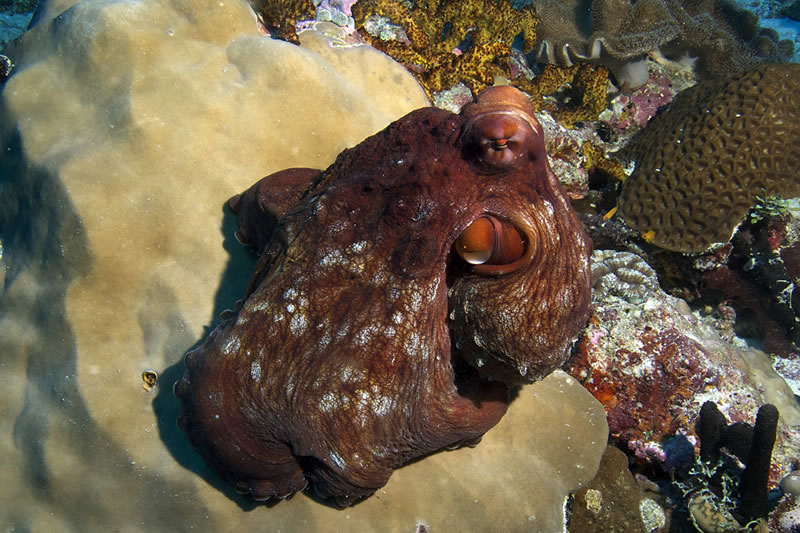
A Day Octopus (Octopus cyanea) emerges from its den where it has been hiding.
Photos: 1 Stefan Andrews, 2-3 Ken Marks, 4 Alex Dempsey