
search-icon
Teamwork on the Reef

Sunshine and calm seas greeted the Golden Shadow as she lay at anchor in Man of War Bay on the west side of Great Inagua.  After a quick breakfast, the first researchers set off to start the day’s survey work.

Coral Reef Research Teams

The scientists on board for the Inaguas leg of the Global Reef Expedition have been organized into several coral reef research teams. Team Parrotfish is engaged in reef fish herbivory studies, while Team Barracuda members are responsible for recording the benthic organisms including coral coverage.  Team Eagle Ray is surveying fish, corals and any coral diseases they encounter during their underwater investigations.
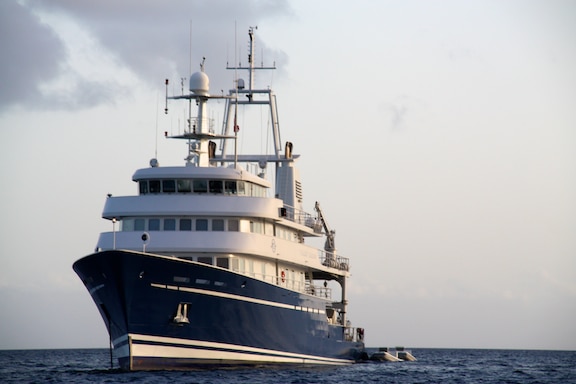
 

The Golden Shadow at anchor in Man of War Bay, Great Inagua


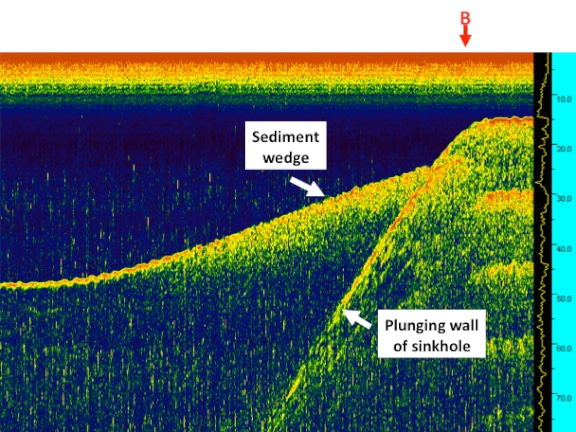
Team Worldview is responsible for creating underwater maps of the area.  They accomplish this in part by groundtruthing data that has been previously acquired from satellites and aerial photographs.  The team validates existing satellite map data by collecting depth soundings, taking videos of the seafloor, and making observations that will assist in the process of generating detailed habitat maps for the area.  Additionally, the team uses a technique called sub-bottom profiling, which utilizes highly specialized equipment to send out acoustic energy that penetrates beneath the sea floor.  The sound waves help the scientists identify and map the composition of sub-surface materials, such as sand and limestone rock.  The picture generated by this method of sampling reveals the arrangement of sub-surface materials and helps coral reef researchers understand more about the composition and structure of the reef.   For example, in the Bahamas deep, eroded formations known as blue holes will often occur in the limestone bedrock.  Sub-bottom profiling allows researchers to tell the difference between how deep a blue hole really is, and how much of it has been filled in by sand.  In this way, the acoustic surveys help to tell the story of the reef’s geological history.  This helps coral reef researchers to understand the bigger picture of reef formation and gradual changes over time.
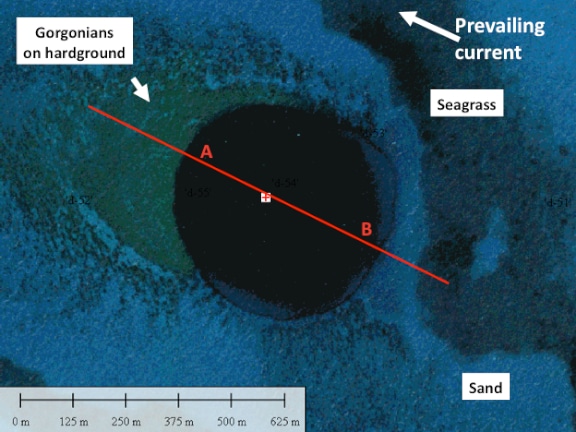
 

Aerial view of a Bahamian blue hole in Cay Sal studied during the Cay Sal Global Reef Expedition. Note the transect line intersecting the geologic feature with two points labeled 'A' and 'B' on either side of the blue hole.
Aerial view of a Bahamian blue hole in Cay Sal studied during the Cay Sal Global Reef Expedition. Note the transect line intersecting the geologic feature with two points labeled ‘A’ and ‘B’ on either side of the blue hole.


Profile view of the blue hole pictured above, at the  point labeled 'B'.  This image was generated with acoustic sub-bottom profiling technology and clearly shows the limestone wall of the blue hole and the sand (or sediment) that has been deposited in the blue hole over time.
Profile view of the blue hole pictured above, at the point labeled ‘B’. This image was generated with acoustic sub-bottom profiling technology and clearly shows the limestone wall of the blue hole and the sand (or sediment) that has been deposited in the blue hole over time.


Finally, Team Hollywood, which is composed of two cinematographers, is roving between all the teams to document the research that is taking place on this expedition.  The footage will be edited into a broadcast that will tell the story of the Khaled bin Sultan Living Oceans Foundation and the Global Reef Expeditions to a larger audience.

This morning, the first groups of scientific divers (Team Worldview and Team Barracuda) departed for the dive sites and began surveying.  Immediately after lunch and a quick swap out, the second teams (Team Eagle Ray and Team Parrotfish) left to dive.  Each coral reef research team is able to do two dives per day.  This will increase to three dives a day once our large dive boat, the Golden Osprey, joins us.  The Osprey has been forced to wait out Tropical Storm Emily and the storm’s remnants before they can safely head south to join the Golden Shadow in the Inaguas.  Until the Osprey arrives, the coral reef research teams must share the small Twin Vee catamaran that can carry eight people to a dive site.  The arrangement seems to be working well so far, and today proved to be another productive day for both data collection and teamwork.
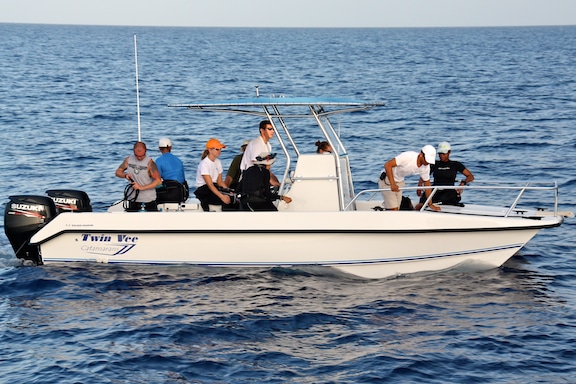
 

Coral Reef Research Teams: Team Barracuda departs to survey benthic coverage and corals in particular
Coral Reef Research Teams: Team Barracuda departs in the Twin Vee catamaran to survey benthic coverage and corals in particular


Written by Kit van Wagner

(Photo/Images by:  1 & 4  Kit van Wagner, 2 – 3 Dr. Sam Purkis)

To follow along and see more photos, please visit us on Facebook! You can also follow the expedition on our Global Reef Expedition page, where there is more information about our research and our team members.
Related Posts

Introducing Our New Website: A Fresh Look for the Foundation’s Future

As we celebrate the Khaled bin Sultan Living Oceans Foundation’s 25th anniversary, we are proud to unveil our newly redesigned website—a modern home for our science, conservation work, and educational programs. This launch marks an important moment for the Foundation as we honor our long history and look toward the future of ocean conservation.

For more than two decades, the Foundation has worked tirelessly to improve the health of our living oceans. We have advanced ocean science, led one of the largest coral reef research missions in history, restored mangrove forests with local communities, created award-winning education programs, and shared the wonders of the ocean with people around the world. Our new website reflects the organization we are today—focused on conserving coral reefs, restoring mangrove forests, and improving ocean literacy—while still highlighting the legacy of work that brought us here.

The redesigned site…

Read More

Connecting People, Art, and Oceans: Championing Conservation at the 2025 IUCN Congress

The IUCN World Conservation Congress brings together thousands of leaders and decision-makers from governments, non-profit organizations, civil society, Indigenous groups, and the private sector to shape global conservation policy and action. This influential gathering serves as a platform to share knowledge, build partnerships, and advance initiatives that protect our planet’s biodiversity.

As a member of the International Union for Conservation of Nature (IUCN), the Khaled bin Sultan Living Oceans Foundation was honored to take part in the Congress, joining a global community of leaders, organizations, and changemakers committed to protecting nature and advancing sustainable futures.

Read More
Privacy Overview

This website uses cookies so that we can provide you with the best user experience possible. Cookie information is stored in your browser and performs functions such as recognising you when you return to our website and helping our team to understand which sections of the website you find most interesting and useful.  You can view our complete Privacy Policy here.

Strictly Necessary Cookies

Most of our cookies are used to improve website security and reduce spam. These cookies should be enabled at all times. They also enable us to save your preferences for cookie settings.

3rd Party Cookies

This website uses Google Analytics to collect anonymous information such as the number of visitors to the site, and the most popular pages. Keeping this cookie enabled helps us to improve our website.