
search-icon
Ready, Set…Not Quite Yet

Clear skies and sunshine greeted the Golden Shadow this morning as drowsy research team members congregated over breakfast.  The conversation soon turned to the storm gathering and organizing in the southeastern Caribbean.   Many onboard wondered if the approaching tropical storm might interfere with the plan to start steaming for the Inaguas; a course that would point us directly into the path of newly formed Tropical Storm Emily.
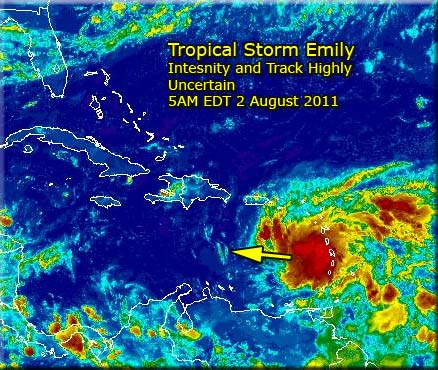
 

TS Emily as of 5 AM on Tuesday morning.  Photo courtesy of the Central Florida Hurricane Center (flhurricane.com)
TS Emily as of 5 AM on Tuesday morning. Photo courtesy of the Central Florida Hurricane Center (flhurricane.com)


Sure enough, after everyone on board participated in a required safety drill, a briefing from the ship’s Captain made it clear that the original plan to head southeast towards the Inaguas was no longer an option.  Tropical Storm Emily was projected to track northwest along the Bahamian island chain.  We were faced with weighing all the possible ways for avoiding Tropical Storm Emily to keep the ship safe, while minimizing delays to our research.
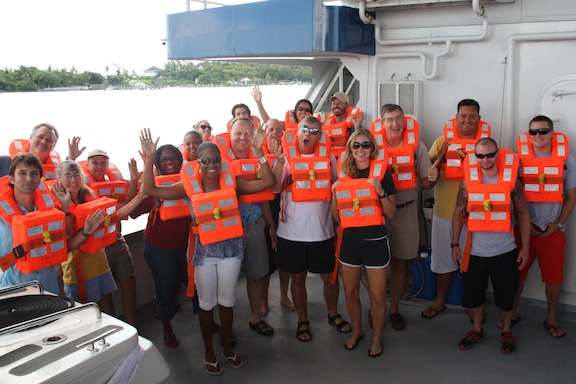
 

The research team shows off their life jackets during a safety drill
The research team wearing life jackets during a safety drill


The following four options and map roughly outline our choices for avoiding Tropical Storm Emily.  If you were Captain of the Golden Shadow, what would you do?  Consider the following alternatives:


Option 1:  Head North

One possibility for avoiding Tropical Storm Emily is seeking shelter in a port like Miami or Cape Canaveral along Florida’s east coast.  An obvious disadvantage to this option is that the ship would be moving in the same direction as the storm and might still be in the storm’s track several days from now.  In addition, the ship would be moving away from our study site in the Inaguas.


Option 2:  Head West

The Golden Shadow could move into the Gulf of Mexico, thereby avoiding Tropical Storm Emily.  This option moves us safely out of the storm’s track, but has the disadvantage of moving us away from our study site.
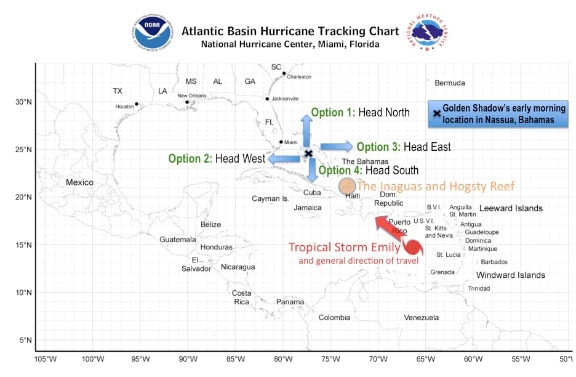
 

Options for the Global Reef Expedition and the Golden Shadow avoiding Tropical Storm Emily
Options for the Global Reef Expedition and the Golden Shadow avoiding Tropical Storm Emily.  (Tracking Chart from NOAA National Hurricane Center)

Option 3:  Head East

If the ship sails east into the open waters of the Atlantic Ocean and the storm curves more north and east than forecasted, we might encounter an area of the storm known as the dangerous semicircle.  In the northern hemisphere, tropical storm and hurricane force winds located to the right of a storm are strongest.  This is because momentum from the storm’s track and the storm’s wind speed are compounded.


Option 4:  Head South

One benefit to steaming south is that we would be heading in the general direction of the Inaguas so that once Emily clears out of the area, the ship could turn to the east and reach the islands before too long.  However, if the ship were to sail due south, she would eventually reach Cuba and could risk being in the storm’s path without a clear way to hide from the strong winds and waves that Emily will surely bring.
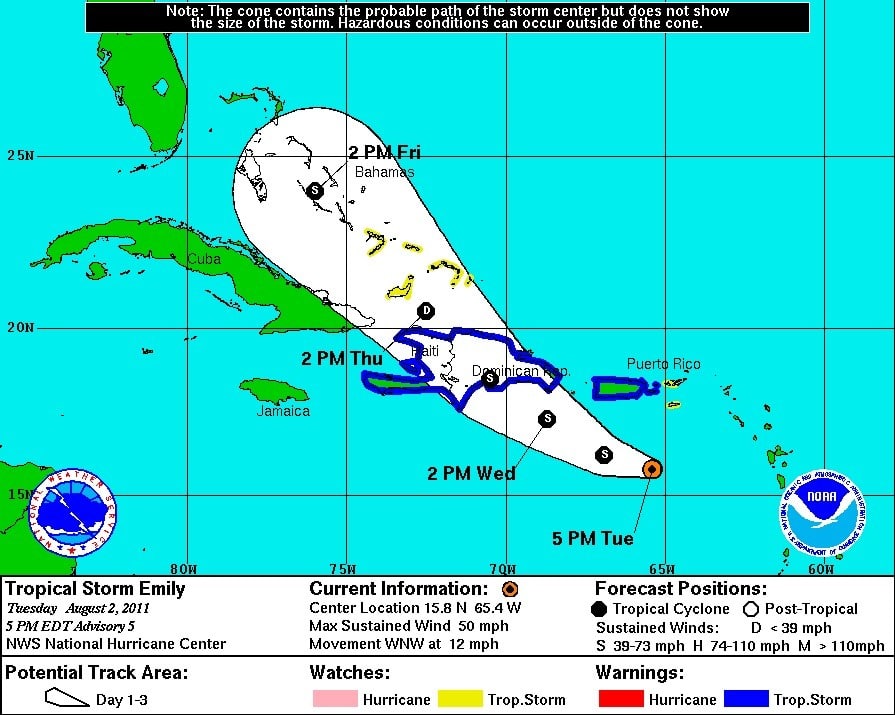
 

National Hurricane Center forecast map for TS Emily at 5 PM on August 2, 2011


And so, after giving the Captain some of our ideas about ways to minimize the delay in starting our research, the Golden Shadow left the cruise ship dock in Nassau passing by the oldest lighthouse on the island.  The team meanwhile huddled in the staff mess room waiting to hear what the Captain had decided to do.

Which option do you think he decided on?

To be continued…
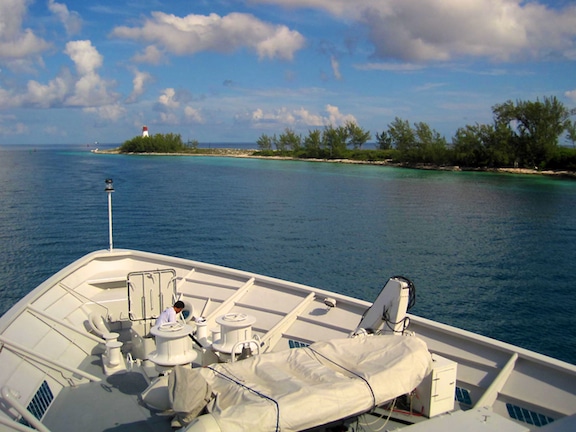
 

Passing Nassau Lighthouse as the Golden Shadow leaves Nassau Harbour


Written by Kit van Wagner

(Photo/Images by: 1 Central Florida Hurricane Center (flhurricane.com); 2 – 4 Kit van Wagner)

To follow along and see more photos, please visit us on Facebook! You can also follow the expedition on our Global Reef Expedition page, where there is more information about our research and our team members.
Related Posts

World Oceans Day: Protecting the Ecosystems That Protect Us

This World Oceans Day, the global community is being challenged to think differently about the ocean.

The 2026 World Oceans Day theme, “Reimagine: Beyond the World We Know, A New Relationship With Our Ocean,” invites us to recognize that the ocean is not something distant or separate from our lives. It regulates our climate, supports our economies, provides food for billions of people, and sustains the natural systems that make life on Earth possible.

Few places illustrate this connection more clearly than the coastal ecosystems that protect our shores and support marine life. While coral reefs, mangrove forests, and seagrass meadows are often…

Read More

After the Storm: Standing with Our J.A.M.I.N. Family in Jamaica

There are moments in this work that feel heartbreakingly familiar.

Two weeks after we completed our Jamaica Awareness of Mangroves in Nature (J.A.M.I.N.) programming, Hurricane Melissa made landfall. A powerful Category 5 hurricane, Melissa is now tied with Hurricane Allen in 1980 for the strongest winds ever recorded in an Atlantic storm. Like Hurricane Dorian, which devastated The Bahamas in 2019, Melissa will be remembered as one of the strongest hurricanes on record in the region.

For 11 years, the University of the West Indies Discovery Bay Marine Laboratory and William Knibb Memorial High School have been more than program partners. They have welcomed us into their classrooms and labs, shared meals and laughter, and committed themselves to educating their students about mangroves and coastal resilience. These colleagues and students are not distant collaborators. They are family.

And they were hit hard…

Read More
Privacy Overview

This website uses cookies so that we can provide you with the best user experience possible. Cookie information is stored in your browser and performs functions such as recognising you when you return to our website and helping our team to understand which sections of the website you find most interesting and useful.  You can view our complete Privacy Policy here.

Strictly Necessary Cookies

Most of our cookies are used to improve website security and reduce spam. These cookies should be enabled at all times. They also enable us to save your preferences for cookie settings.

3rd Party Cookies

This website uses Google Analytics to collect anonymous information such as the number of visitors to the site, and the most popular pages. Keeping this cookie enabled helps us to improve our website.