search-icon
World Changers… One Student at a Time

Mangrove Education and Restoration Program Blog
Bahamas Mangrove Project Teacher ReflectionA Bahamas Mangrove Project Teacher Reflection

By Michelle Bailey, Science Teacher Abaco Central High School


A few years ago a student’s parent told me that her daughter refused to let her use pesticides and artificial fertilizers in their home garden. I smirked inside, and thought yes, each one reach one, the pollution unit had migrated from the classroom and had a foothold in the community. Like that long ago girl, I believe that the students that spent two semesters working on the Bahamas Awareness of Mangroves (B.A.M.) programme are the vanguard that will one by one change minds and shape the actions of their community. On this small island of Abaco, these children of builders, fishers, businessmen, and tourist industry workers are going to be world changers – one ecosystem at a time.
Bahamas Mangrove Project Teacher Reflection
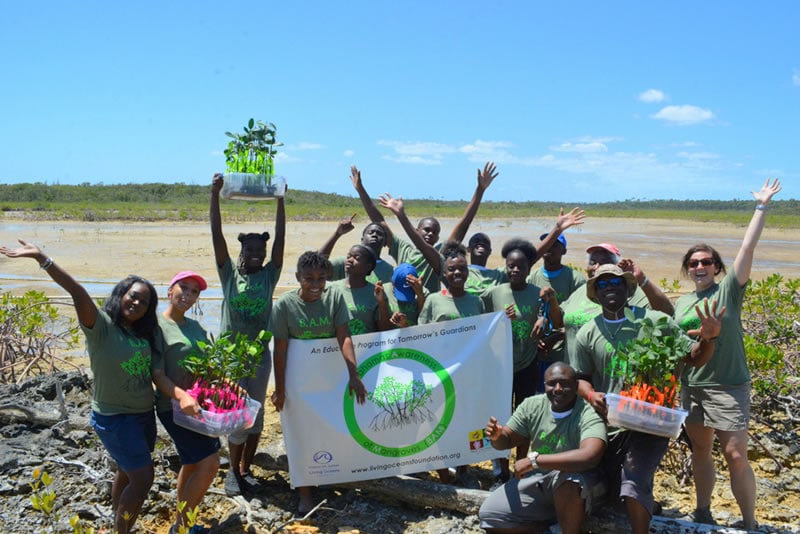
Our cast of world changers… one ecosystem at a time.

The students took an almost parental interest in the growth of their “babies”, the mangroves they grew in the classroom in different substrates. One was quite affronted when the leaves of one of her plants turned brown. Having a long term project made science real for them, and gave them an understanding of how much effort it took to slog through from hypothesis to conclusion. Not to mention that the results were not always quite what you thought they would be. I should have kept some records of my own especially a tally of the number of times I heard, “This a lot of work Mrs Bailey.” It was worth it, having been hooked into inquiry by this programme, students have applied for summer workshops in environmental studies. Their friends who did not participate this year want to know if they will get the opportunity next year. Those same students that stared daggers at me when they sank to their thighs in mud cannot wait to get muddy again, well… most of them anyway.
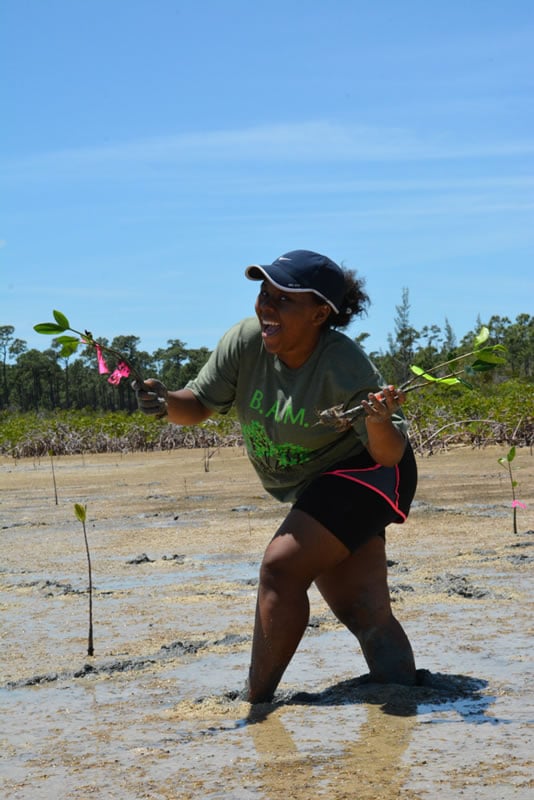
Bahamas Mangrove Project student up to her knees in mud.
BAM student getting good and muddy… and loving it.

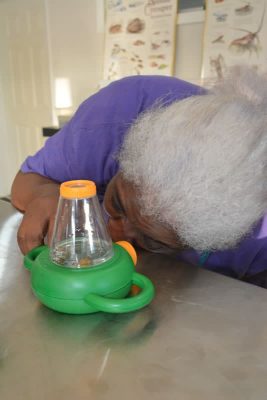
As a member of the curriculum team for the 2010 Ministry of Education Biology Curriculum Guidelines I was grateful that the BAM project provided opportunities for the realization of the curriculum’s overarching goal of having students “become critical thinkers, problem-solvers, innovators, visionaries, scientifically and technologically literate citizens who will appreciate, interpret and conserve the natural environment.” The field trips, the long term study and the classroom workshops provided such a wide variety of invaluable learning experiences. Some touched yucky things for the first time, I was thrown way back to my university days when I got squirted by a sea cucumber. My favourite snapshot in time is of a young lady standing in the middle of the room enraptured by what she saw in the microviewer oblivious to everything else around her. Aha moments that have translated into we know mangroves confidence.
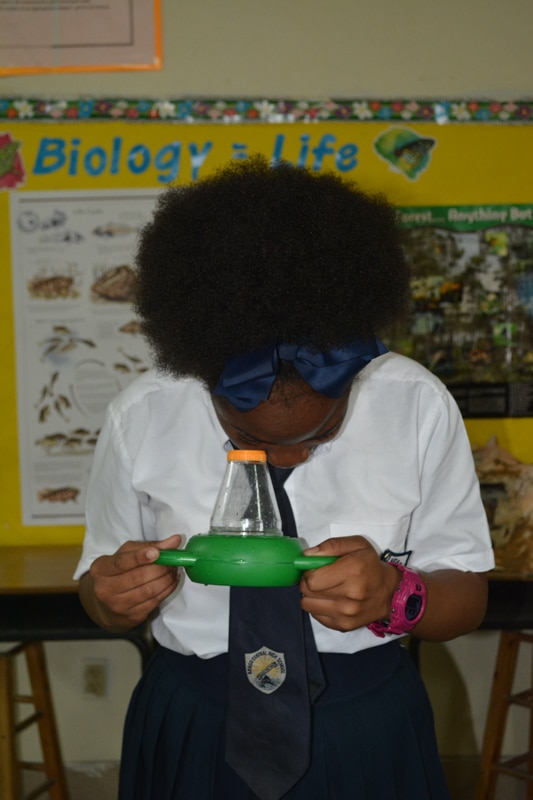
One of those fantastic 'Aha!" moments.
My favorite: A fantastic ‘Aha!” moment.

Photos by Amy Heemsoth.
Related Posts

Meet IFAN: Helping Bring Navigate with Care to the Next Generation

If you’ve ever seen a lighthouse flashing from the shore or a brightly colored buoy bobbing in the water, you’ve seen Aids to Navigation at work.

Aids to Navigation, often called AtoNs, help mariners navigate safely. They can mark channels, warn of hazards, help vessels determine their position, and provide other information people need to make safe decisions on the water. Around the world, these systems help guide everything from small recreational boats to large commercial or container ships. 

But safe navigation isn’t only about protecting vessels and the people aboard them. The choices mariners make can also affect the animals and ecosystems beneath and around them.

That connection between maritime safety and ocean conservation is at the heart of this year’s Science Without Borders® Challenge—and of our partnership with this year’s theme sponsor, the International Foundation for Aids to Navigation (IFAN).

Read More
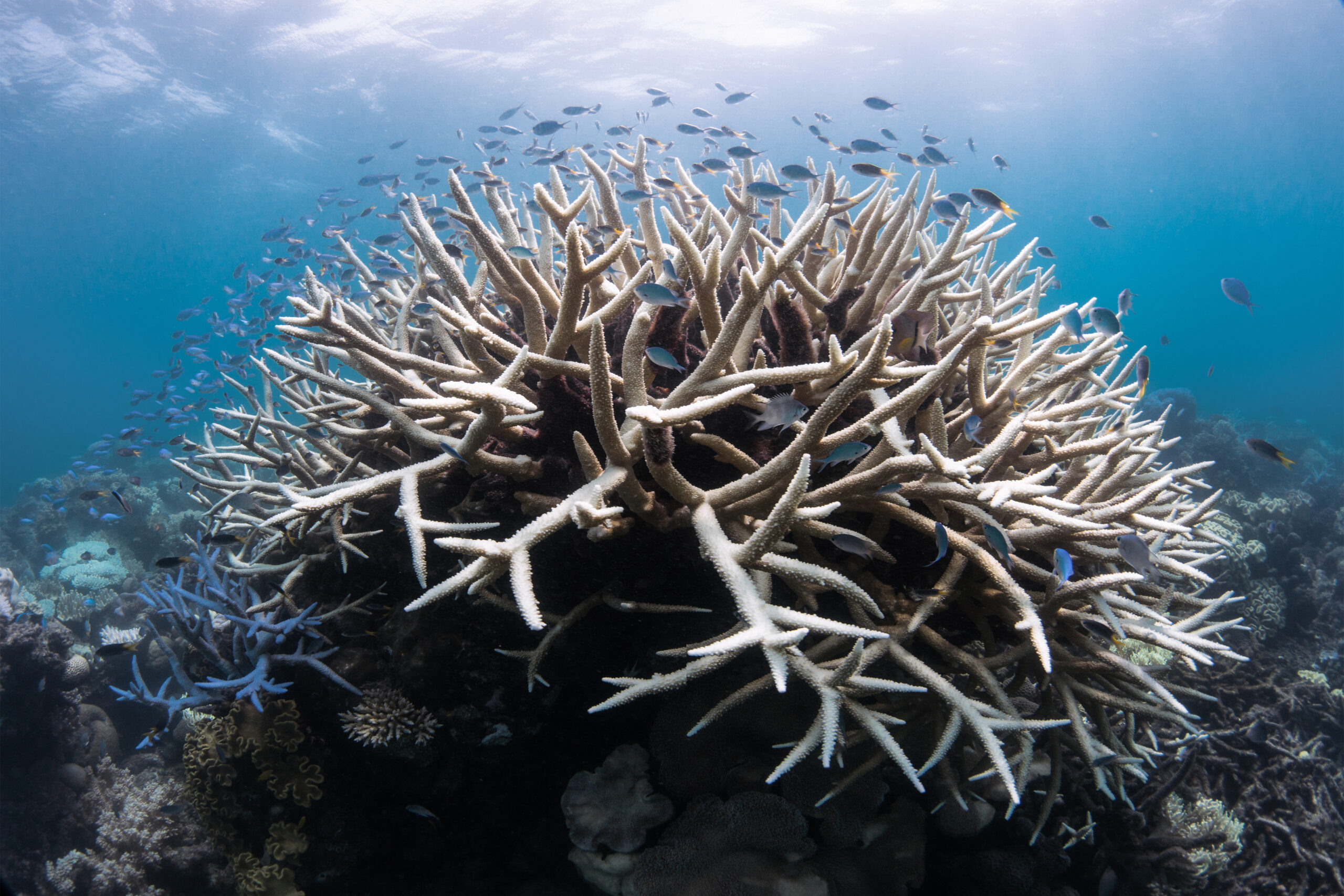
OceanImageBank_TheOceanAgency_Bleaching_16-scaled-1

Coral Bleaching Awareness Month: Giving Coral Reefs a Chance to Recover

For hundreds of millions of years, coral reefs have supported life in our oceans. Although they cover less than 1% of the ocean floor, they provide habitat for at least 25% of all marine species. They also support people around the world by sustaining fisheries and tourism, providing food and livelihoods, and helping protect coastlines from waves and storms.

But coral reefs are under increasing pressure. Pollution, overfishing, coastal development, physical damage, and increasingly warm ocean temperatures can all affect reef health. One of the most visible signs that a coral reef is under stress is coral bleaching.

This September, in recognition of Coral Bleaching Awareness Month, we’re taking a closer look at what happens when corals bleach, why bleaching matters, and what scientists around the world are doing to better understand, protect, and restore coral reefs.

Read More
Privacy Overview

This website uses cookies so that we can provide you with the best user experience possible. Cookie information is stored in your browser and performs functions such as recognising you when you return to our website and helping our team to understand which sections of the website you find most interesting and useful.  You can view our complete Privacy Policy here.

Strictly Necessary Cookies

Most of our cookies are used to improve website security and reduce spam. These cookies should be enabled at all times. They also enable us to save your preferences for cookie settings.

3rd Party Cookies

This website uses Google Analytics to collect anonymous information such as the number of visitors to the site, and the most popular pages. Keeping this cookie enabled helps us to improve our website.