
search-icon
Using satellites to monitor reef biodiversity

In DIVE Magazine
By Stewart Butler
February 15, 2024

Using space technology, a team of researchers has developed a technique for monitoring reef biodiversity on a global scale.
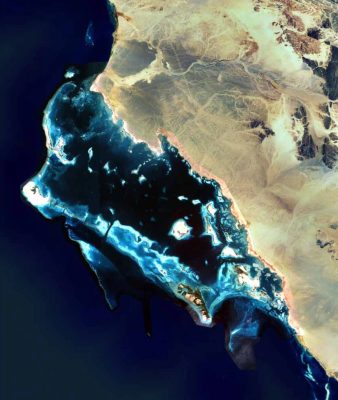
Satellite imagery of coral reefs near Al Wajh in the Saudi Arabian Red Sea


Almost since the very day marine biology was invented the standard method of surveying oceanic environments and the creatures living there was by donning a mask and diving in the water to do a manual count.

This technique is of course great for getting an intimate view of the marine environment (and is normally a lot of fun for the diver), but it’s a time-consuming and expensive technique if you want a general overview of the bigger picture.
Now though, a research team from the University of Miami Rosenstiel School of Marine, Atmospheric, and Earth Science thinks they’ve come up with a better technique. And it involves heading into space!

The researchers have been experimenting with the idea of using satellites to map coral reef biodiversity on a worldwide scale to show that areas of high habitat diversity also have high species diversity.

The concept has been successfully used on land-based environments for a few years now, but to test it in an ocean environment, the team took satellite-derived reef habitat maps from 880 locations distributed on a global transect through the Atlantic, Pacific, and Indian Oceans.

The satellite data was combined with in-water diver surveys of fish and coral species collected by the Khaled bin Sultan Living Oceans Foundation’s (KSLOF) Global Reef Expedition, a massive ten-year survey to map the world’s coral reefs.

From these, the scientists measured the complexity of the patterning of seabed habitats, which correlated with the diversity of species present in each. This relationship was the same across the Atlantic, Pacific, and Indian Oceans, which – according to the report – can be used as a proxy for reef biodiversity.

Related Posts

2025-2026 B.A.M. Student Voices

Throughout the Bahamas Awareness of Mangroves (B.A.M.) and Jamaica Awareness of Mangroves in Nature (J.A.M.I.N.) programs, we evaluate each phase of the mangrove education and restoration process to better understand how students are learning, growing, and connecting with their coastal environments.

Before the programs begin, students share what they already know about mangroves and how they feel about them. As the program progresses, we continue to gather feedback to see how their knowledge evolves from identifying mangrove species and understanding food webs to recognizing the role mangroves play in coastal protection and climate change mitigation.

But the surveys go beyond science content.

We also ask students…

Read More

Ten Years of B.A.M.: Rooted in Partnership, Growing in Purpose

Ten years ago, the Bahamas Awareness of Mangroves (B.A.M.) program began with a simple but meaningful commitment: to connect Bahamian students with the mangrove ecosystems that shape and protect their island home.

Since 2015, B.A.M. has been implemented in partnership with Friends of the Environment, whose dedication to environmental stewardship in Abaco has made this program possible year after year. Together, we have worked alongside Patrick J. Bethel High School and Forest Heights Academy to bring hands-on mangrove science into classrooms and out into the field.

What makes ten years remarkable is not just longevity — it is consistency…

Read More
Privacy Overview

This website uses cookies so that we can provide you with the best user experience possible. Cookie information is stored in your browser and performs functions such as recognising you when you return to our website and helping our team to understand which sections of the website you find most interesting and useful.  You can view our complete Privacy Policy here.

Strictly Necessary Cookies

Most of our cookies are used to improve website security and reduce spam. These cookies should be enabled at all times. They also enable us to save your preferences for cookie settings.

3rd Party Cookies

This website uses Google Analytics to collect anonymous information such as the number of visitors to the site, and the most popular pages. Keeping this cookie enabled helps us to improve our website.