Expedition Log: Maldives – Day 8
Ask anyone to name a fish found on a coral reef, and I almost guarantee most will reply “clownfish!” A fish made famous by Disney/Pixar’s 2003 film Finding Nemo.
What most of these people won’t know is that there are approximately 30 different species of clownfish, also referred to as anemonefish. These 30 species belong to the family Pomacentridae and subfamily Amphiprioninae. The most recognizable member of this distinctive family is probably the species used in the famous film, the common clownfish (Amphiprion ocellaris). Clownfish are found down to 40m depth throughout the tropical and subtropical Indo-Pacific. There are no clownfish found in the Atlantic or Caribbean.
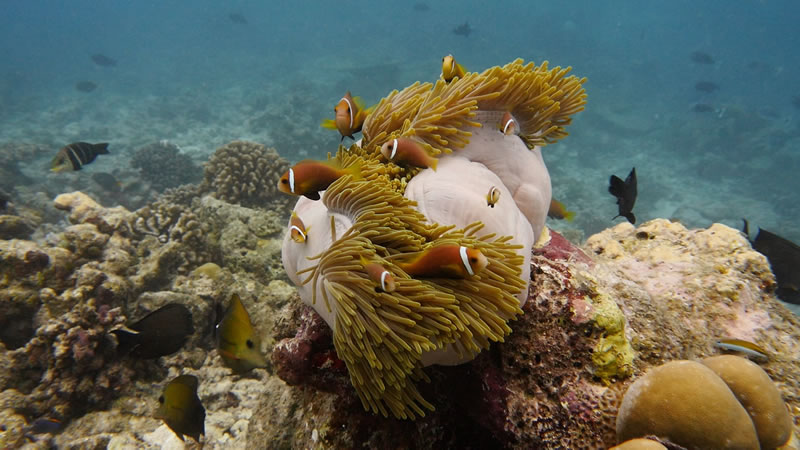
A group of clownfish around an anemone… a mix of adults and juveniles.
Anemonefish are aptly named because of their symbiotic relationship with a host anemone. The anemone provides a refuge for the fish and the occasional meal from food particle scraps, and in return the clownfish defend the anemone from predators and parasites. The clownfish inhabit their host anemones, most commonly in pairs or groups. Each group has a hierarchy, with the largest and most aggressive female as the dominant. The group will have a single pair of adult anemonefish that will reproduce, and then a varying number of small males and juveniles. All anemonefish begin as males and mature into females (sequential hermaphrodites). If the dominant female dies then the largest and most dominant male will become female and will fill her role. These fish exhibit strong parental care. The males are responsible for parental care of eggs, and will fan and guard the eggs for up to ten days until they hatch.
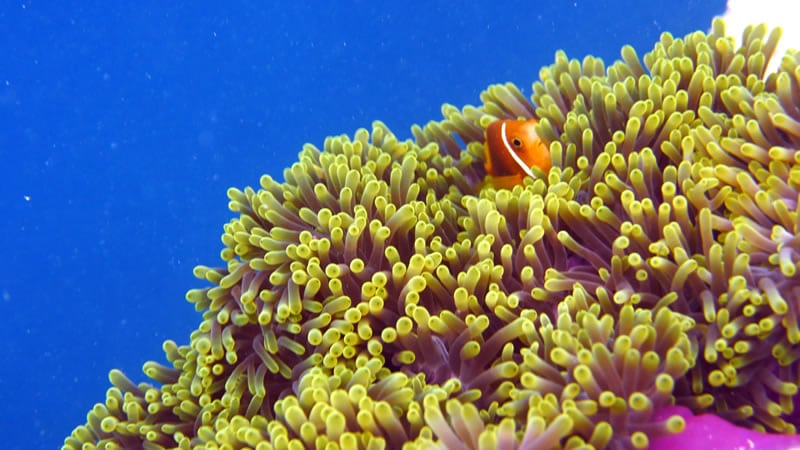
“We see you!” … a clownfish hides amongst the tentacles of its host anemone.
Several countries or geographic areas contain endemic species of clownfish and the Maldives is no exception. The Maldive anemonefish or blackfinned anemonefish (Amphiprion nigripes) is an orange color, with a white stripe behind its eye and black pelvic and anal fins. This beautiful fish is found only in the Maldives and some areas of Sri Lanka. We saw this species on almost every dive in the Maldives, often in clumps of up to 8 different anemones. Their strong characters and charismatic nature is always fun to see, and it is not surprising why they have become the reef’s most famous member.
Photos: Stefan Andrews