Dear Educators,
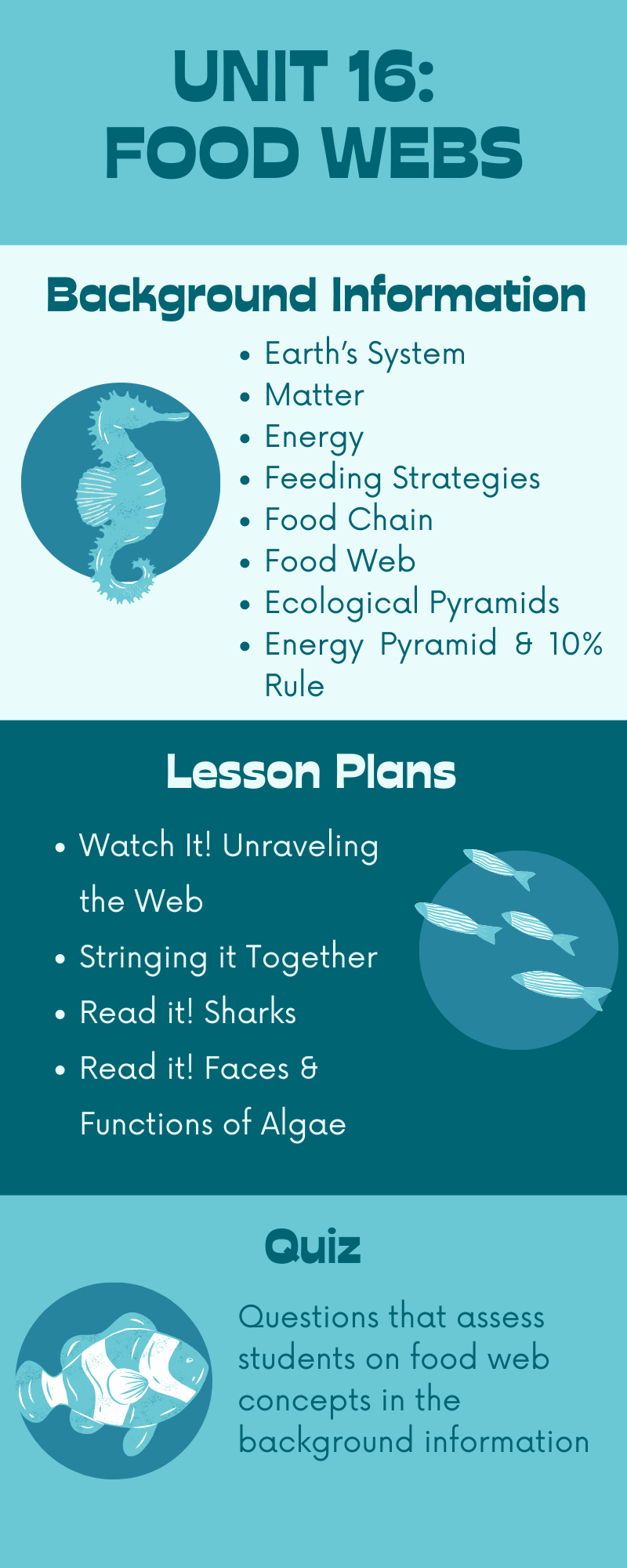
We are excited to announce that we have two new Coral Reef Ecology Curriculum units – Unit 16: Food Webs and Unit 22: Conservation. These two units can be a great resource to include in your science classes.
In the food webs unit, start off your class with an engaging short video about the coral reef food web and make sure to use the accompanying Watch It! worksheet. For students who are hearing impaired or need further assistance, you’ll notice that all our Watch It! worksheets now include video scripts.
Using the background information provided, teach your students about how matter is recycled and energy is transferred in the living parts of a coral reef ecosystem. Remember that there are images, graphics, and vocabulary in in the background information to help your students learn about these concepts.
To aid in solidifying food web concepts, conduct a hands-on activity called Lesson 1: Stringing it Together. Your students can explore the feeding relationships between organisms in a coral reef ecosystem and model how matter is cycled and energy flows through it. At the end of the lesson, students will also learn about disruptions that threaten the stability of the coral reef food web. Students will form a food web out string and determine what happens when the web is out of balance.
Incorporate English Language Arts into your science classes by using our custom Read It! worksheets that accompany our field blogs. Students will read and analyze a blog written by a scientist on one of our research expeditions. In Watch It! Sharks, Dr. Will Robbins discusses the predatory role of sharks in a coral reef food web and what recent studies have revealed in Australia. At the opposite end of the food chain, learn about producers by completing Watch It! Faces & Functions of Algae. Researcher Samantha Clements describes the role of algae or “seaweed” in the coral reef food web and how it can become detrimental to the ecosystem.
Finally, assess your students’ knowledge about food webs using our online quiz. After logging in, create a class and send the code to your students so that they can track your students’ quiz scores.
Stay tuned for more information about the Conservation unit.
Amy Heemsoth
Director of Education