Marine parks have been introduced worldwide to preserve biodiversity and protect important underwater habitats. Protected zones serve as baselines for undisturbed, natural ecosystems that can be used to measure the effects of human activities in other areas, and thereby help to improve resource management.
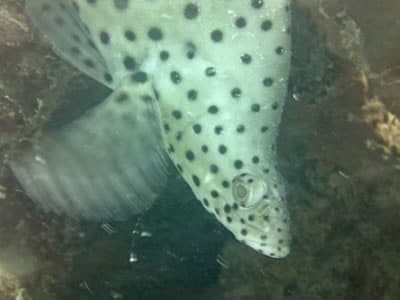
Barramundi Cod
The Great Barrier Reef Marine Park (GBRMP) protects a large part of Australia’s Great Barrier Reef (GBR) from damaging activities. No-take areas are locally known as Green Zones. People can access these zones and activities such as boating, snorkeling and diving are allowed, but all types of fishing, including trawling, and all collecting and extractive activities are prohibited. In 2004, the proportion of the GBR protected by ‘no-take’ zones was increased from less than 5% to more than 33%, and now protects representative examples of each of the broad habitat types.
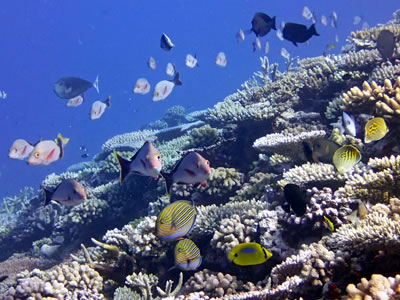
School of Humpback Snapper
The strongest level of protection is in Preservation (pink) zones. These zones are classified as ‘no entry’, and provide a high-level of protection for special and unique places, habitats, plants and animals. A special permit is required to conduct research in these zones. As part of The Khaled bin Sultan Living Oceans Foundation’s Global Reef Expedition, scientists on board the M.Y. Golden Shadow are conducting identical surveys in pink, green and blue (general use) areas to determine differences in reef health and fish population between these zones.
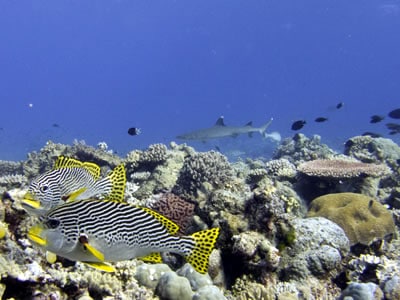
Diagonal Banded Sweetlips and White tip Reef Shark
The first Pink zone we surveyed was Ribbon Reef#8. As a fish surveyor, I observed a high density of sharks, sweetlips, snapper and several especially large grouper at this reef. The dive really felt alive with action everywhere. Herbivorous reef fish casually grazed over the colorful corals while cleaning wrasse busily worked away. Large schools of fusiliers sped past while other fish species darted for the shelter of the reef as predators darted with power… This reef was alive.
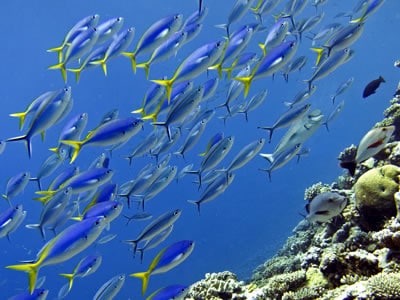
Yellow, Blue, and Twinstripe Fusileers
On our 5m safety stop of the final dive of the day, I was reflecting over the action packed dive when my thoughts were interrupted by the distinctive sound of dolphins. I pointed to my ear at and my dive buddy Katie, who recognized the sound as well. We scanned the clear blue water, when suddenly a playful pod of around 50 bottlenose dolphins danced over to check us out. As fast as they appeared they were gone, but I somehow managed to luckily snap a quick shot of the action.
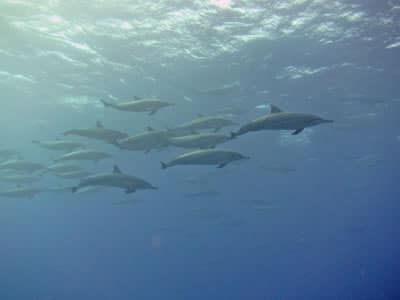
Pod of Bottlenose Dolphins
Photos by Stefan Andrews.