Expedition Log: Cook Islands – Day 10
Juvenile and adult crown of thorns starfish (COTS) do not walk on their arms. Instead, they have thousands of tiny tube feet which occur along the grooves underneath each arm. Operated hydraulically using fluid within their body cavity, these sucker-covered tube feet can propel a starfish across the sand at incredible rates of speed. Well, maybe not quite as fast as a speeding bullet, but still very fast for a starfish. A single animal can move up to 20 meters per hour, with aggregations of starfish covering close to 600 meters in a single week.
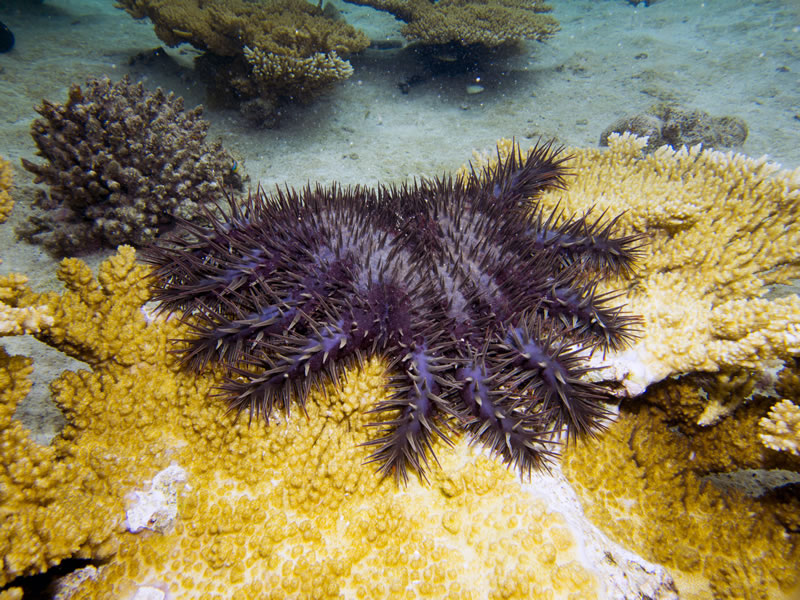
COTS on the move.
COTS can also go without food for long periods of time, allowing them to move between nearby reefs and reef habitats (covering possibly as much as 1 km). This probably does not occur often because they cannot maintain high rates of movement without some source of nutrition. Rather, they will move over areas of live coral at rates of about 0.25 meters per hour, denuding a reef of the preferred coral species before initiating a search pattern for more food in a new area.
When our science team first surveyed Aitutaki’s reefs in 2013, large numbers of starfish were seen moving in a drove across the reef, much like a spreading forest fire, eating nearly every coral in their path. Hundreds of starfish progressively worked their way along the leeward (western) side of the fore reef, beginning near the northern tip of the atoll, and reaching the south coast two years later. A second group moved along the east coast, working their way towards the southeastern tip. The highest numbers of animals were concentrated in shallow water (3-5 m depth) among virtually the only remaining healthy stand of branching and digitate acroporids. In the surrounding area, slightly deeper (5-30 m depth), and in all fore reef environments north of the outbreak more than 95% of the preferable species of corals had been eaten.
During our surveys in Aitutaki we failed to identify a single large aggregation of starfish on the fore reef. A few isolated individuals were identified on outer reefs, and these were feeding on the newly settled juvenile corals.
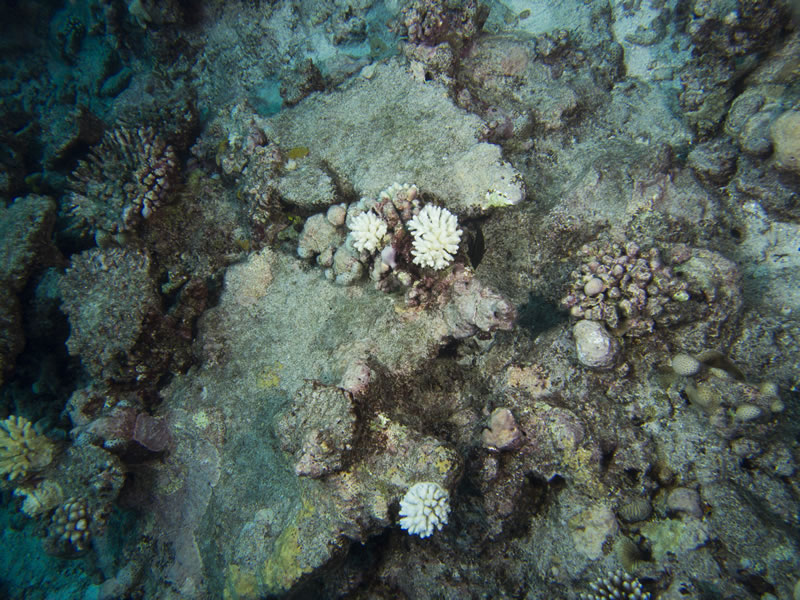
COTS eating coral recruits.
After nearly a week of long-distance surveys, we were confident that the outbreak had disappeared from the fore reef. Unfortunately, most of the coral had also gone. We did find one small area in the southeast, from 1-5 m depth, that was largely undamaged, while a band of dead corals formed a distinct demarcation below this, with nearly a complete absence of live corals extending to 25-30 m depth.
So where had the remaining starfish gone? Local dive operators told us they had continued to collect COTS in low numbers over the last two years.
During our second week, we relocated, focusing our efforts on shallow lagoonal habitats. On each survey we would collect a few dozen COTS. Because the corals were patchy, and the water was murky, searching for COTS was much more challenging and time consuming. It would take an exhausting 2-3 hours for four of us to thoroughly search an area about the size of a football field.
There was extensive coral habitat in the lagoon, beginning just off the beach and extending out 1-1.5 km to the reef crest. The corals formed large bommies (some up to 10 m diameter), separated by patches of sand. There was a lot of algae here, and a lot of dead coral, including many colonies that showed signs of recent mortality from COTS. On nearly every bommie we collected 1-2 COTS. These were some of the largest animals we had seen in Aitutaki.
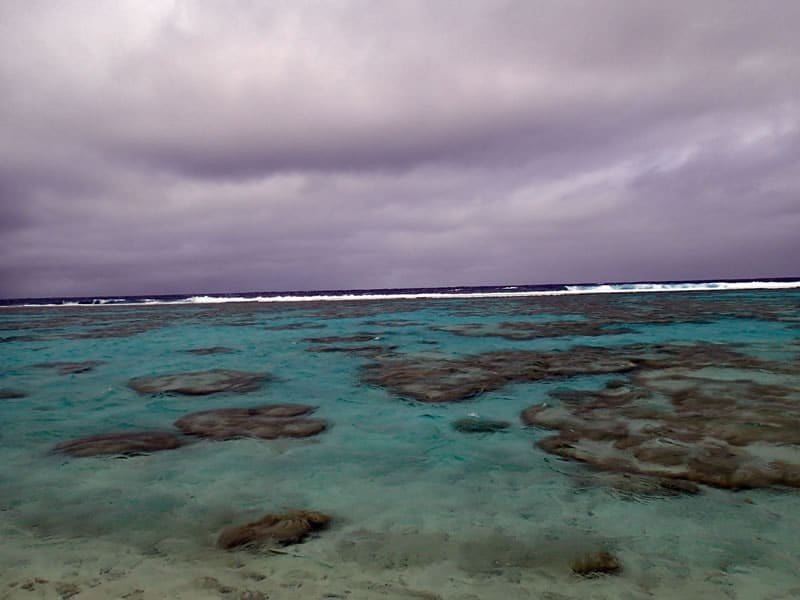
COTS habitat.
We found two distinct outbreaks, one on the northern tip and a second, much more severe outbreak in the back reef at the southeastern end of the lagoon. In this area, we removed a few hundred animals from a particularly beautiful dense stand of table acroporids – the only one such community we found in Aitutaki.
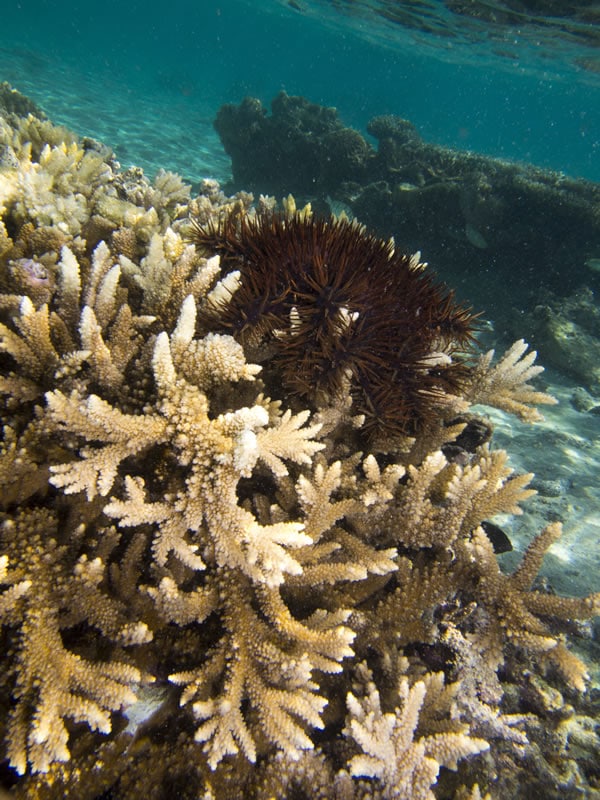
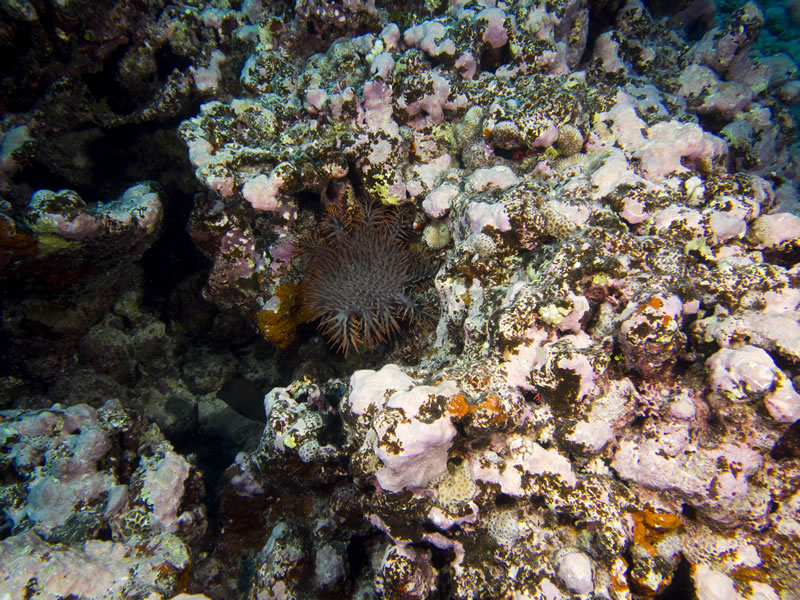
Acropora with COTS on the north coast (left) and COTS on northeast fore reef (right) of Aitutaki.
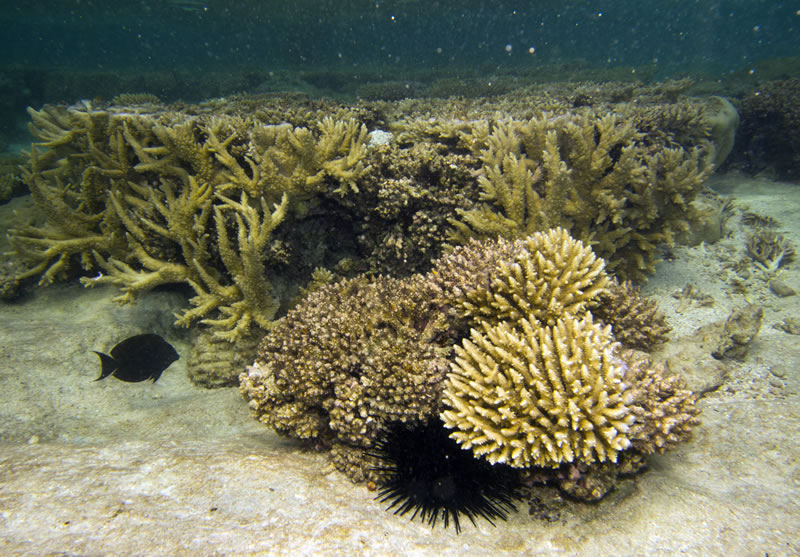
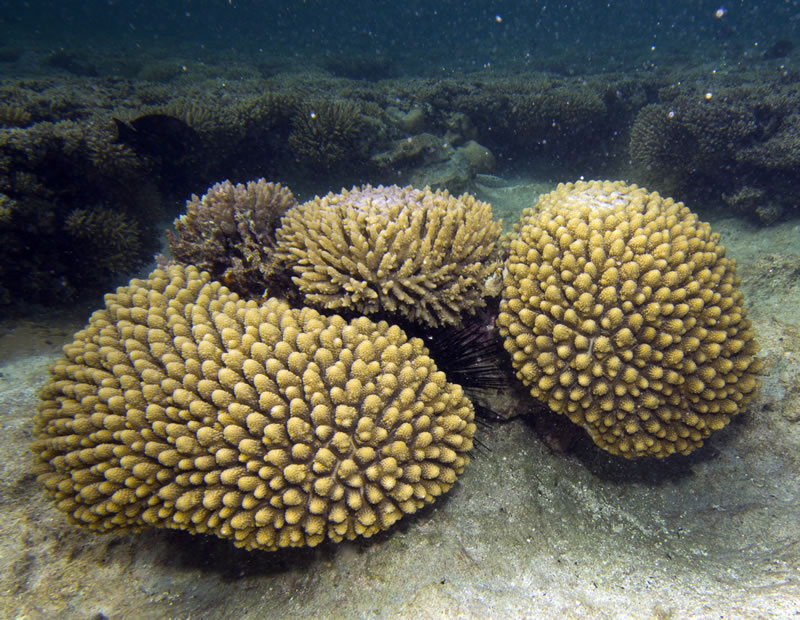
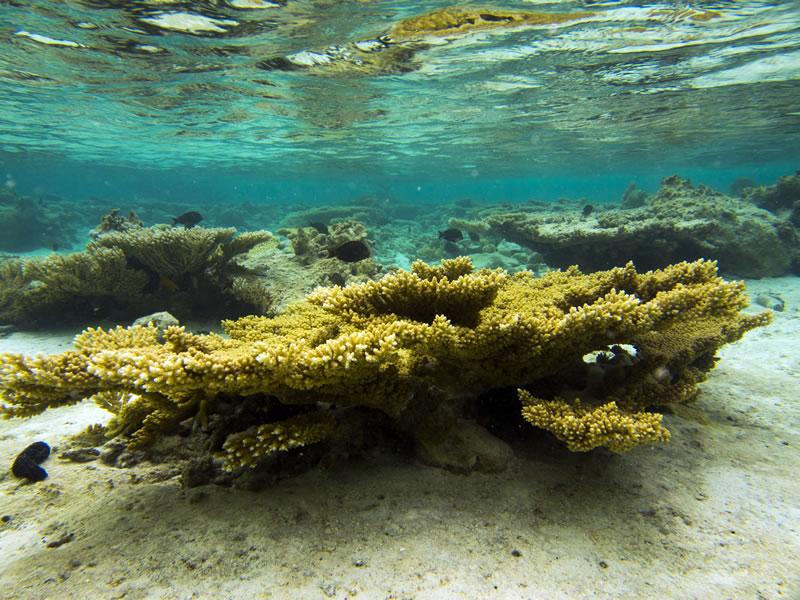
One foot back reef (above) and with COTS damage (below).
(click-thru on images for greater detail)
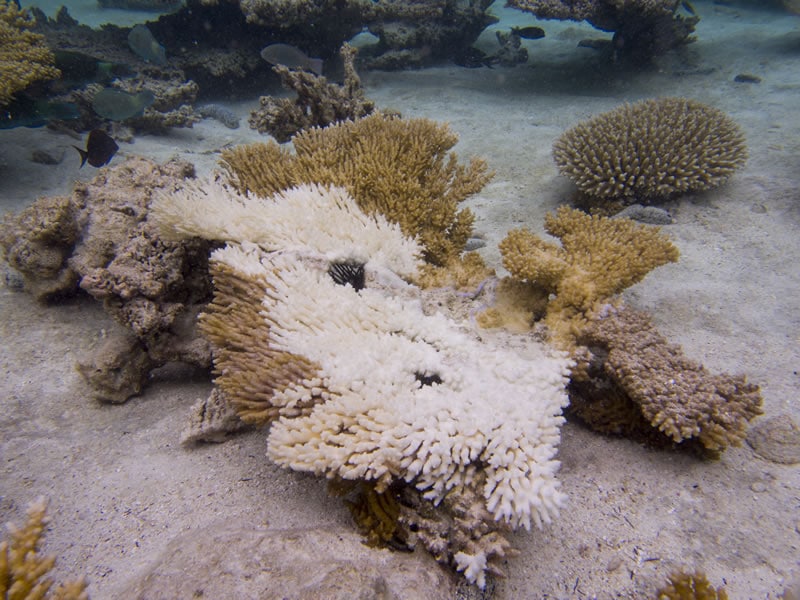
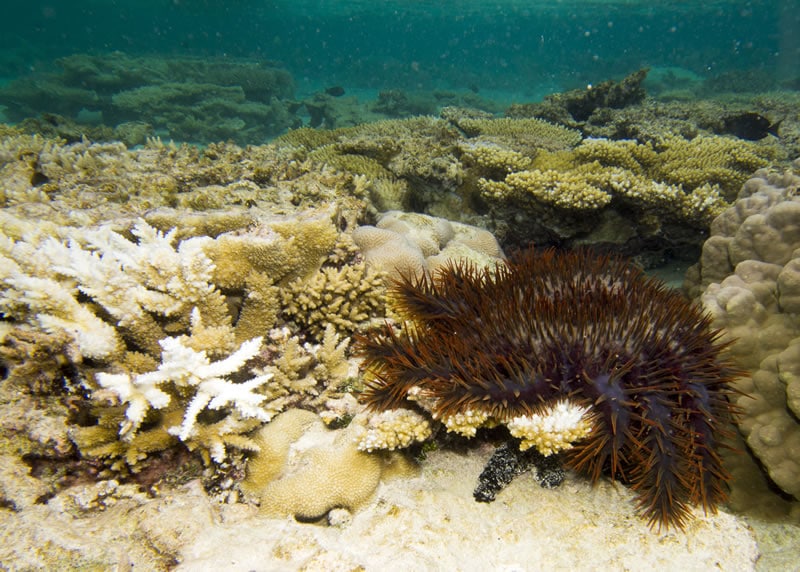
Over the Global Reef Expedition (GRE), we had seen COTS outbreaks in very shallow water in the reef crest, and much more commonly on the fore reef. This was the first time we had seen COTS eat their way around the outside of the atoll, and then move to the lagoon, continuing to devastate the remaining corals. Fortunately, we were able to collect most of the animals, we estimate 95%, and some of the healthy remaining stands of coral will survive, and possibly contribute to the recovery of the areas that have been devastated by these voracious predators.
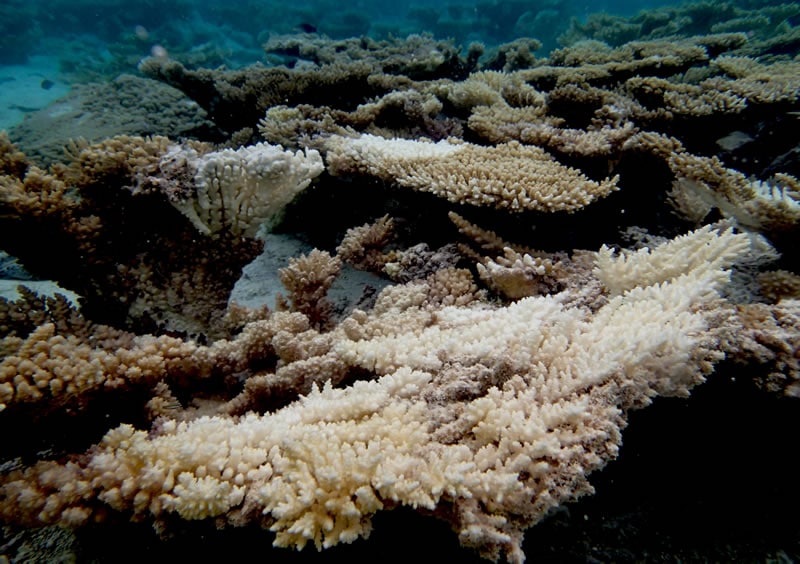
Shallow Acropora stand with some COTS damage.
Photos by Andy Bruckner