Expedition Log: BIOT – Day 14
Scientific breakthroughs are made every day, though the vast majority go unnoticed by the general public. Particularly important are discoveries that can lead to improvements in human well-being, such as those culminating in novel therapies for life threatening diseases. Much of what we know about animal physiology, particularly at the cell and molecular levels, is due not to studies conducted on human subjects, but instead on what are known as “model” organisms, such as mice or fruit flies. Likewise, marine biologists rely on model organisms for advancing our knowledge of particular disciplines. For instance, there is currently an urgent need to better understand how reef-building corals respond to elevated temperatures and carbon dioxide concentrations, given the threat of global climate change towards corals and the reef ecosystems they construct. The model coral for studying the effects of climate change is the cauliflower coral, Pocillopora damicornis.
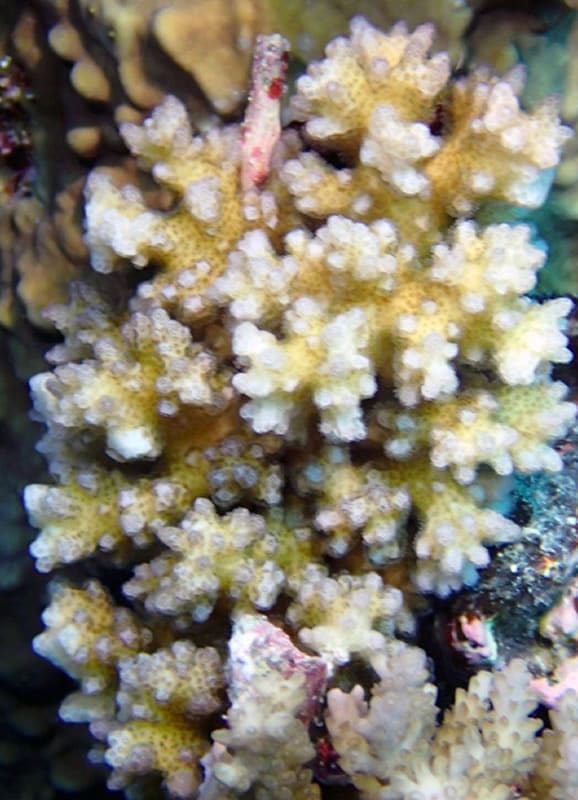
A cauliflower coral colony from Fiji’s Lau Archipelago. (left)
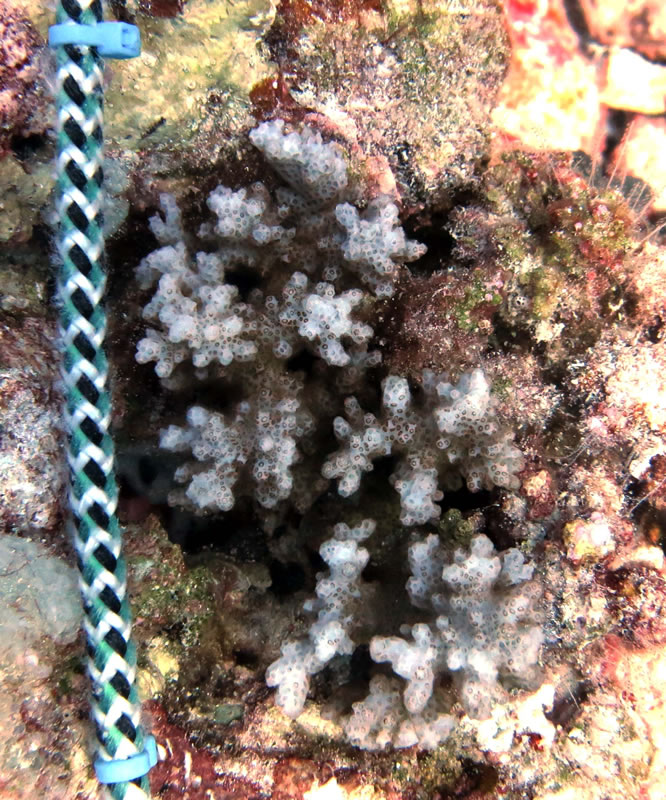
A cauliflower coral from the British Indian Ocean Territory. The length between the two blue zip ties is 10 cm. (right)
(click-thru on images for greater detail)
For over 25 years, scientists from the United States, Taiwan, Japan, Australia, Israel, French Polynesia, Monaco, and other countries have been studying the basic physiology, as well as the stress response, of the cauliflower coral P. damicornis, which, like all reef-building corals, forms an endosymbiotic association with dinoflagellates of the genus Symbiodinium.
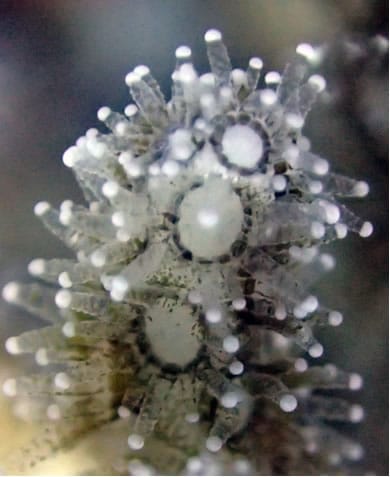
A closeup of a branch of cauliflower coral (~1 cm) from Tonga, with several polyps visible. Each polyp possesses 12 tentacles in this species. The brownish-green pigmentation is the sybiotic Symbiodinium algae, which reside in the coral’s gastrodermal cells and can be found at densities of over one million cells/cm2 of coral surface area.
One of the main reasons why scientists have chosen to pool their efforts on this species is because of its ubiquitous distribution; the cauliflower coral P. damicornis is found nearly everywhere in the Middle East and Indo-Pacific (though not in the Caribbean) and can be found on nearly every major type of reef ecosystem (e.g., atolls, fringing reefs, barrier reefs, and patch reefs). This widespread distribution does not, however, mean that cauliflower coral is always common. As it turns out, it is almost completely absent from the British Indian Ocean Territory; instead, a closely related sister species, Pocillopora acuta, is the dominant lagoonal pocilloporid. Neither species is common on the forereefs here, and the former is completely absent from such environments (as of the 91st dive).
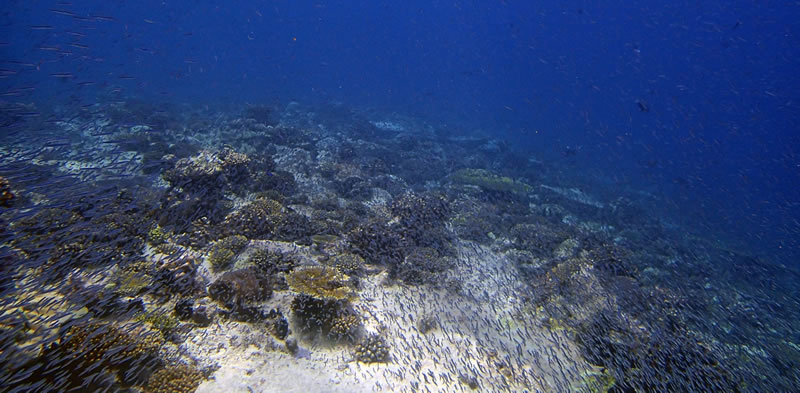
A vibrant reef blanketed with fish in the “Three Brothers” region of BIOT. Only Pocillopora acuta, and not our target coral Pocillopora damicornis, was found at this site.
Thankfully, the molecular biomarker assays I have designed over the past years to assess the health/stress level of P. damicornis appear to work well with P. acuta, given their evolutionarily close relationship; they were, in fact, considered to be the same species until only several years ago. Therefore, I will continue to sample P. acuta specimens, as well as those of the surprisingly elusive P. damicornis, in a variety of habitats in BIOT in order to attempt to diagnose the health of the sampled colonies and better understand how different environmental conditions influence the inner workings of the coral cells. The ensuing data may allow us to gain a better understanding of how corals respond to changing environments, a timely and pertinent topic given the myriad anthropogenic threats towards these beautiful, high biodiversity ecosystems.
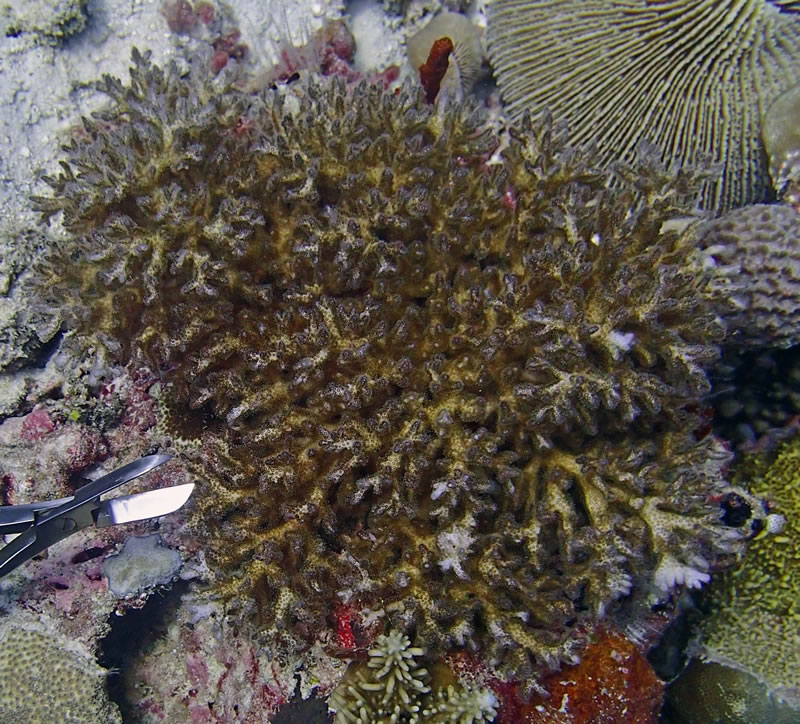
Pocillopora acuta, a closely related sister species of the model reef coral, Pocillopora damicornis. For a sense of the scale, the length of the plier blades is ~ 4 cm.
Photos: 1,3,4,5 Anderson Mayfield; 2 Samantha Clements.