There is a decline in out-of-school science learning around the world, especially outdoor environmental education experiences. Through the Bahamas Awareness of Mangroves (B.A.M.) program, the Khaled bin Sultan Living Oceans Foundation takes students out of the traditional classroom setting and provides them with this opportunity.
Since 2015, the Khaled bin Sultan Living Oceans Foundation (LOF) partnered with FRIENDS of the Environment (FRIENDS) to successfully run the Bahamas Awareness of Mangroves (B.A.M.) program. LOF worked with two high schools in Marsh Harbour – Abaco Central High School and Forest Heights Academy and since its inception, hundreds of students have completed the program.
The B.A.M. program is an immersive, yearlong experiential education program that engages students and teachers to learn about, restore, and monitor mangroves. B.A.M. utilizes project-based learning, a teaching method, which allows students to explore real-world problems and acquire deeper knowledge over extended periods of time. Additionally, the program is designed to strengthen Science, Technology, Engineering, Art, and Math (STEAM) education.
B.A.M.’s custom designed curriculum combines professional development for teachers, experiential learning, field experience, and program evaluation. The core of the program takes place over eight months when students execute hands-on scientific investigations.
YEAR 1 INVESTIGATION – GRADE 10 BIOLOGY STUDENTS
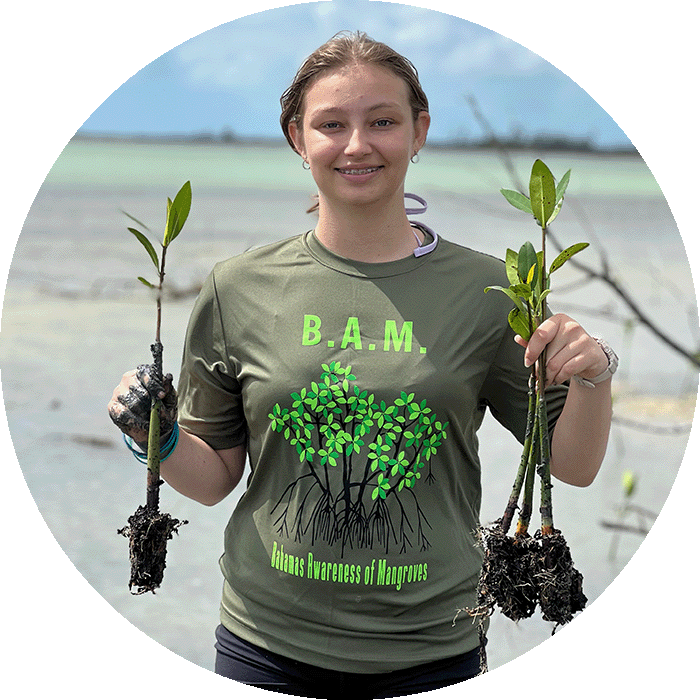
Each student grows 3 mangrove propagules (seedlings) in their classroom. They plant their propagules in different types of soil and hypothesize which soil they will grow best in. Over an eight month period, students measure the growth of each one. At the end of the project, students analyze the data collected and draw conclusions from it to determine whether their hypothesis was correct.
YEAR 2 INVESTIGATION – GRADE 11 BIOLOGY STUDENTS
Students establish quadrats or plots that allow them to consistently monitor the mangrove forest. Using scientific instruments, they collect data from their plot including non-living factors such as geographic location, salinity, dissolved oxygen, temperature, pH, and soil texture, and living factors such as the tree diameter, height, and tree species. Throughout the school year, students use the data they collect to make calculations and begin writing a mangrove report. At the end of the year, the students analyze the data and draw conclusions to determine health of the mangrove forest.
The goal of the B.A.M. program is to provide a unique outdoor environmental education experience that not only creates ocean and environmentally literate individuals, it also fosters awareness and concern about the mangrove ecosystem and its associated problems. Ultimately, the outcome of the program is to shape students’ attitudes and behaviors concerning the mangroves, creating environmentally responsible citizens.
Students who participate in the B.A.M. program are more likely to:
- have a positive attitude towards science
- apply and retain classroom knowledge deepening their understanding of science
- gain practical scientific experience and STEAM skills
- solve real-life problems
- develop a conservation ethic