
search-icon
Biomarker profiling in reef corals of Tonga’s Ha’apai and Vava’u archipelagos

Biomarker profiling in reef corals of Tonga’s Ha’apai and Vava’u archipelagos

PLoS ONE12(11): e0185857
By Anderson B. Mayfield, Chii-Shiarng Chen, Alexandra C. Dempsey
November 1, 2017

Abstract

Given the significant threats towards Earth’s coral reefs, there is an urgent need to document the current physiological condition of the resident organisms, particularly the reef-building scleractinians themselves. Unfortunately, most of the planet’s reefs are understudied, and some have yet to be seen. For instance, the Kingdom of Tonga possesses an extensive reef system, with thousands of hectares of unobserved reefs; little is known about their ecology, nor is there any information on the health of the resident corals. Given such knowledge deficiencies, 59 reefs across three Tongan archipelagos were surveyed herein, and pocilloporid corals were sampled from approximately half of these surveyed sites; 10 molecular-scale response variable were assessed in 88 of the sampled colonies, and 12 colonies were found to be outliers based on employment of a multivariate statistics-based aberrancy detection system. These outliers differed from the statistically normally behaving colonies in having not only higher RNA/DNA ratios but also elevated expression levels of three genes: 1) Symbiodinium zinc-induced facilitator-like 1-like, 2) host coral copper-zinc superoxide dismutase, and 3) host green fluorescent protein-like chromoprotein. Outliers were also characterized by significantly higher variation amongst the molecular response variables assessed, and the response variables that contributed most significantly to colonies being delineated as outliers differed between the two predominant reef coral species sampled, Pocillopora damicornis and Pacuta. These closely related species also displayed dissimilar temporal fluctuation patterns in their molecular physiologies, an observation that may have been driven by differences in their feeding strategies. Future works should attempt to determine whether corals displaying statistically aberrant molecular physiology, such as the 12 Tongan outliers identified herein, are indeed characterized by a diminished capacity for acclimating to the rapid changes in their abiotic milieu occurring as a result of global climate change.
Related Posts

2025-2026 B.A.M. Student Voices

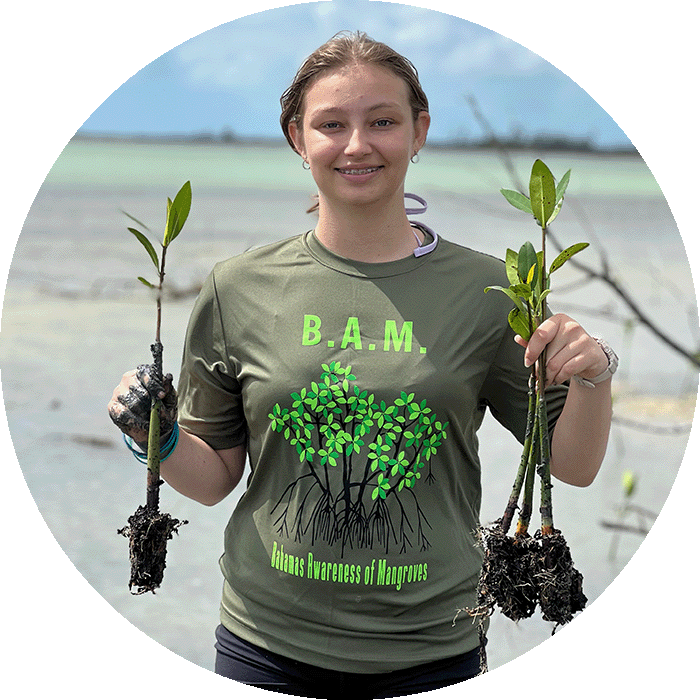
Throughout the Bahamas Awareness of Mangroves (B.A.M.) and Jamaica Awareness of Mangroves in Nature (J.A.M.I.N.) programs, we evaluate each phase of the mangrove education and restoration process to better understand how students are learning, growing, and connecting with their coastal environments.

Before the programs begin, students share what they already know about mangroves and how they feel about them. As the program progresses, we continue to gather feedback to see how their knowledge evolves from identifying mangrove species and understanding food webs to recognizing the role mangroves play in coastal protection and climate change mitigation.

But the surveys go beyond science content.

We also ask students…

Read More

Ten Years of B.A.M.: Rooted in Partnership, Growing in Purpose

Ten years ago, the Bahamas Awareness of Mangroves (B.A.M.) program began with a simple but meaningful commitment: to connect Bahamian students with the mangrove ecosystems that shape and protect their island home.

Since 2015, B.A.M. has been implemented in partnership with Friends of the Environment, whose dedication to environmental stewardship in Abaco has made this program possible year after year. Together, we have worked alongside Patrick J. Bethel High School and Forest Heights Academy to bring hands-on mangrove science into classrooms and out into the field.

What makes ten years remarkable is not just longevity — it is consistency…

Read More
Privacy Overview

This website uses cookies so that we can provide you with the best user experience possible. Cookie information is stored in your browser and performs functions such as recognising you when you return to our website and helping our team to understand which sections of the website you find most interesting and useful.  You can view our complete Privacy Policy here.

Strictly Necessary Cookies

Most of our cookies are used to improve website security and reduce spam. These cookies should be enabled at all times. They also enable us to save your preferences for cookie settings.

3rd Party Cookies

This website uses Google Analytics to collect anonymous information such as the number of visitors to the site, and the most popular pages. Keeping this cookie enabled helps us to improve our website.