search-icon
Footage Reveals New Shark Feeding Behavior
Shark Feeding Behavior
When a shark is lucky enough to catch a fish they still have to fend off their catch from others.

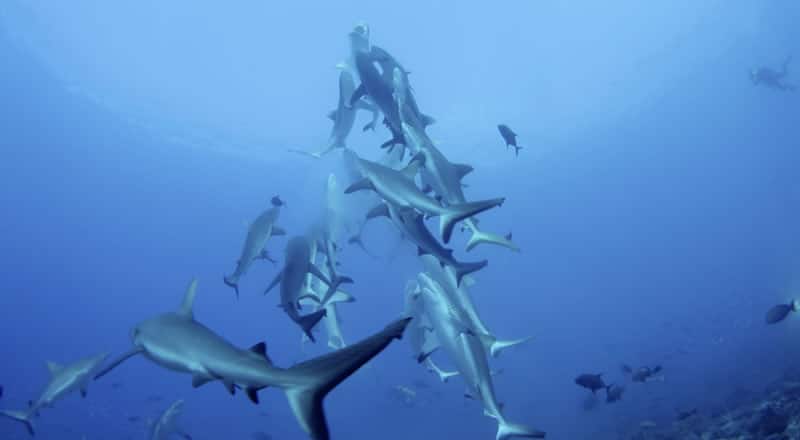
ANNAPOLIS, MD – Scientists with the Khaled bin Sultan Living Oceans Foundation (KSLOF) dove into the shark-infested waters of French Polynesia to study how sharks hunt for prey in the wild–using a professional film crew. The cameramen were shooting footage for Mysteries of the Coral Canyon an award-winning documentary airing this month on PBS. The research, published in Coral Reefs, is the first to document natural predatory behavior of grey reef sharks.

The team was on the Foundation’s Global Reef Expedition to film marbled grouper spawning. Once a year, as many as 10,000 of these fish gather in a narrow channel to mate – attracting hundreds of sharks that hunt the grouper while they are distracted and exposed.

Using the footage taken during the spawning and at the reef 3 weeks later, shark scientist Dr. William Robbins was able to record which fish the sharks targeted and how often they actually caught one.

[embedyt] http://www.youtube.com/watch?v=rM9zxNpknYU&width=660&height=373[/embedyt]


“Grey reef sharks are an adaptable predators,” said Dr. Robbins of Wildlife Marine and lead author of the study, “This research shows sharks modify their hunting strategy based on the type of fish they are targeting–slow and steady for agile fish like fusilier, fast and furious for large fish like grouper.”

Grey reef sharks preyed almost exclusively on the most abundant fish no matter the fish’s position on the food chain. This upends traditional theories of shark feeding behavior by showing that sharks don’t just eat large predatory fish. The sharks were surprisingly unsuccessful when hunting, capturing only 5-8% of the fish they targeted, and still had to fend off their catch from other sharks, often ripping large grouper to pieces in the process.

The cinematographers also captured shark feeding behaviors never seen before, including sharks pulling prey off the coral reef in broad daylight.

“To protect coral reefs, we need to understand the role sharks play in the ecosystem,” said Captain Philip Renaud, Executive Director of KSLOF “This research suggests sharks may be able to regulate the balance of reef fish by hunting over-abundant species.”

no images were found


See additional images on our Google+ page.

 

Related Posts

Meet IFAN: Helping Bring Navigate with Care to the Next Generation

If you’ve ever seen a lighthouse flashing from the shore or a brightly colored buoy bobbing in the water, you’ve seen Aids to Navigation at work.

Aids to Navigation, often called AtoNs, help mariners navigate safely. They can mark channels, warn of hazards, help vessels determine their position, and provide other information people need to make safe decisions on the water. Around the world, these systems help guide everything from small recreational boats to large commercial or container ships. 

But safe navigation isn’t only about protecting vessels and the people aboard them. The choices mariners make can also affect the animals and ecosystems beneath and around them.

That connection between maritime safety and ocean conservation is at the heart of this year’s Science Without Borders® Challenge—and of our partnership with this year’s theme sponsor, the International Foundation for Aids to Navigation (IFAN).

Read More
OceanImageBank_TheOceanAgency_Bleaching_16-scaled-1

Coral Bleaching Awareness Month: Giving Coral Reefs a Chance to Recover

For hundreds of millions of years, coral reefs have supported life in our oceans. Although they cover less than 1% of the ocean floor, they provide habitat for at least 25% of all marine species. They also support people around the world by sustaining fisheries and tourism, providing food and livelihoods, and helping protect coastlines from waves and storms.

But coral reefs are under increasing pressure. Pollution, overfishing, coastal development, physical damage, and increasingly warm ocean temperatures can all affect reef health. One of the most visible signs that a coral reef is under stress is coral bleaching.

This September, in recognition of Coral Bleaching Awareness Month, we’re taking a closer look at what happens when corals bleach, why bleaching matters, and what scientists around the world are doing to better understand, protect, and restore coral reefs.

Read More
Privacy Overview

This website uses cookies so that we can provide you with the best user experience possible. Cookie information is stored in your browser and performs functions such as recognising you when you return to our website and helping our team to understand which sections of the website you find most interesting and useful.  You can view our complete Privacy Policy here.

Strictly Necessary Cookies

Most of our cookies are used to improve website security and reduce spam. These cookies should be enabled at all times. They also enable us to save your preferences for cookie settings.

3rd Party Cookies

This website uses Google Analytics to collect anonymous information such as the number of visitors to the site, and the most popular pages. Keeping this cookie enabled helps us to improve our website.