A new film chronicles a scientist’s investigation to find out how much fish we have taken from the sea and determine how close we are to a global food catastrophe.
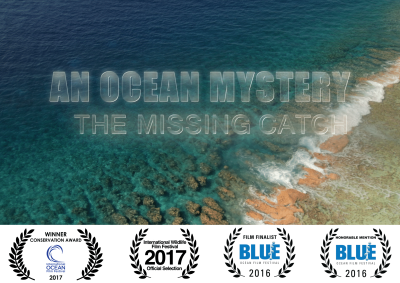 ANNAPOLIS—The Khaled bin Sultan Living Oceans Foundation is celebrating Earth Day with the launch of its film, An Ocean Mystery: The Missing Catch. The award-winning film will screen as part of the Earth Optimism Summit in partnership with the Smithsonian Institution. An Ocean Mystery: The Missing Catch will have its broadcast premiere on the Smithsonian Channel on Saturday, April 22 at 8pm ET/PT.
This film investigates one of the most important stories of our time: how close are we to a global crash in fish populations? As government and industry regulators track the quantity of fish we catch, and claim the oceans can handle the huge catches, fish numbers keep dropping. This may be because of inaccurate figures about how many tons of fish we catch. The film follows the research of Dr. Daniel Pauly and his team of international experts at the Sea Around Us Project, headquartered at the University of British Columbia, as they work to calculate the true amount of fish we catch.
Trying to determine the quantity of fish we have caught has taken almost fifteen years. It has required the Sea Around Us team to track down fishing data from highly unlikely sources such as historical colonial records, imported export documents, satellite imaging, household surveys and even gender study documents. It’s a big-data study on a massive scale.
The research involved hundreds of people and took more than a decade to complete Dr. Daniel Pauly said ‘The job of documenting what is caught in the world and the state of fisheries is a big one’ he continued we did this largely to help the community, the fishery scientists, and civil society to know more about what is really caught.’ That’s where the film comes in.
Communicating science to the public is a driving principal of the Khaled bin Sultan Living Oceans Foundation, who co-produced the film with the Smithsonian Channel. Executive Director of the Foundation, Philip Renaud said ‘finding ways to effectively communicate science helps to close the gap between science and policy’ he continued ‘big data studies that look at global trends can be of particular importance because they tell us a lot about our future.’ The US-based Living Oceans Foundation is involved in a big data study of their own. The Global Reef Expedition, it’s a six-year circumnavigation of the globe to study the state of world’s coral reefs.
Results from the Global Reef Expedition are still being put together but scientists involved in the research traveled to some of the most remote reefs on earth to collect data, and they found disturbing similarities on almost all of them. They virtually all had fewer fish than the science team were expecting. Full results from that study, accompanied by a film, will be published in the next two years but here’s a preview, it’s not good news.

The results of Dr. Pauly’s research show that we have drastically underestimated the true number of fish caught globally and that we are running out of fish much faster than we thought. Since Dr. Pauly’s study was published last year he has been working to make sure that their results are continuously updated and get included in international fishing statistics, particularly when it comes to protecting the livelihood of small-scale fishermen. Dr. Pauly said, ‘Officials in every country have difficulty keeping track of the catch of small scale fishermen, or people who fish to feed their families.’ Dr. Pauly continued ‘these are the fishermen that contribute to the food security of people but their catch is ignored.’
The film featured a pilot study of the Ourfish app in Honduras. It may make it possible to collect this kind of data as the fish are caught, and would allow even the most remote fishermen to send information about how much fish they catch to their national government. The project was led by Dr. Steve Box, VP of Global Fisheries Solutions at Rare, formerly of the Smithsonian Marine Station. This is good news for reefs and for accurate accounting of the worlds fish catch.
Dr. Pauly’s research proves that without accurate data on how many tons of fish we remove from the ocean, it is virtually impossible to manage our fish for the future. An Ocean Mystery: The Missing Catch is a call to arms to governments around the world to take a better accounting of their fish stocks before we have a global food disaster.