search-icon
Global Reef Expedition Navassa Field Report March 25‐31, 2012

Global Reef Expedition Navassa Field Report March 25‐31, 2012
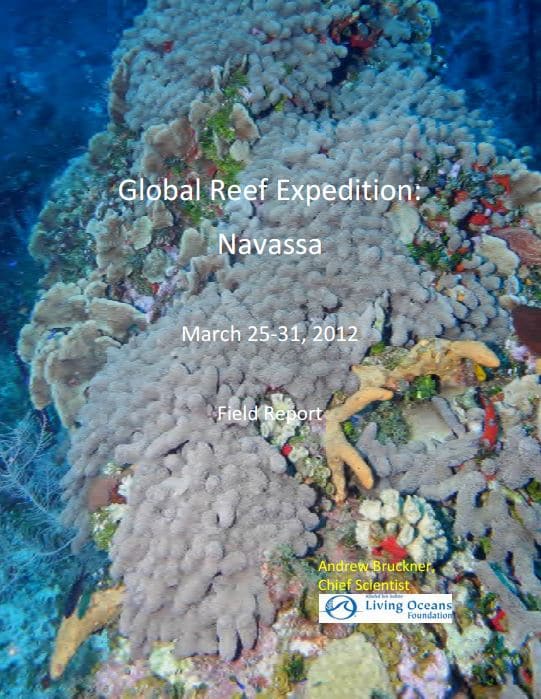
Global Reef Expedition Navassa Field Report - Khaled bin Sultan Living Oceans FoundationNavassa Island (18◦24’10’’ N, 75◦0’45’’W) is a U.S. possession that is approximately 5 km2 in area. The island lacks permanent human population. The island is comprised of a raised plateau surrounded by steep cliffs reaching to a submarine terrace of approximately 23–30 m in depth (Miller et al. 2003). A second raised terrace on the island and additional drop-offs and terraces at depth yield an overall ‘wedding cake’ topography to the region (Miller et al. 2008a). The cliffs surrounding the island preclude the standard coastal mosaic of habitat types such as beaches, mangrove shorelines, and seagrasses. Consequently fish groups dependent on these habitats (e.g., grunts (Haemulidae)) are largely absent from the Navassa assemblage. The primary reef habitats are the steep reef walls formed by the cliffs, large boulders located at the base of the wall, patch reefs, a limited amount of low-relief spur and groove, and rubble covering the terrace. Reefs of the island are exploited by transient subsistence Haitian fishers The island lacks local anthropogenic land-based sources of pollution and has minimal terrestrial run-off due to an absence of rivers.

The island’s oceanic position exposes it to substantial physical energy, and thus most of the sampling in the past was carried out on the leeward side of the island (SW), with only occasional sampling past the northwest point. Ecological assessment of reefs at Navassa Island began around the turn of the 21st century. The first through assessment of reef habitats, and associated habitat mapping was undertaken beginning in 2002 through multidisciplinary efforts of NOAA, US FWS and partner institutions (Miller and Gerstner 2002). These researchers identified major changes to reef communities due to several catastrophic events including a widespread outbreak of a coral disease (white plague-like condition) in 2004 and a mass bleaching event 2006 (Miller and Williams 2007). Changes in benthic community structure from 2002-2009 include a dramatic loss of coral cover and a subsequent dramatic increase in macro-algal cover, particularly in the best-developed reef habitats. The current study focused on an evaluation of patterns of recovery since the last surveys (2009), current impacts affecting the reefs, and characterization of the resilience of these reefs.
 

Related Posts

Introducing Our New Website: A Fresh Look for the Foundation’s Future

As we celebrate the Khaled bin Sultan Living Oceans Foundation’s 25th anniversary, we are proud to unveil our newly redesigned website—a modern home for our science, conservation work, and educational programs. This launch marks an important moment for the Foundation as we honor our long history and look toward the future of ocean conservation.

For more than two decades, the Foundation has worked tirelessly to improve the health of our living oceans. We have advanced ocean science, led one of the largest coral reef research missions in history, restored mangrove forests with local communities, created award-winning education programs, and shared the wonders of the ocean with people around the world. Our new website reflects the organization we are today—focused on conserving coral reefs, restoring mangrove forests, and improving ocean literacy—while still highlighting the legacy of work that brought us here.

The redesigned site…

Read More

Connecting People, Art, and Oceans: Championing Conservation at the 2025 IUCN Congress

The IUCN World Conservation Congress brings together thousands of leaders and decision-makers from governments, non-profit organizations, civil society, Indigenous groups, and the private sector to shape global conservation policy and action. This influential gathering serves as a platform to share knowledge, build partnerships, and advance initiatives that protect our planet’s biodiversity.

As a member of the International Union for Conservation of Nature (IUCN), the Khaled bin Sultan Living Oceans Foundation was honored to take part in the Congress, joining a global community of leaders, organizations, and changemakers committed to protecting nature and advancing sustainable futures.

Read More
Privacy Overview

This website uses cookies so that we can provide you with the best user experience possible. Cookie information is stored in your browser and performs functions such as recognising you when you return to our website and helping our team to understand which sections of the website you find most interesting and useful.  You can view our complete Privacy Policy here.

Strictly Necessary Cookies

Most of our cookies are used to improve website security and reduce spam. These cookies should be enabled at all times. They also enable us to save your preferences for cookie settings.

3rd Party Cookies

This website uses Google Analytics to collect anonymous information such as the number of visitors to the site, and the most popular pages. Keeping this cookie enabled helps us to improve our website.