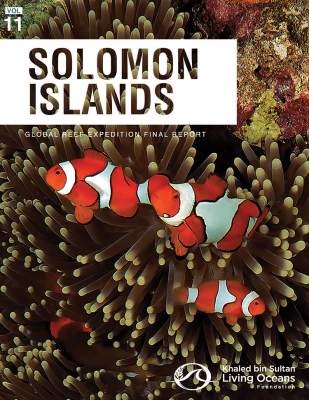
The Global Reef Expedition: Solomon Islands Final Report provides a comprehensive summary of our findings from our research mission to assess the health and resiliency of coral reefs in the Solomon Islands along with recommendations for preserving these reefs into the future.
On the Global Reef Expedition—the largest coral reef survey and mapping expedition in history—an international team of scientists worked closely with local partners and government officials to study coral reefs in the Solomon Islands. In 2014, they spent a month at sea conducting over 1,000 standardized surveys of coral reefs and reef fish in the Western, Isabel, and Temotu Provinces. They also created benthic habitat and bathymetric maps for 3,000 km2 of shallow-water marine habitats, and assessed the status of some of the most remote reefs in the Solomon Islands.
What they found were signs of reefs under stress and in need of aggressive conservation measures. Most of the big fish were gone, and many nearshore reefs appeared to be overfished. Remote reefs tended to fare better than those near population centers. There was considerable variability among the Provinces, but few large fish remained on reefs throughout the Solomon Islands. Coral communities in the Solomon Islands were in better shape, with some showing signs of damage from previous tsunamis and predatory crown-of-thorns-starfish (COTS). Reefs in the Solomon Islands had high coral diversity and moderate coral cover. By prioritizing local management and taking steps now to protect the reefs and reduce fishing pressure, the health and resiliency of reefs in the Solomon Islands can be improved so they can be used well into the future.
The Foundation is grateful for the opportunity to conduct this research and hopes the data in this report will help the Solomon Islands protect and preserve their coral reefs and nearshore fisheries. This report provides valuable baseline data that can be used to monitor the reefs, identify priority areas for conservation, and track changes to the reef over time. We have shared this report widely with government officials, marine park managers, stakeholders, and conservation organizations so that it can inform ongoing marine conservation efforts in the Solomon Islands.
Global Reef Expedition: Solomon Islands Final Report
The Global Reef Expedition: Solomon Islands Final Report presents the Foundation’s findings from the Global Reef Expedition mission to the Solomon Islands in 2014, along with recommendations that can help preserve the reefs into the future.