Abstract
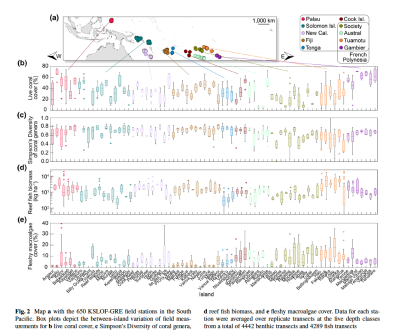 Diver assessments can reveal much about coral reef condition, but fieldwork is expensive and challenging. To address this limitation to effective reef assessment, we identified predictive relationships between diver measurements of reef condition collected at 650 stations across the South Pacific and a broad portfolio of socio-environmental drivers assembled from public-domain remote sensing data. Our models of coral cover, coral diversity, fish biomass, and fleshy macroalgae cover performed with relatively high accuracy (mean-squared prediction error, MSPE = 0.35–0.48), implying that the state of the art for public-domain remote sensing is already well poised to extrapolate diver measurements to unsurveyed reefs. Whereas sea surface temperature, protected status, market gravity, and geomorphological zones retained high importance across all models, their ability to predict each diver measurement varied, highlighting the complex determinants of the different aspects of reef health. To quantify the performance of our approach for a variety of sampling scenarios, we constructed separate models for lagoonal reefs versus forereef stations, and for ‘archipelago,’ ‘region,’ and ‘basin’ spatial scales. Despite maintaining high accuracy (MSPE < 0.38), the socio-environmental drivers that delivered the best models varied between reef zones and spatial scale. While we demonstrated high accuracy in predicting metrics coral reef health, our findings caution against one-size-fits-all interpretation of the drivers, so we suggest testing remote sensing models across geomorphological zones and scale to understand systematic changes in the variables that drive reef condition. Our study paves the way for an amplified role of remote sensing to inform reef conservation at multiple scales.