In SevenSeas Magazine
Issue 108, May 2024
This is the fourth global bleaching event in recorded history, the second to hit reefs in the past ten years.
A worldwide network of coral reef scientists announced that the world is currently experiencing its fourth global coral bleaching event, the second to hit reefs in the last 10 years. The announcement, made by the National Oceanic and Atmospheric Administration (NOAA) and the International Coral Reef Initiative (ICRI), comes at a time when coral reefs are facing a number of threats to their survival.
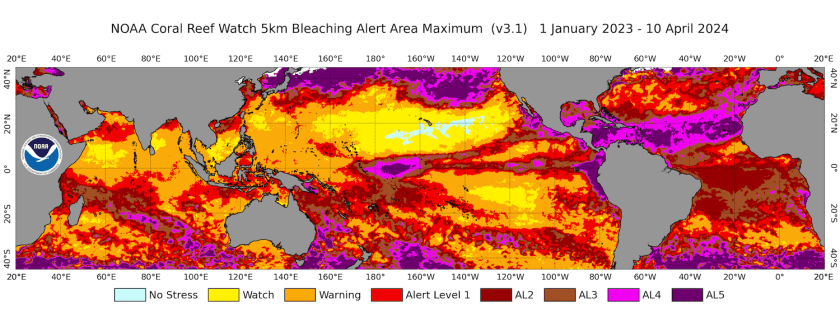
Bleaching-level heat stress, caused by prolonged increases in anomalous ocean temperatures, has – and continues to be – extensive across the Atlantic, Pacific, and Indian Oceans.
“From February 2023 to April 2024, significant coral bleaching has been documented in both the Northern and Southern Hemispheres of each major ocean basin,” said Derek Manzello. Dr. Manzello joined the Khaled bin Sultan Living Oceans Foundation (KSLOF) on the Global Reef Expedition and is now the coordinator of NOAA’s Coral Reef Watch program, which remotely monitors and predicts the extent of coral bleaching worldwide.
Since early 2023, mass bleaching of coral reefs has been confirmed in at least 53 countries, territories, and local economies, including Florida, the Caribbean, the Eastern Tropical Pacific (including Mexico, El Salvador, Costa Rica, Panama, and Colombia), Australia’s Great Barrier Reef, large areas of the South Pacific (including Fiji, Vanuatu, Tuvalu, Kiribati, and the Samoas), the Red Sea (including the Gulf of Aqaba), the Persian Gulf, and the Gulf of Aden.
Bleaching must be confirmed within each ocean basin to make a final determination of a global bleaching event. Reports have now been confirmed of widespread bleaching across parts of the Western Indian Ocean, including Tanzania, Kenya, Mauritius, the Seychelles, Tromelin, Mayotte, and off the western coast of Indonesia.
“As the world’s oceans continue to warm, coral bleaching is becoming more frequent and severe,” Manzello said. “When these events are sufficiently severe or prolonged, they can cause coral mortality, which can negatively impact the goods and services coral reefs provide that people depend on for their livelihoods.”
Where coral bleaching results in mortality, especially on a widespread scale, it impacts economies, livelihoods, food security, and more. However, it is important to remember that coral bleaching does not always lead to coral death. Rather, if the stress driving the bleaching diminishes, corals can recover, with reefs maintaining their biodiversity and continuing to provide the ecosystem services that we rely on.
“Climate model predictions for coral reefs have been suggesting, for years, that bleaching impacts would increase in frequency and magnitude as the oceans warm,” said Jennifer Koss, director of NOAA’s Coral Reef Conservation Program.
This global event requires global action. The International Coral Reef Initiative (ICRI), a partnership of 101 international members, currently co-chaired by NOAA and the U.S. Department of State, is steadfast in applying resilience-based management actions for coral reefs. In response to the three previous global bleaching events as well as regional and local events, ICRI and its members have advanced coral interventions and restoration in the face of climate change.
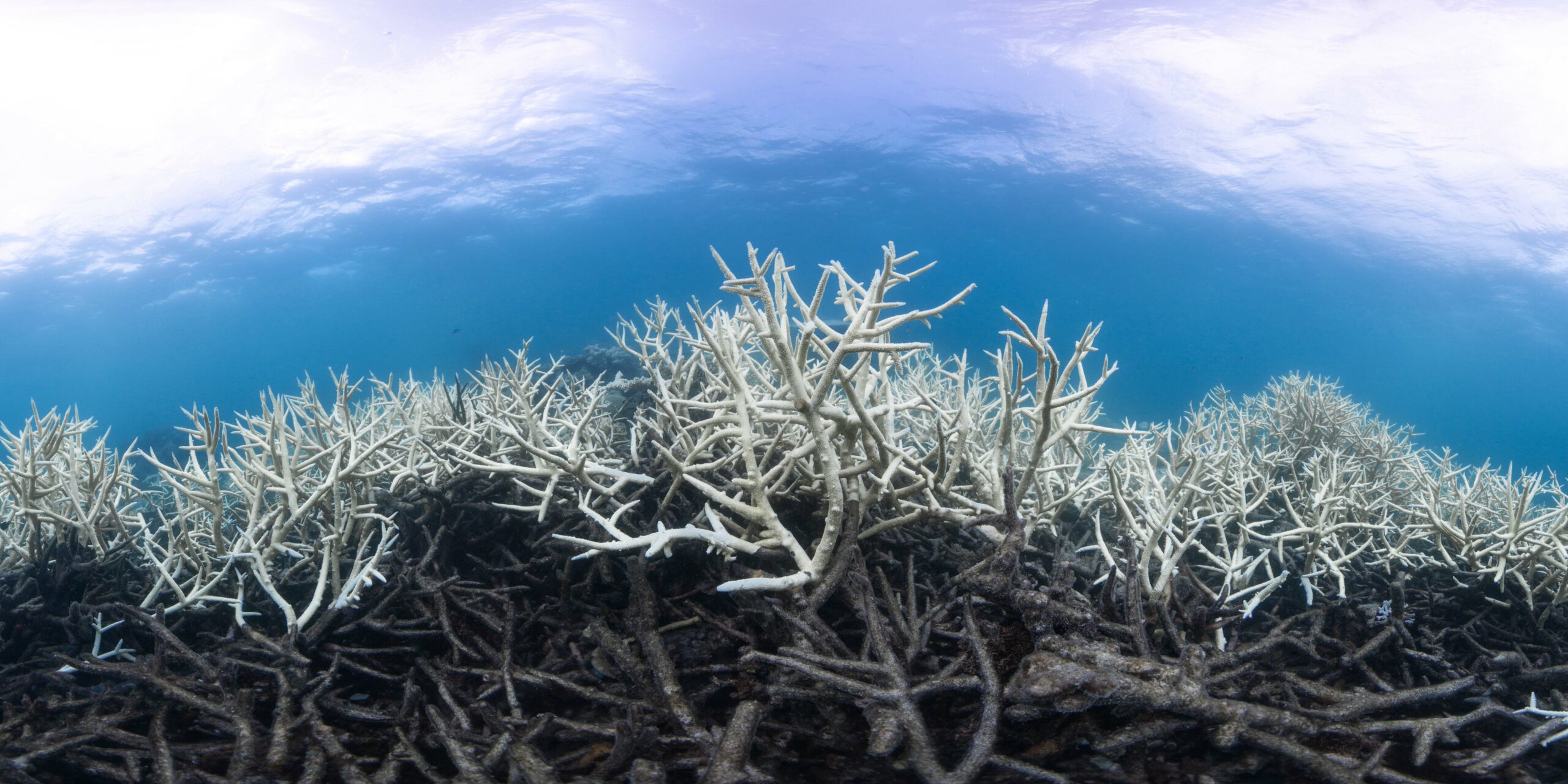
Bleached coral on the Great Barrier Reef in 2015 © The Ocean Agency / Ocean Image Bank
“One of the best ways to assess the impact of a bleaching event is to track changes to a reef over time,” said Alexandra Dempsey, CEO of the Khaled bin Sultan Living Oceans Foundation. “Reliable baseline data on the state of the reef—such as the data on coral cover, fish biomass, and species diversity we collected on the Foundation’s Global Reef Expedition—can help scientists assess the impact of the bleaching event and understand how the health of a reef changes over time.”
Global bleaching events do not affect all coral reefs equally and require a suite of global, regional, and local interventions. This emphasizes the importance of regularly monitoring coral reef ecosystems, and not just during bleaching events. Networks such as the Global Coral Reef Monitoring Network, an operational network of ICRI, and the U.S. Coral Reef Task Force, provide mechanisms for reporting on the impact of bleaching on the World’s coral reefs, alongside regional bleaching observation networks.
“As the Living Oceans Foundation continues to work on coral reefs, particulalry in the South Pacific, we have been called upon by NOAA to report on active bleaching events we have witnessed in the field,” said Dempsey. “This is critical for real-time reporting for the global status of coral reef bleaching events.”
If you would like to learn more about this global bleaching event and its potential impact, ICRI will be hosting a webinar on Tuesday, May 14th, 2024 to present and discuss the status of the 4th Global Bleaching Event and the role of the global coral reef community. Register your interest to attend the webinar here.