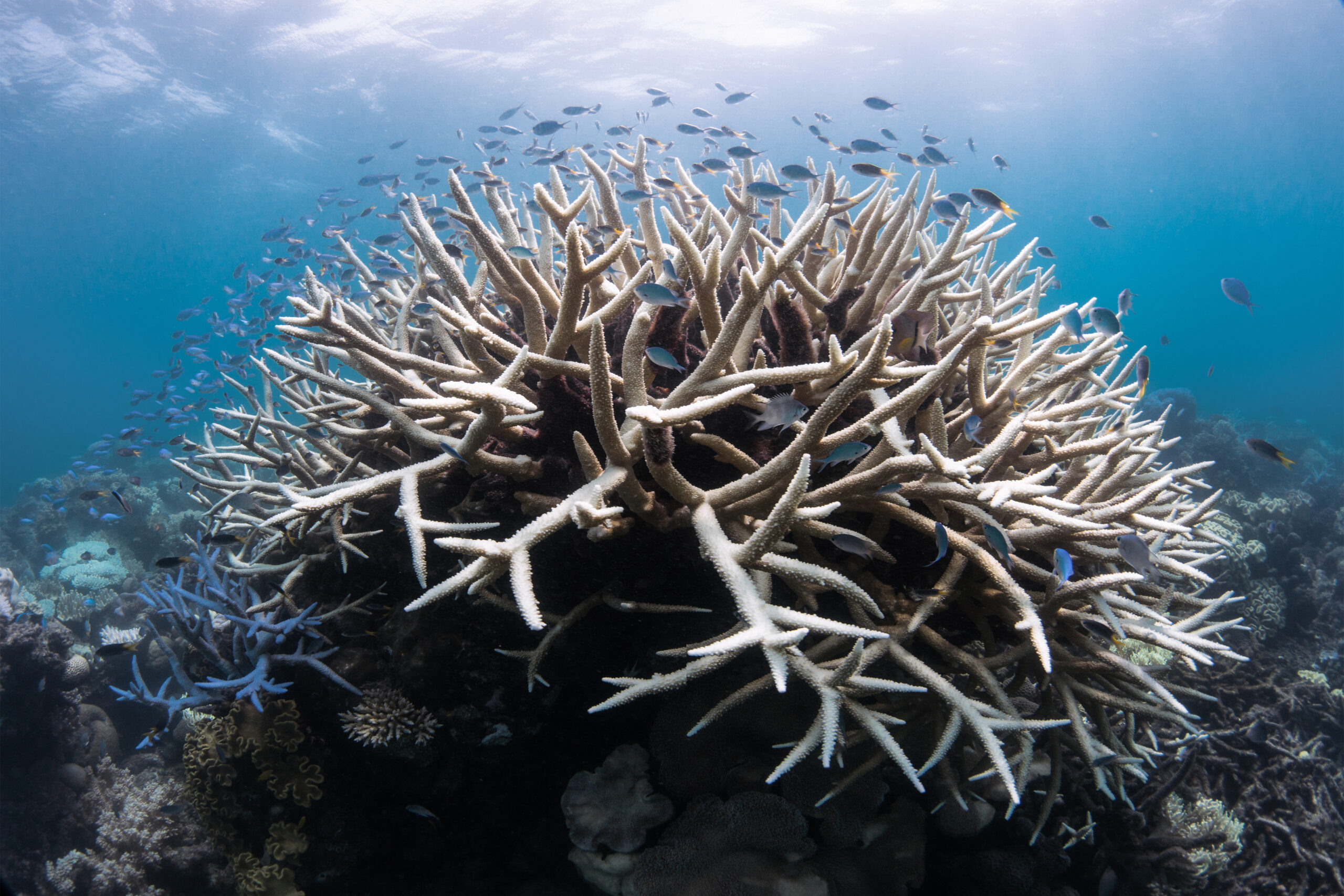
This article, written by several Living Oceans Foundation Chief Scientist, Andrew Bruckner, and Research Fellow, Joao Monteiro, along with Science Team members Illiana Baums, Joshua Feingold, and Tyler Smith, looks at the marginal coral populations of Pocillopora in the Galápagos Archipelago.
Marginal coral populations: the densest known aggregation of Pocillopora in the Galápagos Archipelago is of asexual origin
Frontiers in Marine Science
November 12, 2014
By Illiana B. Baums, Meghann Devlin-Durante, Beatrice A. A. Laing, Joshua Feingold, Tyler Smith, Andrew Bruckner, and Joao Monteiro
 Coral populations at distributional margins frequently experience suboptimal and variable conditions. Recurrent El Niño-Southern Oscillation (ENSO) warming events have caused extensive mortality of reef-building corals in the Eastern Pacific, and particularly impacted branching pocilloporid corals in the Galápagos Islands. Pocillopora spp. were previously more common and formed incipient reefs at several locations in the archipelago but now occur as scattered colonies. Here, we report an unusually concentrated aggregation of colonies and evaluate their current genetic diversity. In particular we focus on a large population of 1614 live Pocillopora colonies found in a volcanic lagoon along the southern shore of Isabela Island. Forty seven colonies were sampled, primarily using a spatially explicit sampling design, and all colonies belonged to Pocillopora mitochondrial open reading frame lineage type 3a. Typing of additional Pocillopora samples (n = 40) from three other islands indicated that this stand is the only known representative of type 3a in the Galápagos Islands. The Isabela Pocillopora type 3a colonies harbored Symbiodinium ITS-2 clade C1d. Multilocus genotyping (n = 6 microsatellites) capable of resolving individual clones indicated that this stand is monogenotypic and thus the high density of colonies is a result of asexual reproduction, likely via fragmentation. Colony size distribution, while an imperfect measure, suggested the stand regrew from remnant colonies that survived the 1997/98 ENSO event but may postdate the 1982/83 ENSO. The community of Pocillopora colonies at Isabela is of particular ecological value due to its high density and support of associated organisms such as fish and benthic invertebrates. The Galapagos Pocillopora corals will continue to provide insights into the genetic structure and population dynamics of marginal coral populations.