
search-icon
Scientist Spotlight – Chief Scientist Andrew Bruckner
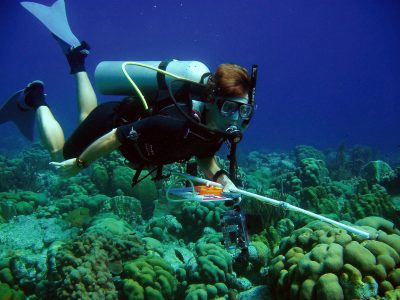
Chief Scientist Dr. Andrew Bruckner performing a transect survey.

Title: Chief Scientist

Name: Andrew Bruckner

Questions:

What do you do? I am a Coral Reef Ecologist. I am working to identify strategies to halt the degradation of coral reefs and promote their conservation and sustainable use. As Chief Scientist, I am leading the implementation of the Global Reef Expedition.  On a day to day basis, I divide my time between field research, planning and execution of research missions, analysis of data, development of reports and products from our findings, and communication with scientists, managers and policy makers and the public on coral reef issues.

How did you get started? I first began to dive in the late 1970’s in Jamaica when reefs were still flourishing.  In the early 1980’s, I witnessed the devastation caused by a major hurricane, a rapid die-off of the most important herbivore (long-spined black sea urchins), and an outbreak of a coral disease that targeted elkhorn and staghorn corals.
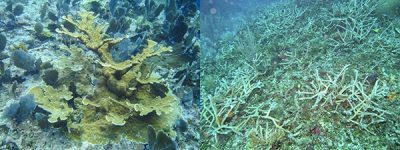
Some of the Elkhorn and Staghorn Coral left in Jamaica.

Over a ten year period, I witnessed mass bleaching events where entire reefs turned stark white, the disappearance of two of the most important and most abundant reef building corals, and the transformation of vibrant coral reefs to meadows of fleshy seaweed.  Seeing such remarkable changes over such a short time triggered the future directions of my research.  During the 1990’s and 2000’s, I conducted research to better understand the impact of natural factors that were killing corals – coral diseases, outbreaks of coral predators, and hurricanes — before becoming Chief Scientist here at Living Oceans Foundation.

Chief Scientist Dr. Bruckner doing outreach in Jamaica about the health of the coral reefs, and the impact that overfishing has had in the area.

What do you like best about your work?  The ability to make a difference.  Over my career, I have led initiatives that resulted in the listing of the first two corals on the endangered species list, international regulations in trade in coral reef species through CITES, and implementation of sustainable management practices for coral reef fisheries.  I now have the ability to fill major gaps in our understanding of factors and mechanisms that can help enhance the recovery of corals and make them better withstand impacts from climate change. As Chief Scientist with Living Oceans Foundation, I have had an unprecedented opportunity to dive the most remote and untouched coral reefs found on the planet and interact with communities dependent on these resources.

What are your fears about the future of coral reefs? Unless we address direct human impacts on coral reefs, especially pollution from land and unsustainable and destructive fishing practices, reefs will be unable to persist through these periods of climate change.  This is becoming increasingly difficult, as human populations are rapidly expanding which increases pressures placed on coral reefs.

What do you hope for the future of ocean conservation? Humans are able to live in balance with the ocean. Future development, agriculture, and other land-based activities will be conducted in an environmentally friendly manner and fisheries will become less destructive and more sustainable.

Dr. Bruckner is the Chief Scientist for Living Oceans Foundation. To learn more about Dr. Bruckner, read some of his publications and view his photos, you may visit his bio page.
Related Posts

Introducing Our New Website: A Fresh Look for the Foundation’s Future

As we celebrate the Khaled bin Sultan Living Oceans Foundation’s 25th anniversary, we are proud to unveil our newly redesigned website—a modern home for our science, conservation work, and educational programs. This launch marks an important moment for the Foundation as we honor our long history and look toward the future of ocean conservation.

For more than two decades, the Foundation has worked tirelessly to improve the health of our living oceans. We have advanced ocean science, led one of the largest coral reef research missions in history, restored mangrove forests with local communities, created award-winning education programs, and shared the wonders of the ocean with people around the world. Our new website reflects the organization we are today—focused on conserving coral reefs, restoring mangrove forests, and improving ocean literacy—while still highlighting the legacy of work that brought us here.

The redesigned site…

Read More

Connecting People, Art, and Oceans: Championing Conservation at the 2025 IUCN Congress

The IUCN World Conservation Congress brings together thousands of leaders and decision-makers from governments, non-profit organizations, civil society, Indigenous groups, and the private sector to shape global conservation policy and action. This influential gathering serves as a platform to share knowledge, build partnerships, and advance initiatives that protect our planet’s biodiversity.

As a member of the International Union for Conservation of Nature (IUCN), the Khaled bin Sultan Living Oceans Foundation was honored to take part in the Congress, joining a global community of leaders, organizations, and changemakers committed to protecting nature and advancing sustainable futures.

Read More
Privacy Overview

This website uses cookies so that we can provide you with the best user experience possible. Cookie information is stored in your browser and performs functions such as recognising you when you return to our website and helping our team to understand which sections of the website you find most interesting and useful.  You can view our complete Privacy Policy here.

Strictly Necessary Cookies

Most of our cookies are used to improve website security and reduce spam. These cookies should be enabled at all times. They also enable us to save your preferences for cookie settings.

3rd Party Cookies

This website uses Google Analytics to collect anonymous information such as the number of visitors to the site, and the most popular pages. Keeping this cookie enabled helps us to improve our website.