

Expedition Log: Palau – Day 7
I felt like I was floating in an emerald green broth chock full of mushrooms. Thousands of mushrooms, actually more like 13 million mushrooms. I dove to the depths and looked up, rays of sunlight streaming through the green water and penetrating the translucent mushrooms. I was swimming in one of 57 of Palau’s marine lakes among millions of jellyfish – an endemic subspecies of golden jellyfish called Mastigias papua etpisoni found only in Onegeum’l Tketau (the “fifth lake”).
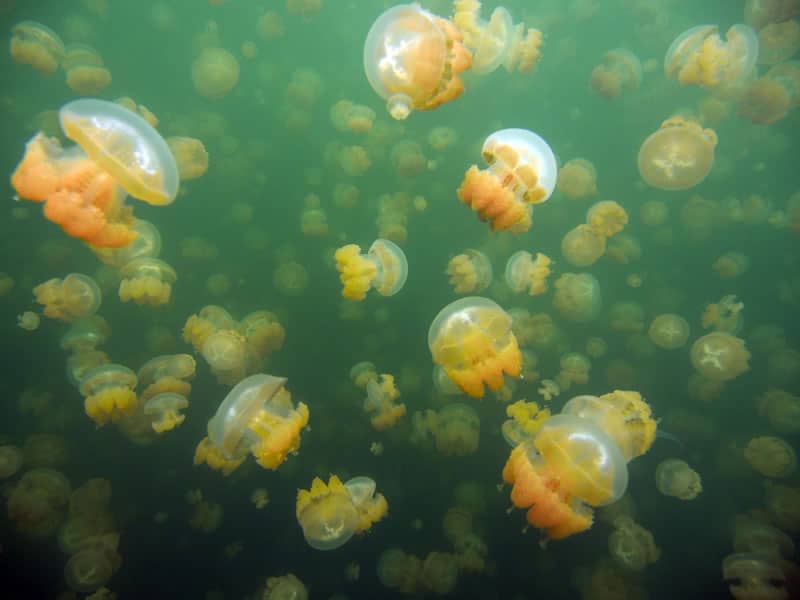
A swarm of jellyfish in Onegeum’l Tketau, Palau’s “fifth lake”
Unlike many of its relatives, this species won’t cause a painful sting. Like most jellyfish, though, it has two life stages, the familiar swimming medusa and a small benthic polyp that lives on the sides and slopes of the lake, attached to the bottom only on hard substrates like mangrove roots. They go through a process known as strobilation, where a tiny ephyrae (attached medusa) forms on the top of the polyp (asexual reproduction) and then pops off to swim free in the water. While a single polyp only produces one medusa at a time, it can produce hundreds over its lifetime. The jellyfish, at a later stage, produce free-swimming larvae through sexual reproduction that swim to the edge of the lake, attach to the bottom and transform into a polyp.
These jellyfish are found in four other lakes in Palau, but each is a distinct subspecies that varies in shape and behavior. The subspecies I was looking at was named after an early president of Palau.
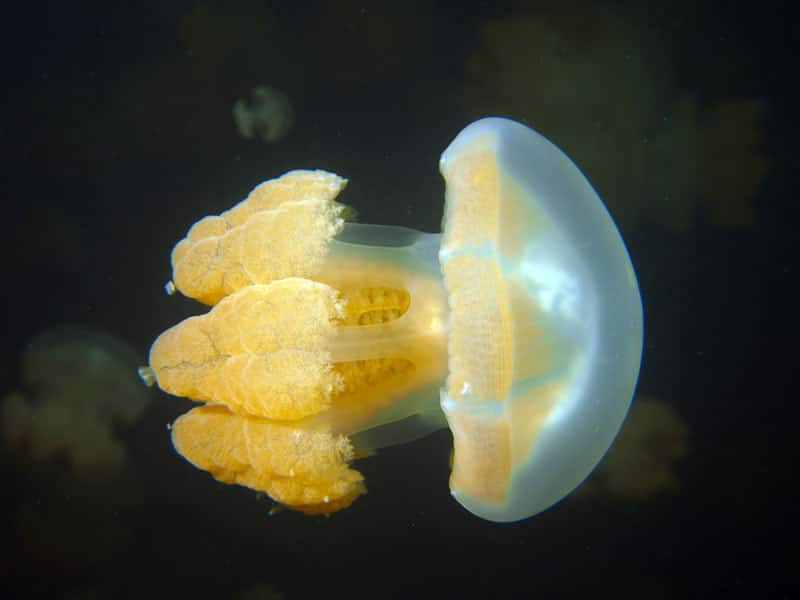
The golden jellyfish Mastigias papua etpisoni was named after an early President of Palau
Like corals, jellyfish get most of their energy from algae (zooxanthellae) living in their tissues and they can also catch microscopic zooplankton. These jellies are very sensitive to stressors just like corals. During the 1998 bleaching event, they lost all their symbiotic algae, bleached and died and the polyps stopped producing ephyrae. All of the jellyfish disappeared from the lake. Fortunately, the polyps survived and when cooler water returned the jellyfish rebounded.
The lakes themselves are quite unique. They are entirely surrounded by land. To access this lake, we had to hike up a long and densely vegetated ridge and then back down the other side. The lake is 30 m deep, lacks direct exchange with the sea, and has slightly lower salinity that the open ocean, but there are tides (delayed by two hours relative to the surrounding lagoon) caused by limited exchange with the lagoonal waters. With each rising tide, water from the lagoon permeates through small crevices in the limestone under the island, trickling into the lagoon.
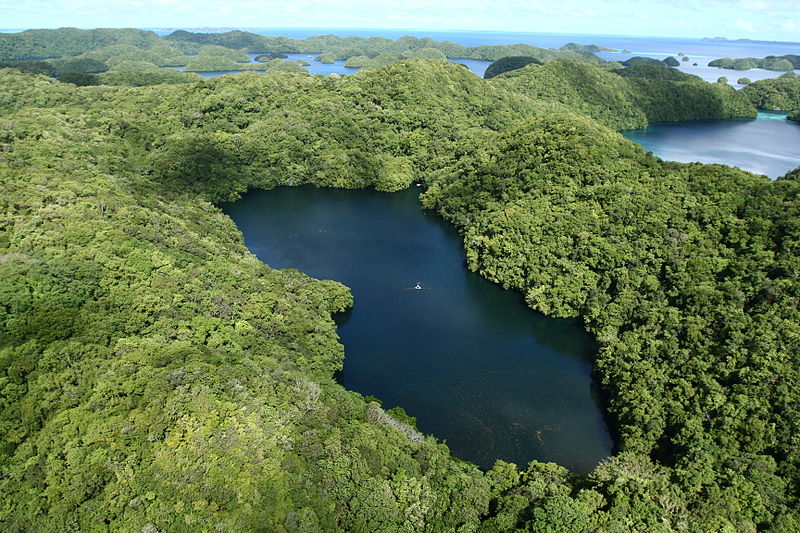
Palau’s “fifth lake.” At the bottom of the image, in the lake, the numerous bright dots are the jellyfish.
By Lukas from Munich, Germany [CC BY 2.0], via Wikimedia Commons
The jellyfish in this lake have a unique behavior, migrating more than 1 km each day. They swim towards the rising sun in the morning, and follow the setting sun in the afternoon, which prevents them from encountering their one predator, a sea anemone (Entacmea) that lives on the edge of the lake.
There are other critters that live in the lake such as several small fishes, fragile whispy sponges, seastars, mussels and gastropod mollusks to name a few. Most of these live among the mangrove roots that surround the perimeter of the lake. Very few species (other than bacteria) are found in deeper water as there is a poisonous anoxic (oxygen free) layer beginning at 12-14 m, which is bright pink due to a layer of bacteria.
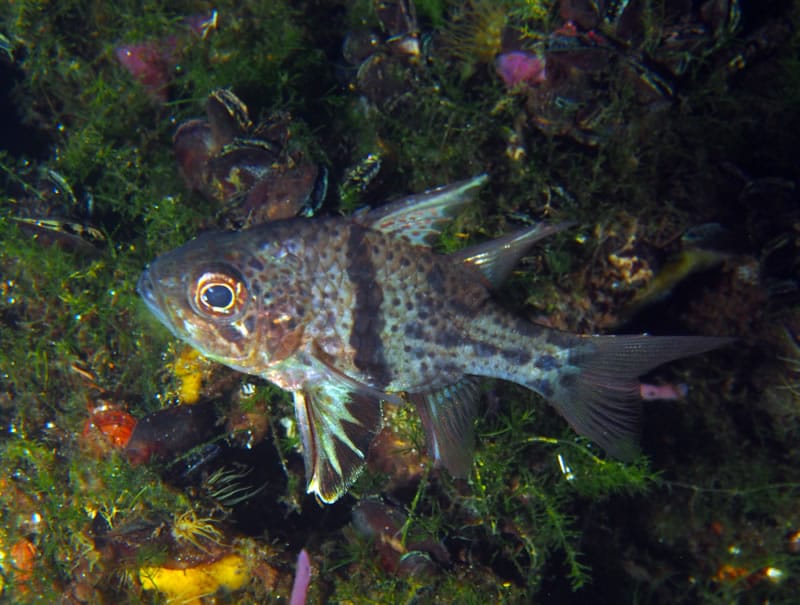

An orbiculate cardinalfish, Sphaeramia orbicularis (left) / A clump of the fragile sponge Haliclona hanging off a mangrove root (right)
(Click-thru on images for greater detail)
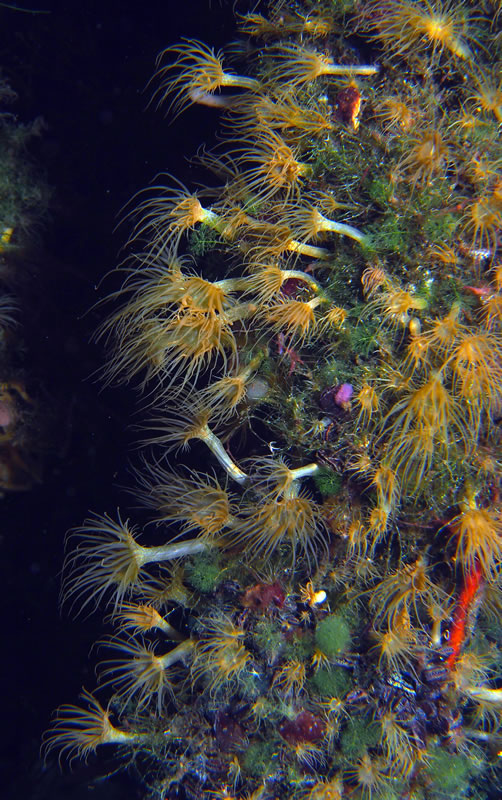
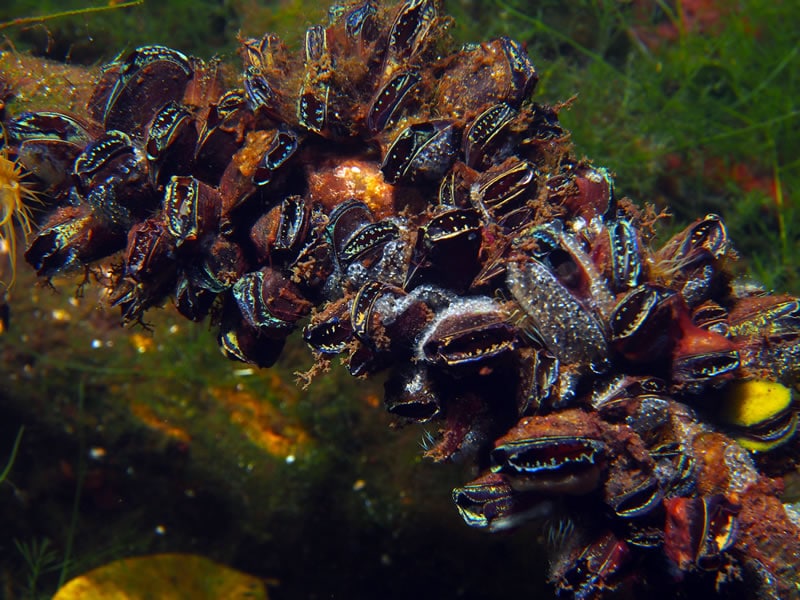
An invasive sea anemone, Aiptasia, is covering much of the available hard substrate, reducing the number of places jellyfish polyps can settle (left) / A group of mussels (Brachidontes) with shells colonized by encrusting sponges (right)
(Click-thru on images for greater detail)
Photos 1,2,4,5,6,7 – Andy Bruckner
Photo 3: By Lukas from Munich, Germany [CC BY 2.0], via Wikimedia Commons

.jpg)