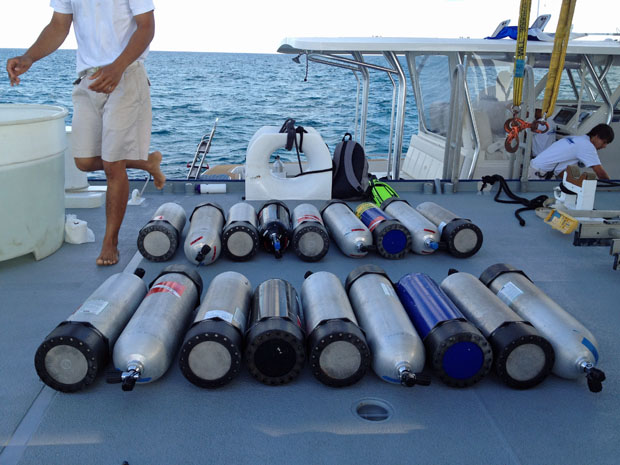
After a week of scuba, long boat rides and evenings filled with planning and data entry, the faces around the dinner table have grown progressively more tanned and tired. Sitting in the sun and moving a dozen or so 18-kg (40-lb) scuba tanks every day takes it out of you. It’s a good tired, though, the satisfied exhaustion of lots of work done well.
The second-to-last day of diving saw a brave boatload take the Calcutta 73 km (45 mi) to the far southwestern end of the Bank – two hours out and three hours back. And after all that, they only found two good dive sites. The first site, Northwest Ridge, had good coral reef structure, but a swift current. At the end of the dive, three researchers signaled for a pick-up by employing their “safety sausages,” neon-colored inflatable tubes that make you easy to spot when you surface far away from the boat.
The second site, on the sheltered side of Banner Reef, had lots of three-dimensional reef structure (known as rugosity and a sign of good health) with an abundance of sea urchins (Diadema sp.) and macroalgae (a.k.a. seaweed). It also had high fish biodiversity and biomass (i.e. lots of fish and lots of species), including French grunts (Haemulon flavolineatum), the first French angels (Pomacanthus paru) and sand divers (Synodus intermedius) Ken and Dave had seen in Jamaica. This was especially heartening since just a few hundred yards away were a set of fish traps.
Fishermen make these fish traps from sticks and chicken wire and leave them on the bottom, sometimes with bait inside. Fish swim in through funnel-shaped openings and can’t get back out. The concern with fish traps is they’re non-selective; anything that swims in and is too big to get out through the chicken wire is caught, even unwanted and/or threatened species. So, the gauge of the chicken wire is key. By law, the openings shouldn’t be less than an inch and a half across, but this can be tough to monitor. Smaller-gauge wire is cheaper, but it also rusts quicker underwater.
If not managed well, fish traps can be destructive to reef ecology, as can compressor diving, which the film crew witnessed firsthand today. Ernie Kovacs and Jessie Williams went out on a fishing boat to film divers using “hookahs,” scuba regulators attached by a long air hose to a compressor in a boat.
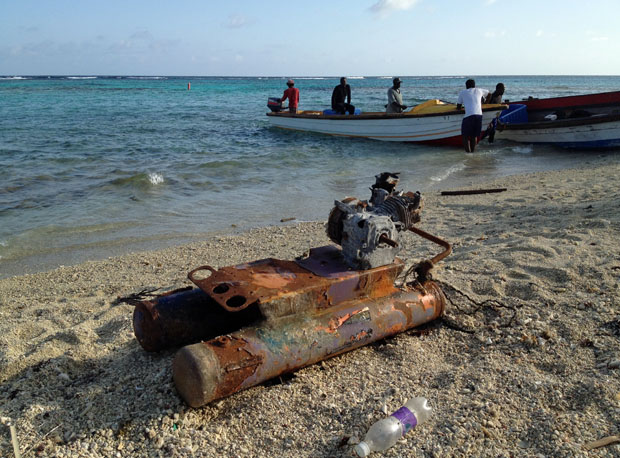
Experienced divers can stay down for two or three hours, using elastic-powered pole spears to collect a fish every few seconds. Some wear thin wetsuits, but not many bother with decompression stops or surface intervals. The technique is much more efficient than free (breath-holding) diving and has slowly been replacing free diving since it was introduced to Jamaica by Hondurans in the late ‘80s and early ‘90s. Compressors let divers fish at night, too, when many species like parrotfish are sleeping, although this was recently made illegal throughout Jamaica.
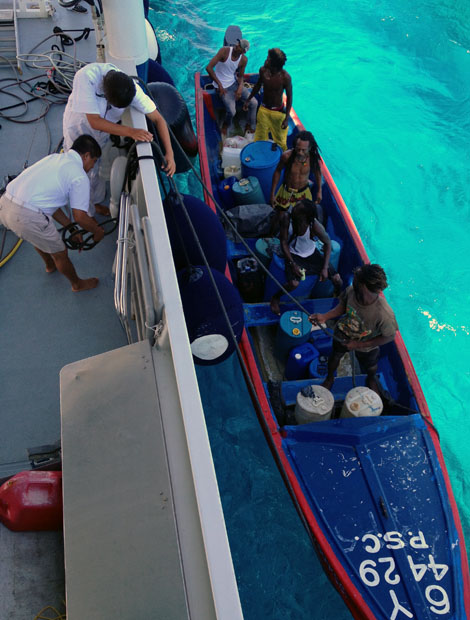
For most of the last few days, fishing boats have been stopping by the Golden Shadow to fill up with water. The ship’s reverse-osmosis desalinators can convert up to 50,000 liters (13,200 gallons) of salt water into fresh water every day, and since we don’t need that much, Captain Steve Breen been generous with our supplies.
(Photos/Images by: 1-3 Julian Smith)
To follow along and see more photos, please visit us on Facebook! You can also follow the expedition on our Global Reef Expedition page, where there is more information about our research and team members.