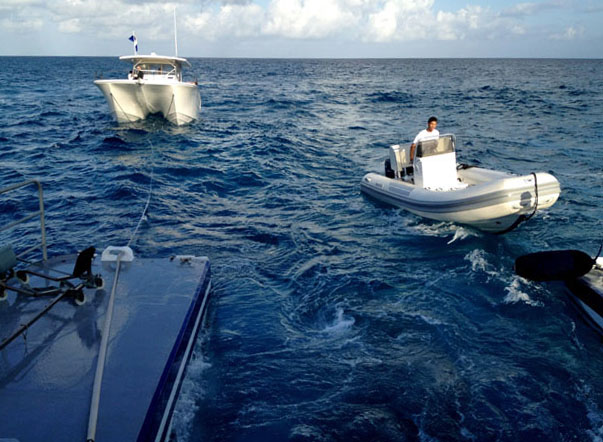
The swells had the final word today: we made only one dive, in the morning, off a rollicking Calcutta. The boat spent a few hours after lunch looking for a site that was protected from the swells and also had healthy coral, but no luck. So by 3 p.m. everyone was back on the Golden Shadow, which was rolling enough itself that the Captain decided to move the anchor slightly closer to Southwest Cay to keep the motion to a minimum. (You can estimate the size of the swells by what’s falling over on the dining table. Salt and pepper shakers = small, salad dressing = medium. Glasses tumbling? Big.)
At the after-dinner meeting, the researchers described what they have seen so far and their impressions, three days and four dives into the expedition. Dave Grenda, an expert on reef fish, said the fish diversity wasn’t as high as he’d hoped—although we’ve seen more sharks in four dives in Jamaica than in 30 dives in the Bahamas (which could be partly luck).
Caribbean Fish Surveys
Dave is lending his skills to two different Caribbean fish surveys on this trip. The first is for the Atlantic Gulf Rapid Reef Assessment, spearheaded here by Judy Lang and Ken Marks. AGRRA is a group effort by over 100 researchers and resource managers to find out how reefs are doing in the Caribbean, the Western Atlantic and the Gulf of Mexico, and to record their findings in a regional database. At last count they had assessed 819 reef areas in 39 places.
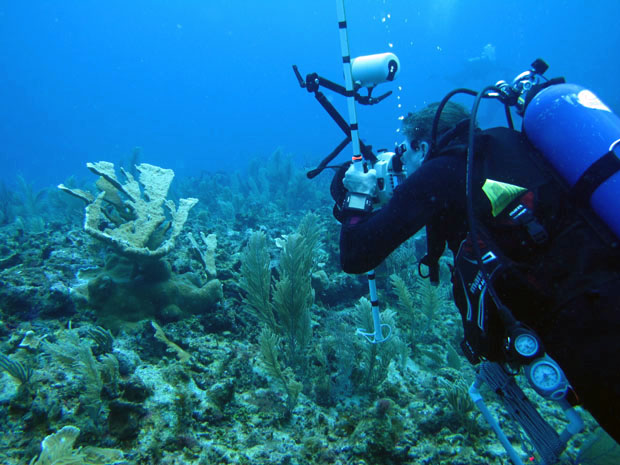
For AGRRA, Dave is doing 30-meter transects, looking for fish on a list of target species that are either commercially important, like groupers and jacks, or have an impact on the ecosystem, like grunts, surgeonfish and other herbivores. Dave swims down the line and records which of those species are present, from the bottom to the surface, and how large they are. Since the guidelines say a transect should take roughly six minutes, this obviously takes a quick eye and the occasional experienced estimate when schools dart past. The idea is to get data on the total species biomass, so a little uncertainty is acceptable sometimes.
Dave’s fish-ID job number two is one anyone can participate in: the REEF Environmental Education Foundation’s Tropical Western Atlantic Fish Survey. This volunteer effort already has a database of 150,000 surveys taken by divers and snorkelers from Canada to the Caribbean. Whatever’s visible is fair game, and there’s no transect line to follow or study area to stay inside, just swimming around, identifying and counting fish. The goal is to record specific species and their numbers, from a single fish to “a few” (2-10), “many” (11-100), and “abundant” (>100).
On a single dive, Dave typically completes four AGRRA transects and then pulls out his REEF checklist. (AGRRA species automatically go on that list too.) Small fish, like blennies and gobies, are always a challenge, he says, and parrotfish were tough at first, since they change colors as they grow and also when they change sex. He likens the experience to birdwatching, complete with life lists and the thrill of finding something where it isn’t expected. The REEF list comes along on recreational dives too, he says. “If I’m just looking I feel like I’m missing something.” Since he’s been doing Caribbean fish surveys so long, it’s hard to find a species he hasn’t seen before. “If I find ten new species a year, I’m ecstatic.”
Speaking of fish, we’ll soon be talking about one that’s gaudy, venomous and wreaking havoc on reefs from the mid-Atlantic to the Caribbean. Any guesses?
(Photos/Images by: 1-2 Julian Smith, 3 Sean Green)
To follow along and see more photos, please visit us on Facebook! You can also follow the expedition on our Global Reef Expedition page, where there is more information about our research and team members.