
search-icon
Huahines’ Reefs: Home for the Small Ones

At first sight, Huahines’ reefs appeared to lack vertical relief; the bottom was barren and without much life. It was obvious to all of us that a disturbance had impacted these reefs sometime in the past.  Locals indicated it was the result of an invasion of hungry crown-of-thorn-sea stars in 2008 and a cyclone in 2010.

A closer look at Huahines’ reefs over the last couple of days, however, immersed us in a world of miniature creatures. A wide variety of young and healthy-looking corals thrived in the small crevices and crannies, and thousands of tiny fish constantly emerged from invisible refuges, crowding the blue water column like swarms of busy bees.
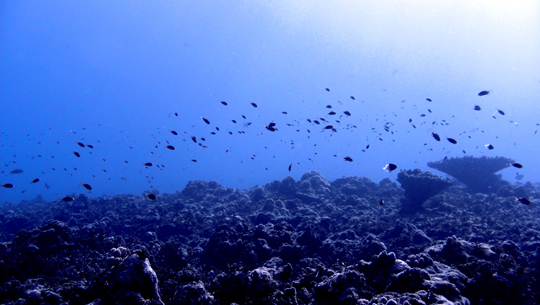
Tiny fish in the water column of Huahines' reefs
Tiny fish in the water column of Huahines’ reefs

Huahines’ reefs are perhaps not the safest place for large fish, since there are virtually no places to hide. But for small fish and juveniles of larger species, like these Nemateleotris magnifica, a pile of rubble is more than a home, it’s a palace for four!
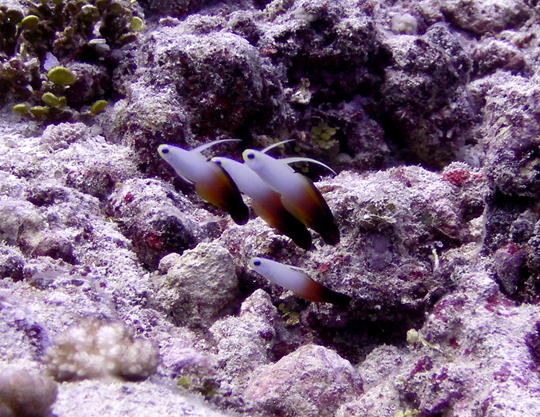
Nemateleotris magnifica fish x 4


This butterflyfish, for example, found a safe place to escape my camera lens, retreating into a hole where I could hardly fit my thumb. This small hole will provide a safe refuge until it reaches a larger size, and can venture out safely to feed on coral polyps.
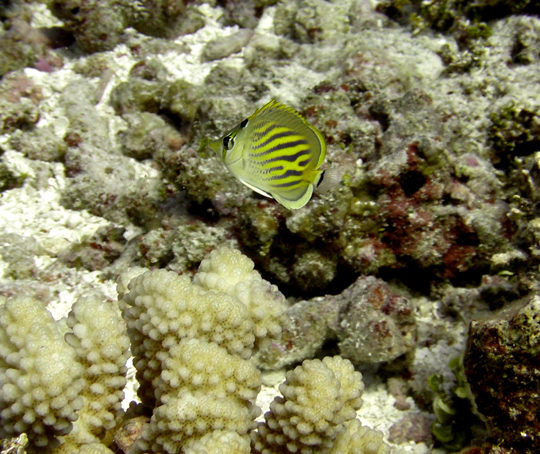
A tiny butterflyfish


The wide variety of tiny life forms thriving on Huahines’ reefs was a lesson for our divers’ eyes, who were accustomed to healthy and colourful-looking reefs with large corals and large fishes. Although the reef appeared degraded from a distance, the landscape was scattered with juvenile corals that should  grow up in a few years time and carpet the bottom. Huahines’ reefs remind us that not only healthy reefs, but also those that are on a slow path to recovery, must get all our help and protection to ensure they can rebound and provide a home for larger fish in the future.

(Photos by: Dr. Sonia Bejarano)

To follow along and see more photos, please visit us on Facebook! You can also follow the expedition on our Global Reef Expedition page, where there is more information about our research and team members.
Related Posts

After the Storm: Standing with Our J.A.M.I.N. Family in Jamaica

There are moments in this work that feel heartbreakingly familiar.

Two weeks after we completed our Jamaica Awareness of Mangroves in Nature (J.A.M.I.N.) programming, Hurricane Melissa made landfall. A powerful Category 5 hurricane, Melissa is now tied with Hurricane Allen in 1980 for the strongest winds ever recorded in an Atlantic storm. Like Hurricane Dorian, which devastated The Bahamas in 2019, Melissa will be remembered as one of the strongest hurricanes on record in the region.

For 11 years, the University of the West Indies Discovery Bay Marine Laboratory and William Knibb Memorial High School have been more than program partners. They have welcomed us into their classrooms and labs, shared meals and laughter, and committed themselves to educating their students about mangroves and coastal resilience. These colleagues and students are not distant collaborators. They are family.

And they were hit hard…

Read More

B.A.M. Turns 10: A Year of Milestones, Resilience, and Growth

The 2025–2026 academic year was one of those defining years for our Bahamas Awareness of Mangroves (B.A.M.) and Jamaica Awareness of Mangroves in Nature (J.A.M.I.N.) programs. It was a year marked by celebration, challenge, growth, and powerful full-circle moments, and a reminder of why mangrove education matters.

In The Bahamas, B.A.M. reached a major milestone: ten years of partnership and environmental education in Abaco. Since 2015, in collaboration with Friends of the Environment, we have worked alongside Patrick J. Bethel High School and Forest Heights Academy to bring hands-on mangrove science into classrooms and into the field. This year, we were proud to expand the program to S.C. Bootle High School, increasing access for students who live…

Read More
Privacy Overview

This website uses cookies so that we can provide you with the best user experience possible. Cookie information is stored in your browser and performs functions such as recognising you when you return to our website and helping our team to understand which sections of the website you find most interesting and useful.  You can view our complete Privacy Policy here.

Strictly Necessary Cookies

Most of our cookies are used to improve website security and reduce spam. These cookies should be enabled at all times. They also enable us to save your preferences for cookie settings.

3rd Party Cookies

This website uses Google Analytics to collect anonymous information such as the number of visitors to the site, and the most popular pages. Keeping this cookie enabled helps us to improve our website.