For our third dive of the day we surveyed a submerged mid shelf reef, adjacent and west of a deep water channel that bisects the Farasan Banks. As I descended to the bottom, something seemed amiss. Unlike the crystal clear, aquamarine waters of other reefs we examined today, visibility was poor and the water had a greenish tint. Approaching the reef, evidence of mortality was disconcerting.
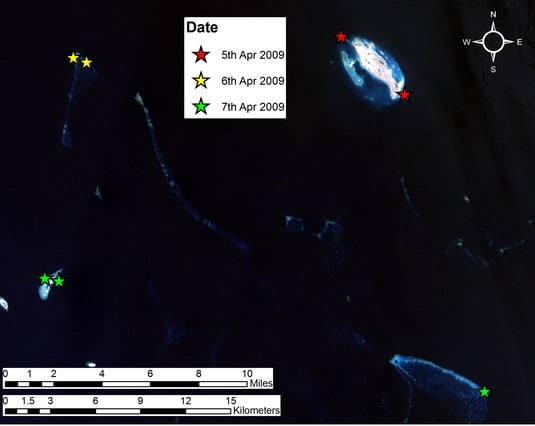
The star in the lower right shows the location of the recovering reef.
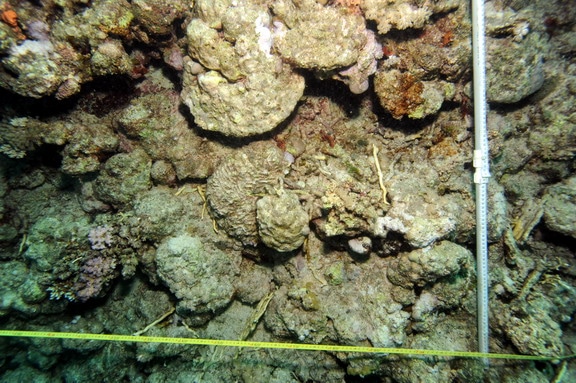
Large, one to two meter table acroporids, still in growth position, were completely dead. The reef framework, consisted primarily of columnar Porites, along with other massive corals like Goniastrea, Diploastrea and Favia, all of which had all died within the last 2-3 years. Vertical surfaces in deeper water were covered with colonies of the plating coral Pachyseris, often 1-2 meters in diameter, also dead. What appeared to have once been a flourishing reef was now largely dead, and the only color was provided by the encrusting sponges and green rope sponges, isolated soft corals (Dendronepthya), fire coral, a few patches of coralline algae and brilliant red cyanobacterial mats.
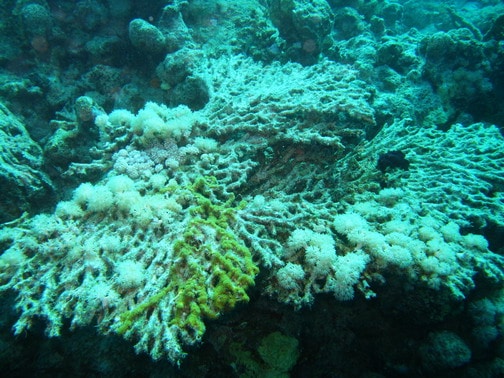
Dead table Acropora colonized by soft corals.
I ran out a transect tape to assess coral cover, and found that living coral cover was now less than 1% in most locations, while dense mats of soft corals (Xenia) and other invertebrates had colonized much of the available substrate.
What could have happened? Was it climate related? The first thought was that the reef had bleached due to a temperature anomaly, and then died. However, other reefs in the area appear to be healthy and vibrant, with high coral cover. There were also a few isolated colonies of Galaxea, lobate Porites and Diploastrea colonies in shallow water that had survived, some up to 2-4 meters in height or diameter.
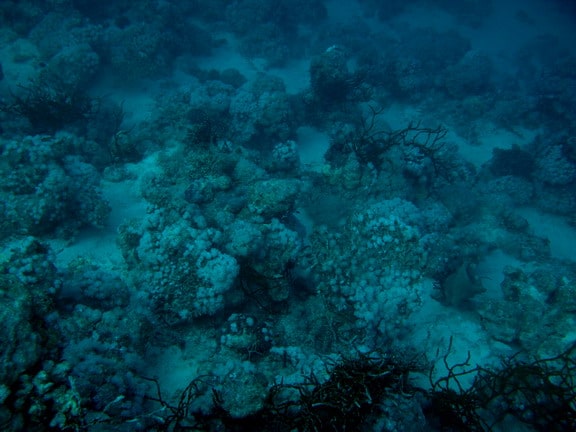
Dead Porites framework at 20 m depth.
Could the reef been affected by an outbreak of voracious crown of thorns (COTS) sea stars (Acanthaster)? There were no sea stars to be found, although we did see several on an earlier dive. But one would not expect to find COTs here since there was little remaining food and the disturbance occurred several years earlier.
While the exact cause may be difficult to pinpoint, more importantly, I was interested in knowing if the reef had a chance for recovery.
Typical photoquadrat at 10 m depth.
Taking a closer look, it was apparent that some corals were still surviving. A number of the massive and plating corals had experienced near total mortality, yet there were numerous tissue remnants. These were often at the base of the coral head, but also within the surface of the corallum, and many appeared to be slowly resheeting over their skeleton.
Other corals, in particular Pocillopora, appeared to have begun to recolonize the reef. There were numerous small colonies (10-20 cm in diameter) of this species that likely settled 3-4 years ago. Some of these showed signs of recent mortality, mostly from Drupella snails, but partial mortality to this species from corallivores appears to be a fairly common occurrence on Saudi Arabian reefs and the snails were not unusually abundant.
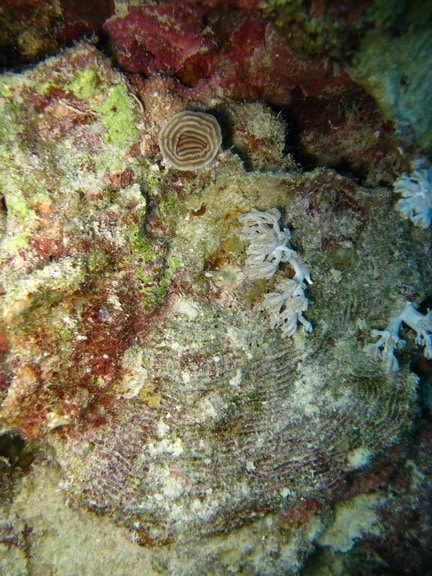
Small remnant of Pachyseris in upper right. The remainder of colony is dead.
Using a small quadrat (0.25 sq. m), I began counting juvenile (1-5 cm diameter) corals. While these colonies are not readily apparent from a distance, they were unusually abundant and included many of the species that formerly dominated this reef. There were many juvenile acroporids, Pocillopora, Porites, Goniastrea, Favia, Pavona and other taxa.
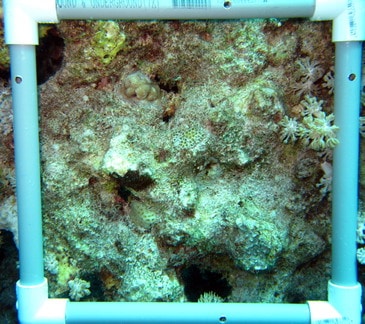
Small quadrat with juvenile corals.
Two of the scientists in our group had similar observations. Using a special NightSea FL-1 flashlight and a BlueBlock Filter Visor on their mask, they were able to count fluorescing coral recruits that are too small to see without magnification.
Even though most of the large corals had died, this site exhibited coral recruitment that was up to 10 fold higher than seen at other sites (up to about 100 recruits per square meter).
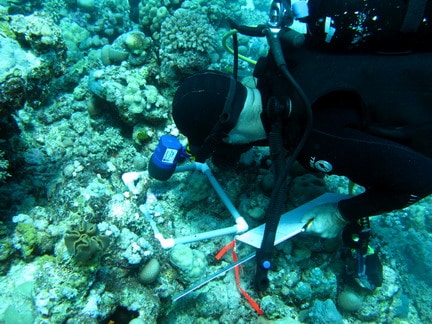
Dr. Riegl identifying fluorescent coral recruits.
Given the high rates of recruitment, large numbers of juvenile corals, as well as an unusually high number of herbivorous fish, this site is exhibiting rapid rates of recovery, and we anticipate high coral cover could be restored within the next five years.
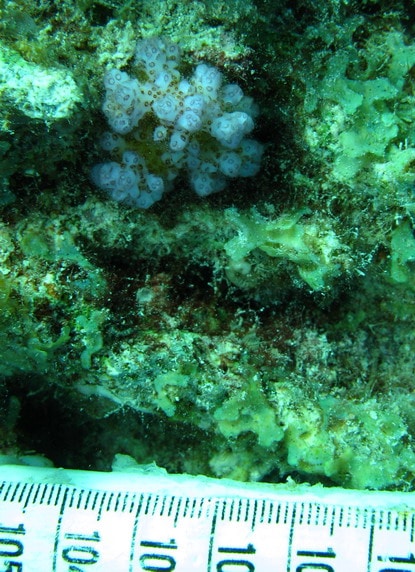
Juvenile colony of Pocillopora.
Tomorrow we plan to explore other nearby reefs, including two sites along the same bank, several kilometers away, to better characterize the spatial patterns of coral mortality, recovery and resilience of this system.