search-icon
Sea Snakes Galore!

Yesterday, while exploring a nearby island, Dive Safety Officer, Nick Cautin, spotted 15 sea snakes on the beach!  We seem to be seeing them everywhere – on land, SCUBA diving, and even on the aft deck of the M/Y Golden Shadow (our research vessel). You may recall from our previous blog that sea snakes are air breathing reptiles that inhabit both the land and sea.  Read more about sea snakes in our past blog https://livingoceansfoundation.org/snakes-2/.
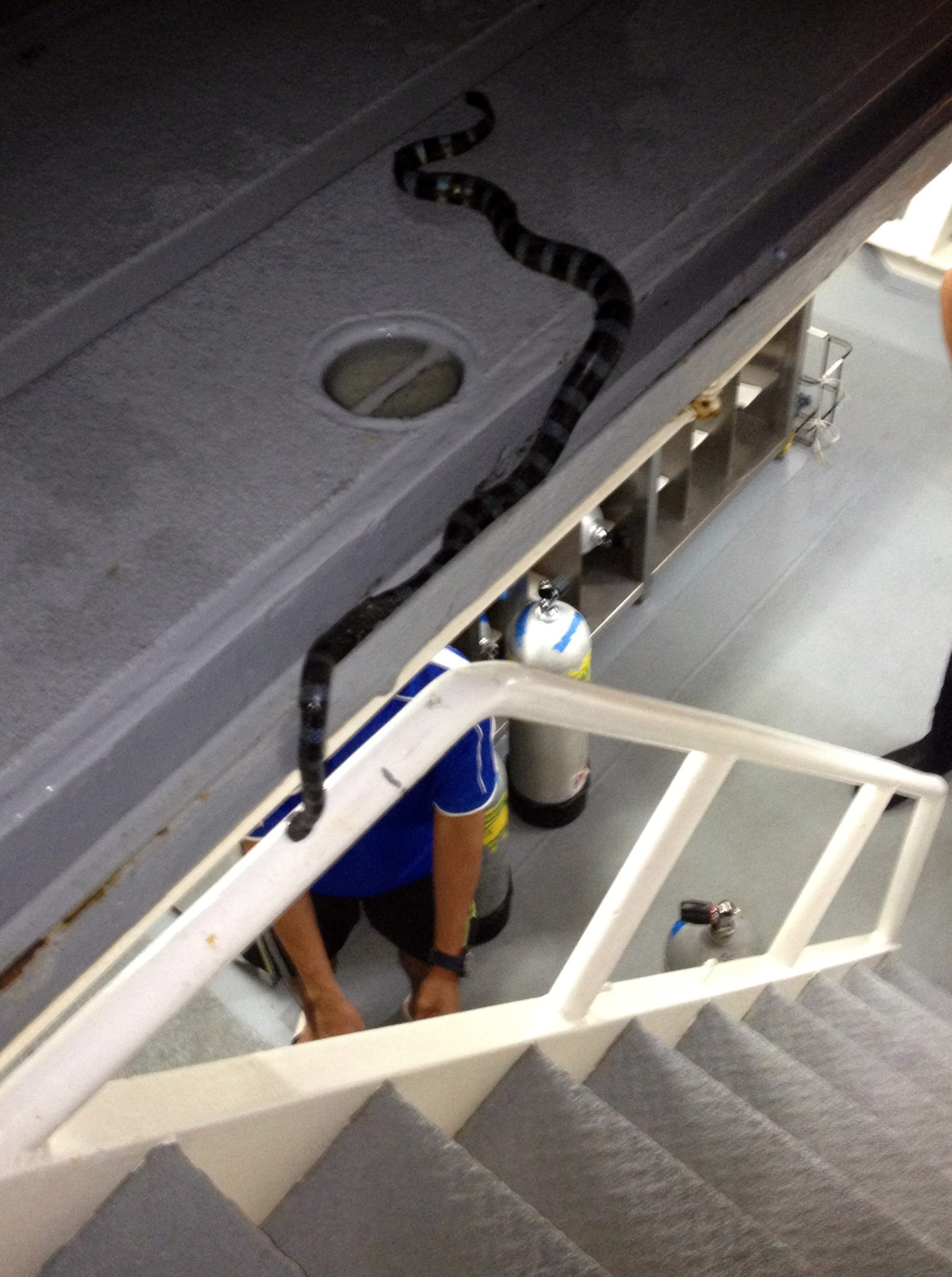
Blue-banded sea snake on board the M/Y Golden Shadow during New Caledonia mission.
Blue-banded sea snake, Lauticada lauticadata, on board the M/Y Golden Shadow heading toward the dive locker.

Species of Sea Snakes in New Caledonia

Why do there seem to be so many? It seems that this area of New Caledonia may be a hotspot for these snakes. There are thought to be twelve species of sea snakes that occur in New Caledonia. So far, we have seen four different species including the blue-banded sea snake, Lauticada lauticadata; the banded sea krait, Laticauda colubrina; the golden sea snakeAipysurus laevis; and the turtle-headed sea snake, Emydocephalus annulatus.
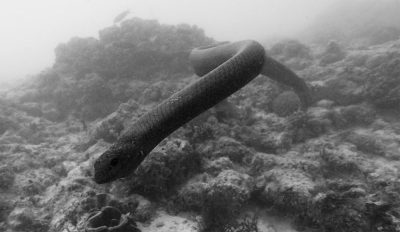
Species of sea snakes: Golden sea snake
Aipysurus laevis,  golden sea snake seen perusing the reef.


Scientific Diver, Ken Marks, was the first to spot the turtle-headed snake while it was sheltering in a small crevice in the reef. As the dive continued, five more were seen swimming around the reef. Though common in New Caledonia, this is the first time the turtle-headed sea snake has been seen on the Global Reef Expedition.
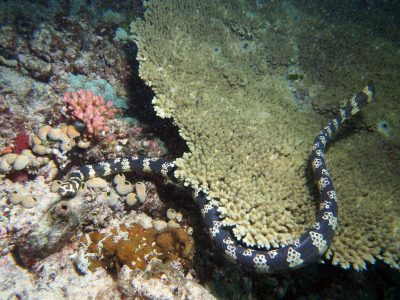
Turtle-headed sea snake above a table acroporid.
Turtle-headed sea snake above a table acroporid

Turtle-headed sea snakes are commonly found throughout the Indo-Pacific; however, studies show that these snakes continuously return to the same area. They may continue to return to this area due to the many beaches and nesting places that make up their habitat. Additionally, there are lots of lagoonal areas with lots of food.  Studies have also shown that this species of sea snakes feeds primarily on fish eggs, unlike the banded sea krait that feeds on small fish and eels.
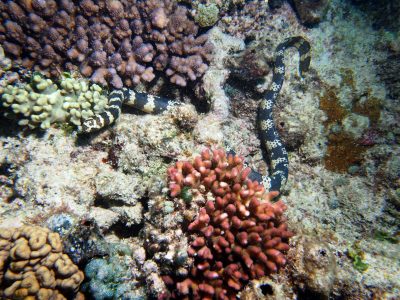
Turtle-headed sea snake, Emydocephalus annulatus, swimming around the reef.

With a little more luck, we will continue see these remarkable and mysterious creatures on our scientific dives as we carry on with our mission in New Caledonia.

Photos by: 2 Serge Andrefouet; 3-4 Andrew Bruckner
Related Posts

Introducing Our New Website: A Fresh Look for the Foundation’s Future

As we celebrate the Khaled bin Sultan Living Oceans Foundation’s 25th anniversary, we are proud to unveil our newly redesigned website—a modern home for our science, conservation work, and educational programs. This launch marks an important moment for the Foundation as we honor our long history and look toward the future of ocean conservation.

For more than two decades, the Foundation has worked tirelessly to improve the health of our living oceans. We have advanced ocean science, led one of the largest coral reef research missions in history, restored mangrove forests with local communities, created award-winning education programs, and shared the wonders of the ocean with people around the world. Our new website reflects the organization we are today—focused on conserving coral reefs, restoring mangrove forests, and improving ocean literacy—while still highlighting the legacy of work that brought us here.

The redesigned site…

Read More

Connecting People, Art, and Oceans: Championing Conservation at the 2025 IUCN Congress

The IUCN World Conservation Congress brings together thousands of leaders and decision-makers from governments, non-profit organizations, civil society, Indigenous groups, and the private sector to shape global conservation policy and action. This influential gathering serves as a platform to share knowledge, build partnerships, and advance initiatives that protect our planet’s biodiversity.

As a member of the International Union for Conservation of Nature (IUCN), the Khaled bin Sultan Living Oceans Foundation was honored to take part in the Congress, joining a global community of leaders, organizations, and changemakers committed to protecting nature and advancing sustainable futures.

Read More
Privacy Overview

This website uses cookies so that we can provide you with the best user experience possible. Cookie information is stored in your browser and performs functions such as recognising you when you return to our website and helping our team to understand which sections of the website you find most interesting and useful.  You can view our complete Privacy Policy here.

Strictly Necessary Cookies

Most of our cookies are used to improve website security and reduce spam. These cookies should be enabled at all times. They also enable us to save your preferences for cookie settings.

3rd Party Cookies

This website uses Google Analytics to collect anonymous information such as the number of visitors to the site, and the most popular pages. Keeping this cookie enabled helps us to improve our website.