search-icon
Sea Snakes Galore!

Yesterday, while exploring a nearby island, Dive Safety Officer, Nick Cautin, spotted 15 sea snakes on the beach!  We seem to be seeing them everywhere – on land, SCUBA diving, and even on the aft deck of the M/Y Golden Shadow (our research vessel). You may recall from our previous blog that sea snakes are air breathing reptiles that inhabit both the land and sea.  Read more about sea snakes in our past blog https://livingoceansfoundation.org/snakes-2/.
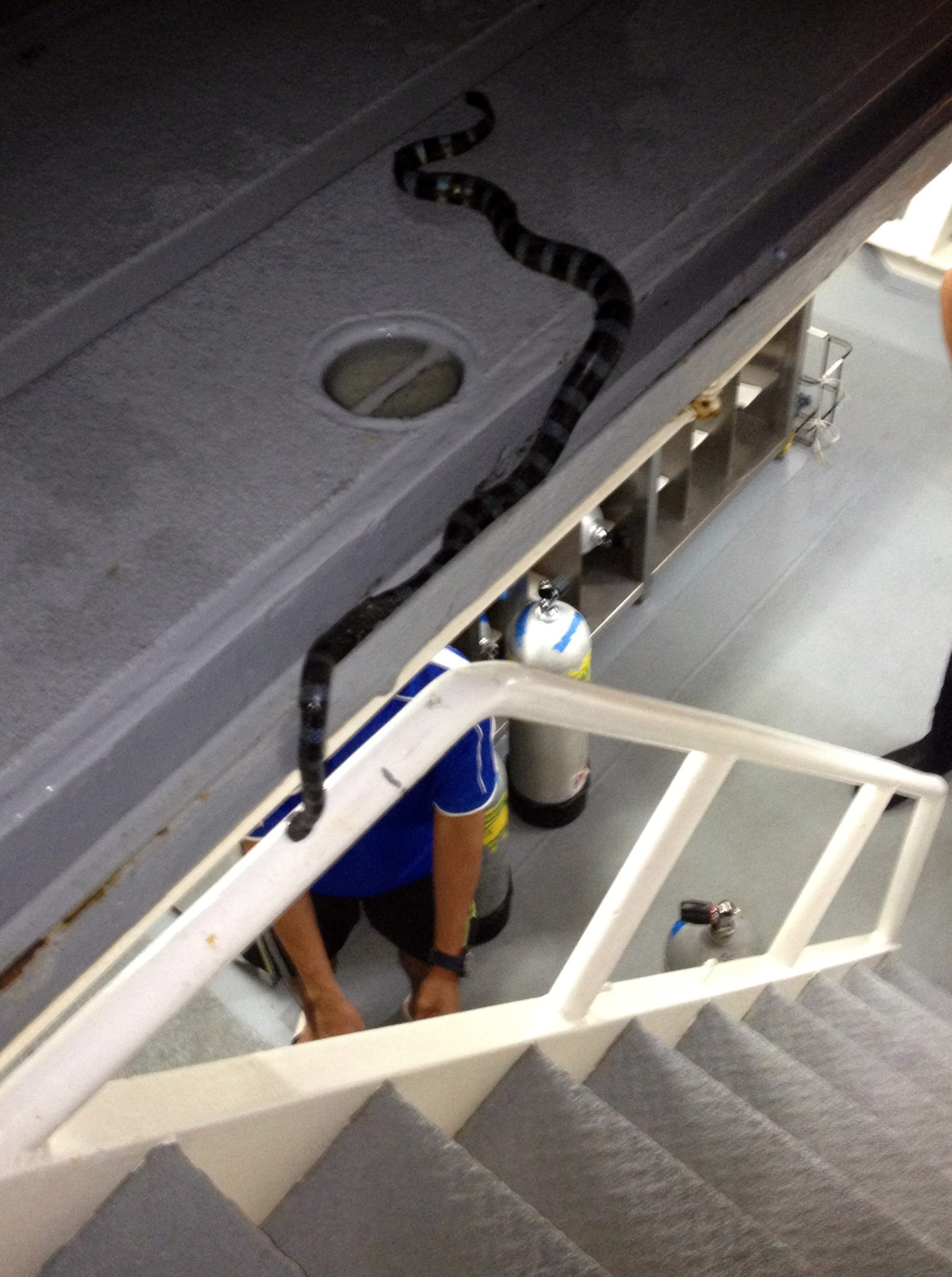
Blue-banded sea snake on board the M/Y Golden Shadow during New Caledonia mission.
Blue-banded sea snake, Lauticada lauticadata, on board the M/Y Golden Shadow heading toward the dive locker.

Species of Sea Snakes in New Caledonia

Why do there seem to be so many? It seems that this area of New Caledonia may be a hotspot for these snakes. There are thought to be twelve species of sea snakes that occur in New Caledonia. So far, we have seen four different species including the blue-banded sea snake, Lauticada lauticadata; the banded sea krait, Laticauda colubrina; the golden sea snakeAipysurus laevis; and the turtle-headed sea snake, Emydocephalus annulatus.
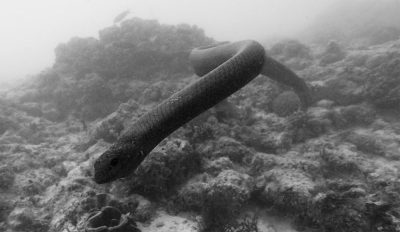
Species of sea snakes: Golden sea snake
Aipysurus laevis,  golden sea snake seen perusing the reef.


Scientific Diver, Ken Marks, was the first to spot the turtle-headed snake while it was sheltering in a small crevice in the reef. As the dive continued, five more were seen swimming around the reef. Though common in New Caledonia, this is the first time the turtle-headed sea snake has been seen on the Global Reef Expedition.
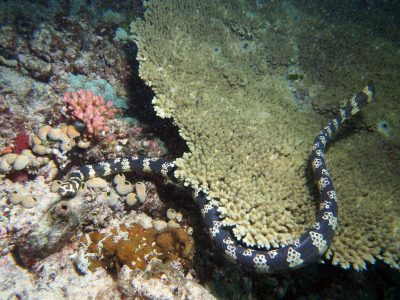
Turtle-headed sea snake above a table acroporid.
Turtle-headed sea snake above a table acroporid

Turtle-headed sea snakes are commonly found throughout the Indo-Pacific; however, studies show that these snakes continuously return to the same area. They may continue to return to this area due to the many beaches and nesting places that make up their habitat. Additionally, there are lots of lagoonal areas with lots of food.  Studies have also shown that this species of sea snakes feeds primarily on fish eggs, unlike the banded sea krait that feeds on small fish and eels.
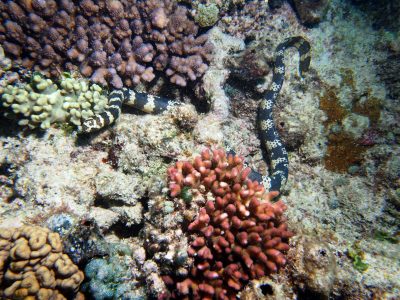
Turtle-headed sea snake, Emydocephalus annulatus, swimming around the reef.

With a little more luck, we will continue see these remarkable and mysterious creatures on our scientific dives as we carry on with our mission in New Caledonia.

Photos by: 2 Serge Andrefouet; 3-4 Andrew Bruckner
Related Posts

2025-2026 B.A.M. Student Voices

Throughout the Bahamas Awareness of Mangroves (B.A.M.) and Jamaica Awareness of Mangroves in Nature (J.A.M.I.N.) programs, we evaluate each phase of the mangrove education and restoration process to better understand how students are learning, growing, and connecting with their coastal environments.

Before the programs begin, students share what they already know about mangroves and how they feel about them. As the program progresses, we continue to gather feedback to see how their knowledge evolves from identifying mangrove species and understanding food webs to recognizing the role mangroves play in coastal protection and climate change mitigation.

But the surveys go beyond science content.

We also ask students…

Read More

Ten Years of B.A.M.: Rooted in Partnership, Growing in Purpose

Ten years ago, the Bahamas Awareness of Mangroves (B.A.M.) program began with a simple but meaningful commitment: to connect Bahamian students with the mangrove ecosystems that shape and protect their island home.

Since 2015, B.A.M. has been implemented in partnership with Friends of the Environment, whose dedication to environmental stewardship in Abaco has made this program possible year after year. Together, we have worked alongside Patrick J. Bethel High School and Forest Heights Academy to bring hands-on mangrove science into classrooms and out into the field.

What makes ten years remarkable is not just longevity — it is consistency…

Read More