
search-icon
Seeing Pink Spots

When we entered the water for our first research dive at Wolf island, the first thing we saw were thousands upon thousands of fish. The fish were so numerous it made seeing the bottom difficult. Underneath the clouds of fish the dominant species of coral was Porites lobata, a lobed pore coral. This species forms massive, helmet-shaped or hemispherical colonies that can exceed 3 m in diameter and 2 m high.
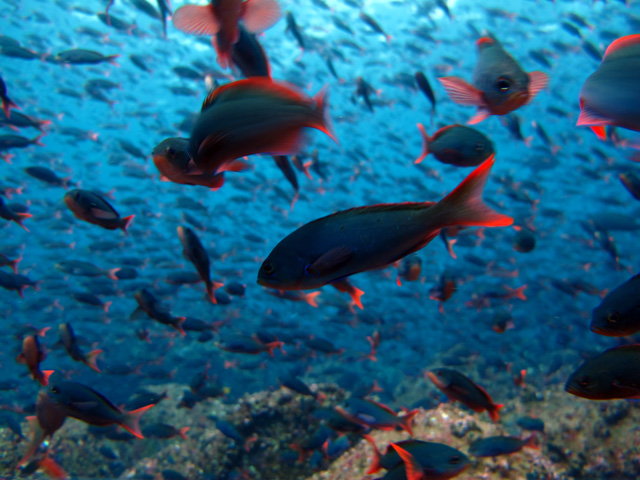
Thick schools of fish

This long-lived coral is slow growing  (1-2 cm/year), but is generally more resistant to diseases and bleaching than other corals.  It recovered fairly quickly from two severe El Niño events (1982-1983 and 1997-1998) and it is the dominant species around both Wolf and Darwin Islands.
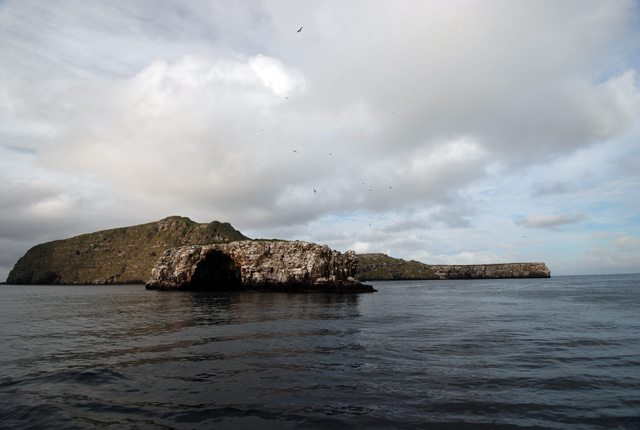
Wolf Island
Wolf Island

This coral is a favorite of coral eating fish, and the colonies we saw were typically covered with bite marks.  In addition to numerous small excavations from fishes, we noted that a high proportion of the colonies have discolored patche, spots, and bands that range in color from pink to blue.  Scientists have seen these kind of pink spots discoloration in other areas.
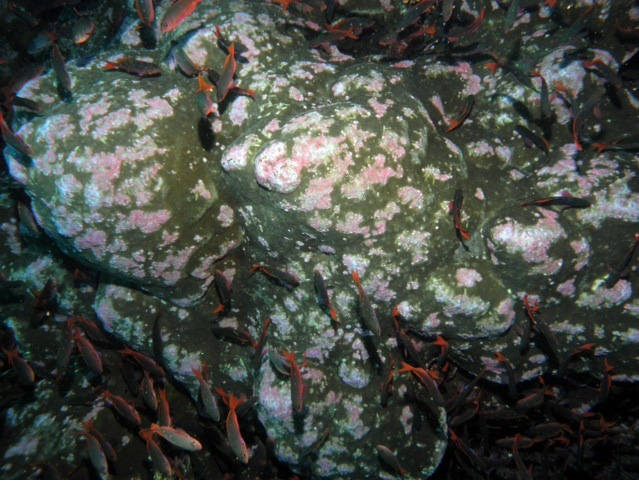
Pink spots covering most of this coral

In Hawaii, the genus Porites is frequently infected with trematodes.  In response to the infection, the coral develops a small nodule, pink in color, to encase the parasite.  These pink spots are selectively preyed upon by butterflyfish, which serve as a host for one life stage of the trematode.
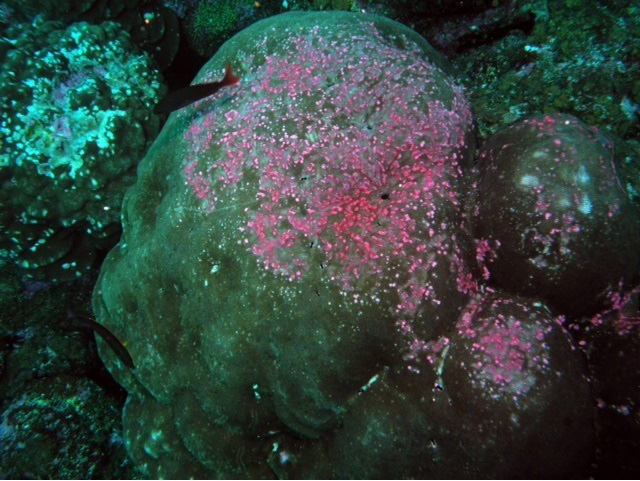
Pink spots
Pink spots

Recently, a new disease called pink line disease emerged on Porites colonies from the Arabian Gulf.  There is considerable dispute of the origin of these pink spots and bands, as they can also be caused by any irritation caused by a fish bite, algal abrasion, barnacles, polychaete tube, and other invertebrates.  One thought is that this is a stress response of the coral, and the discolored area may actually serve as a barrier, protecting unaffected parts of the colony.
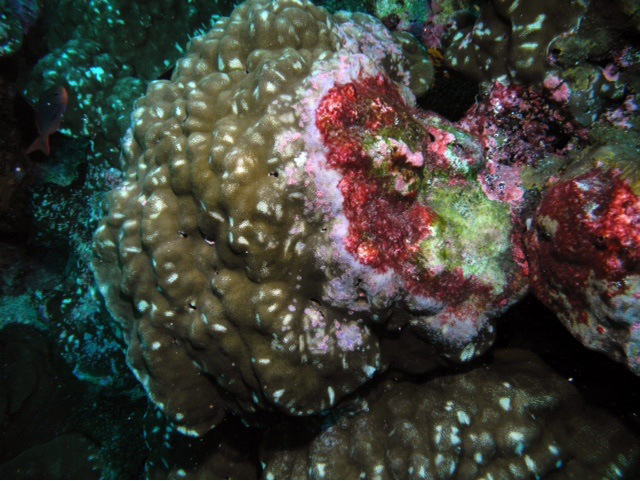
Pink spots in the form of a line

We observed an unusually high prevalence of pink spots and bands during our surveys at Darwin and Wolf Islands, much higher than that reported in the past.  These have a wide variation in appearance and may be associated with obvious injuries and fish bites. We also saw the discoloration forming more of a characteristic band-like pattern that is advancing across the coral, denuding tissue behind it.  To better understand the causes and effects of these pink spots on the colony, Dr. Andrew Bruckner collected tissue samples, which he will examine using histology.
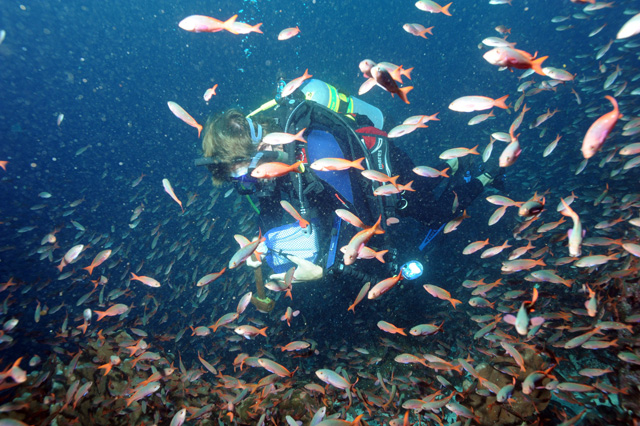
Dr. Bruckner collects samples at Wolf Island
Dr. Bruckner collecting samples at Wolf Island

(Photos by: 1 Dr. Brian Beck, 2 Alison Barrat, 3-5 Dr. Andy Bruckner, 6 Dr. Brian Beck)

To follow along and see more photos, please visit us on Facebook!  You can also follow the expedition on our Global Reef Expedition page, where there is more information about our research and team members.
Related Posts

After the Storm: Standing with Our J.A.M.I.N. Family in Jamaica

There are moments in this work that feel heartbreakingly familiar.

Two weeks after we completed our Jamaica Awareness of Mangroves in Nature (J.A.M.I.N.) programming, Hurricane Melissa made landfall. A powerful Category 5 hurricane, Melissa is now tied with Hurricane Allen in 1980 for the strongest winds ever recorded in an Atlantic storm. Like Hurricane Dorian, which devastated The Bahamas in 2019, Melissa will be remembered as one of the strongest hurricanes on record in the region.

For 11 years, the University of the West Indies Discovery Bay Marine Laboratory and William Knibb Memorial High School have been more than program partners. They have welcomed us into their classrooms and labs, shared meals and laughter, and committed themselves to educating their students about mangroves and coastal resilience. These colleagues and students are not distant collaborators. They are family.

And they were hit hard…

Read More

B.A.M. Turns 10: A Year of Milestones, Resilience, and Growth

The 2025–2026 academic year was one of those defining years for our Bahamas Awareness of Mangroves (B.A.M.) and Jamaica Awareness of Mangroves in Nature (J.A.M.I.N.) programs. It was a year marked by celebration, challenge, growth, and powerful full-circle moments, and a reminder of why mangrove education matters.

In The Bahamas, B.A.M. reached a major milestone: ten years of partnership and environmental education in Abaco. Since 2015, in collaboration with Friends of the Environment, we have worked alongside Patrick J. Bethel High School and Forest Heights Academy to bring hands-on mangrove science into classrooms and into the field. This year, we were proud to expand the program to S.C. Bootle High School, increasing access for students who live…

Read More
Privacy Overview

This website uses cookies so that we can provide you with the best user experience possible. Cookie information is stored in your browser and performs functions such as recognising you when you return to our website and helping our team to understand which sections of the website you find most interesting and useful.  You can view our complete Privacy Policy here.

Strictly Necessary Cookies

Most of our cookies are used to improve website security and reduce spam. These cookies should be enabled at all times. They also enable us to save your preferences for cookie settings.

3rd Party Cookies

This website uses Google Analytics to collect anonymous information such as the number of visitors to the site, and the most popular pages. Keeping this cookie enabled helps us to improve our website.