search-icon
Practice Dives: The Team Gets Their Fins Wet

Following our overnight transit from Freeport, the M/Y Golden Shadow pulled into the southeastern corner of Cay Sal Bank known as Anguilla Cay.  It was already mid-afternoon, so the team divided up into three groups to do some prep and scout work, and practice dives.
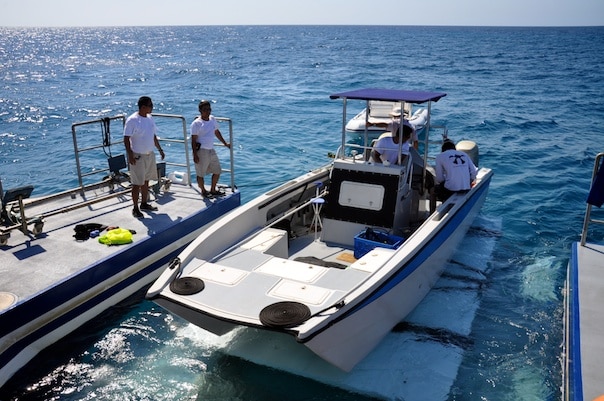
One of the Shadow’s research catamarans launches off the stern.

Dr. Sam Purkis and PhD candidate Jeremy Kerr from the National Coral Reef Institute headed out in their catamaran to do some preliminary testing. They will be launching from the Golden Shadow early in the morning every day to groundtruth sites with their satellite data for large scale mapping of the benthic (bottom dwelling) communities in Cay Sal Bank. Meanwhile Chief Scientist Andy Bruckner, and coral reef experts Judy Lang and Bernhard Riegl set out in a small RHIB with one of the ship’s crew to scout potential dive sites for study over the next few days.
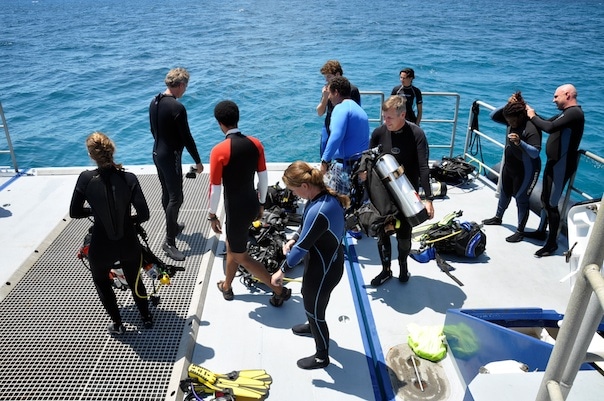
The expedition divers prepare their gear and stage it on the Shadow's stern elevator in readiness for their first practice dives.
The expedition divers prepare their gear and stage it on the Shadow’s stern elevator in readiness for their first practice dives.

Back on the Golden Shadow, the rest of the expedition team put together their dive kits and prepared for a checkout dive with Dive Safety Officer (DSO) Tim Payne off the stern of the Shadow. The 10-meter practice dives gave everyone a chance to check out their dive gear and finally get their fins wet in Cay Sal Bank.
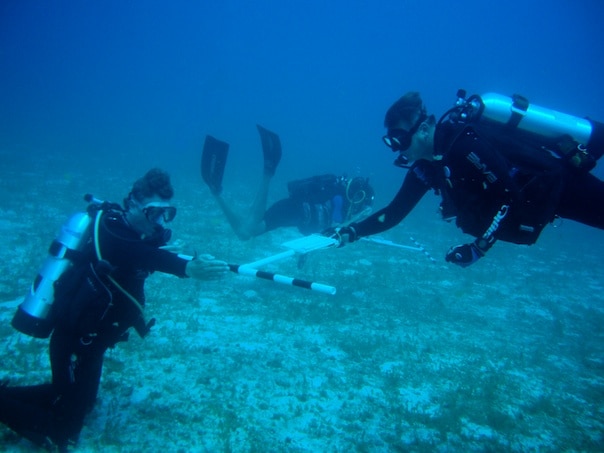
Ken Marks plays the part of the fish for Dave Grenda to survey with the new tool.

The survey team took their newly-made PVC fish surveying tools with them and did practice dives. Unfortunately, there were no fish to be seen at this particular site, so experienced surveyor Ken Marks used his imagination to create “hand-made” fish, allowing the rest of the team to have a chance at practicing their underwater surveying skills with the new tools.

Living Oceans Foundation Fellow Sonia Bejarano took several small GoPro underwater cameras down with her practice dives to set-up for her expedition experiment. She will be investigating the fish that graze on the reef top and are crucial for the reef’s recovery after natural or man-made damage. Part of her research method involves placing up to 10 video cameras on the seafloor in one small area and returning later in the day to retrieve them. She hopes the cameras will allow her to study fish feeding behaviors while they are undisturbed by divers.
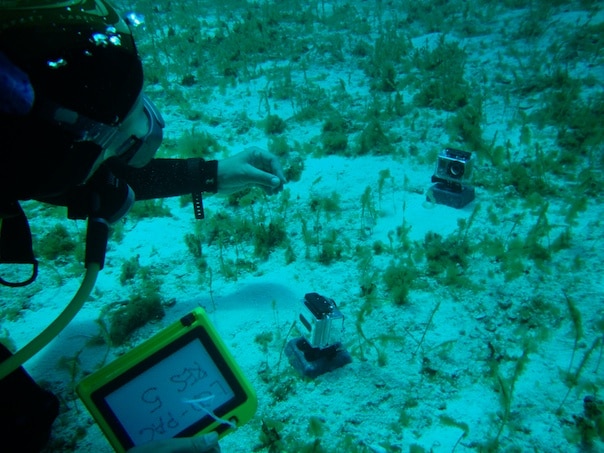
Living Oceans Foundation Fellow Sonia Bejarano conducts a practice run with two of her high-definition video cameras.

The expedition team had a great first day. We arrived on site, scouted the area, conducted practice dives, and spent the rest of the evening preparing for our first research dives in the morning. Tomorrow will mark the first data-collection day of the Global Reef Expedition and we are all excited to roll up our sleeves and get working!

Don’t forget to follow along on Facebook to get blog updates and see more photos! You can also follow the expedition on our Global Reef Expedition main page, where there is more information about our research and our team members.

Post by Liz Smith

(Photo credit: 1, 2. Liz Smith; 3, 4. Leno Davis)
Related Posts

Introducing Our New Website: A Fresh Look for the Foundation’s Future

As we celebrate the Khaled bin Sultan Living Oceans Foundation’s 25th anniversary, we are proud to unveil our newly redesigned website—a modern home for our science, conservation work, and educational programs. This launch marks an important moment for the Foundation as we honor our long history and look toward the future of ocean conservation.

For more than two decades, the Foundation has worked tirelessly to improve the health of our living oceans. We have advanced ocean science, led one of the largest coral reef research missions in history, restored mangrove forests with local communities, created award-winning education programs, and shared the wonders of the ocean with people around the world. Our new website reflects the organization we are today—focused on conserving coral reefs, restoring mangrove forests, and improving ocean literacy—while still highlighting the legacy of work that brought us here.

The redesigned site…

Read More

Connecting People, Art, and Oceans: Championing Conservation at the 2025 IUCN Congress

The IUCN World Conservation Congress brings together thousands of leaders and decision-makers from governments, non-profit organizations, civil society, Indigenous groups, and the private sector to shape global conservation policy and action. This influential gathering serves as a platform to share knowledge, build partnerships, and advance initiatives that protect our planet’s biodiversity.

As a member of the International Union for Conservation of Nature (IUCN), the Khaled bin Sultan Living Oceans Foundation was honored to take part in the Congress, joining a global community of leaders, organizations, and changemakers committed to protecting nature and advancing sustainable futures.

Read More
Privacy Overview

This website uses cookies so that we can provide you with the best user experience possible. Cookie information is stored in your browser and performs functions such as recognising you when you return to our website and helping our team to understand which sections of the website you find most interesting and useful.  You can view our complete Privacy Policy here.

Strictly Necessary Cookies

Most of our cookies are used to improve website security and reduce spam. These cookies should be enabled at all times. They also enable us to save your preferences for cookie settings.

3rd Party Cookies

This website uses Google Analytics to collect anonymous information such as the number of visitors to the site, and the most popular pages. Keeping this cookie enabled helps us to improve our website.