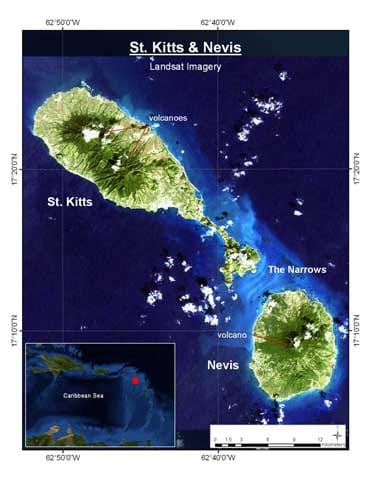
Today we are embarking on the second leg of the Global Reef Expedition. Destination: the Federation of St. Kitts and Nevis (AKA Saint Christopher). The twin islands are part of the West Indies, in the eastern Caribbean, roughly east of Antigua and Barbuda, north of Montserrat and south Saba. Together, having a total landmass of just 262 km2, St. Kitts is slightly larger (168 km2) than Nevis (94 km2). St. Kitts and Nevis are located about 2 miles apart, separated by a shallow channel called the Narrows. They are both volcanic islands; in essence, they are summits of a submerged mountain range which forms the eastern boundary of the Caribbean tectonic plate. These lush islands are known for their dense tropical rainforest, mountain streams and an inland lake, lava formations, white, sandy beaches, and a strong British influence. These islands were home to the first British and French colonies in the Caribbean, achieving full independence in 1983. The total population is about 50,000, with most people residing in St. Kitts (38,000).
Our team is flying into Basseterre, the capital of St. Kitts and Nevis, and also the main commercial and industrial area. Nearby is Basseterre port, located on the southwestern shore of St. Kitts in Basseterre Bay, which will serve as the temporary berth of the M/Y Golden Shadow.
The two-island nation has a fairly small ocean shelf of approximately 845 km2, but it boasts all of the critical marine habitats found in the Caribbean, including mangroves and seagrass beds, fringing coral reefs, and offshore reef ecosystems. It is home to a number of threatened marine animals, including critically endangered elkhorn coral and staghorn coral, migrating marine mammals including humpback whales, sperm whales and several resident dolphin species, three different sea turtles, over 450 species of fishes, queen conch and spiny lobster, to name a few. Of major importance to these species is the Narrows, a shallow area between the two islands that supports extensive seagrass beds that serve as vital breeding grounds and nursery areas for conch, fishes and lobster and a feeding area for hawksbill turtles.
The research our team will conduct over the next two weeks offers a unique opportunity to contribute to the conservation and protection of the marine ecosystem in this two-island nation. A recently completed benthic mapping project, led by our partners from The Nature Conservancy (TNC) and the National Coral Reef Institute (NCRI), identified the extent and distribution of 12 different benthic habitats. These maps were used to draft an island-wide marine zoning plan designed to protect coral reefs, seagrass beds and other critical habitats vital to the Federation’s marine life and economy. Unlike other Caribbean countries, St. Kitts and Nevis has no officially declared marine protected area at this time. Fortunately, as part of PoWPA (Convention on Biological Diversity Program of Work on Protected Areas), and also to fulfill the Caribbean Challenge Initiative, the Federation intends to declare at least 20% of their coastal areas as Marine Protected Areas. Concurrently, they are eager to establish more sustainable management and zoning for the marine ecosystems. Our surveys provide an opportunity to identify critical areas for protection, validate the habitat maps, and collect valuable baseline information on coral reef health and resilience that will be used to help implement their ambitious conservation goals.
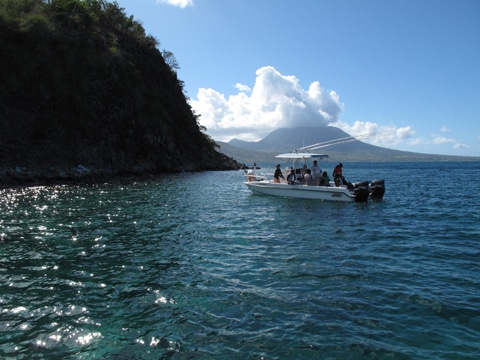
- We plan to implement a national-scale coral reef survey that will target proposed protected areas and strategically-selected offshore areas that should be considered for protection. This work represents the first use of the Atlantic and Gulf Rapid Reef Assessment (AGRRA) protocol in St. Kitts and Nevis, and it will lead to the creation of a standardized protocol for future monitoring and research for the Federation. The extensive surveys we undertake will inform the development of a network of marine protected areas that includes fish sanctuaries, protects larval supplies, fish stocks and critical habitats, and will help enhance the resiliency of the coral reef ecosystems throughout St. Kitts and Nevis.
We are fortunate to have the support of the Government of St. Kitts and Nevis, many eager and talented local scuba divers and scientists from the region to assist with the research, the dedicated commitment of our partners at the Nature Conservancy, and the support and commitment of HRH Prince Khaled bin Sultan. See you underwater!
To follow along and see more photos, please visit us on Facebook! You can also follow the expedition on our Global Reef Expedition page, where there is more information about our research and our team members.
(Images/Photos: 1. Amanda Williams; 2-3. Kathleen Frith)