
search-icon
2023 Science Without Borders® Challenge: Introducing the 15-19 Year-Old Finalists

The response to our Science Without Borders® Challenge has been overwhelming! We’ve been blown away by the sheer number of submissions that we received from aspiring young scientists and artists all over the world. Last week, we proudly unveiled the finalists in the 11-14 age group, and now, we’re ecstatic to announce the finalists in the 15-19 year-old category.

These young artists hail from all corners of the globe, including China, Indonesia, Korea, the Philippines, Poland, Singapore, Spain, the United Kingdom, and the United States. You will be amazed at their incredible artwork and how well they captured the essence of the theme, “The Sixth Extinction.” Students depicted a diverse range of endangered marine animals in their artwork including whales, fish, polar bears, sharks, sea otters, horseshoe crabs, seals, and crocodiles. We were amazed by these students’ boundless creativity, execution of the theme, and artistic abilities.

Without further ado, please meet our talented 15-19 year old finalists! These exceptional artists have not only showcased their incredible talents but also their unwavering passion for marine conservation.

First Place (15-19): "We Are Next" by Boram Shim, Age 16, United States of America
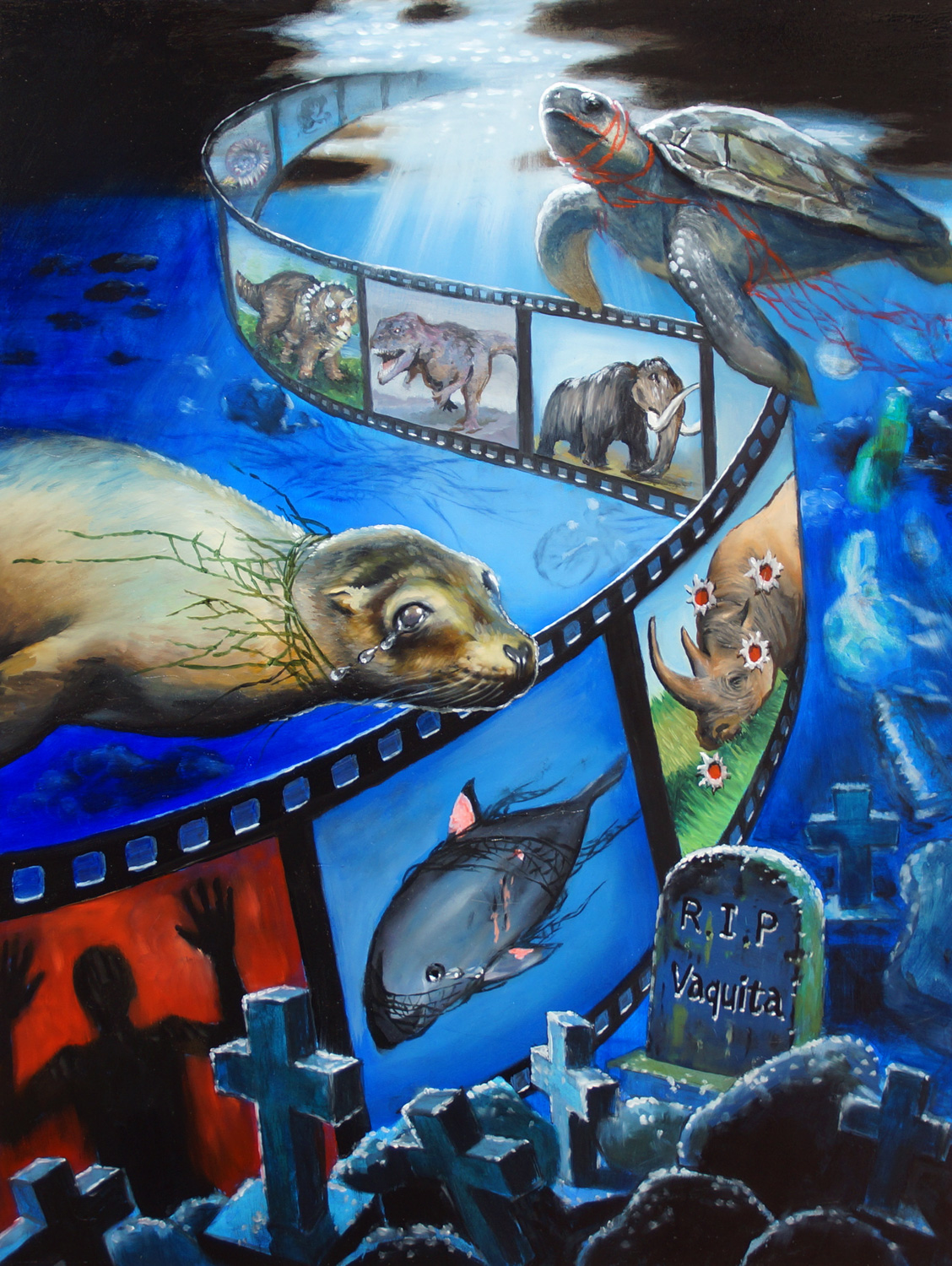
Image 1 of 16

ARTIST’S STATEMENT: Humans would be the ones getting extinct at the end of the sixth extinction. I portrayed the extinct animals, an endangered dolphin, and a person lining up in a film tape as a warning that it will eventually be our turn to be extinct, like a scene in a filmstrip that would inevitably be played in chronological order. Unlike the five previous mass extinctions that occurred due to environmental pressures, “the sixth extinction” is driven by human activities like oil spills, ocean trash, and net entanglements. Vaquita is on the verge of extinction—only ten left—due to illegal fishing and entanglement in gillnets. Moreover, less than 10,000 Kemp’s Ridley Turtles are left due to pollution, overfishing, and humans’ use of artificial light. Furthermore, only 1570 Hawaiian Monk Seals are left due to net entanglements. Finally, tombstones symbolize the deaths of humans following the destruction of marine ecosystems.
Stay tuned! We will announce the winners in the next couple of weeks.

Related Posts

Introducing Our New Website: A Fresh Look for the Foundation’s Future

As we celebrate the Khaled bin Sultan Living Oceans Foundation’s 25th anniversary, we are proud to unveil our newly redesigned website—a modern home for our science, conservation work, and educational programs. This launch marks an important moment for the Foundation as we honor our long history and look toward the future of ocean conservation.

For more than two decades, the Foundation has worked tirelessly to improve the health of our living oceans. We have advanced ocean science, led one of the largest coral reef research missions in history, restored mangrove forests with local communities, created award-winning education programs, and shared the wonders of the ocean with people around the world. Our new website reflects the organization we are today—focused on conserving coral reefs, restoring mangrove forests, and improving ocean literacy—while still highlighting the legacy of work that brought us here.

The redesigned site…

Read More

Connecting People, Art, and Oceans: Championing Conservation at the 2025 IUCN Congress

The IUCN World Conservation Congress brings together thousands of leaders and decision-makers from governments, non-profit organizations, civil society, Indigenous groups, and the private sector to shape global conservation policy and action. This influential gathering serves as a platform to share knowledge, build partnerships, and advance initiatives that protect our planet’s biodiversity.

As a member of the International Union for Conservation of Nature (IUCN), the Khaled bin Sultan Living Oceans Foundation was honored to take part in the Congress, joining a global community of leaders, organizations, and changemakers committed to protecting nature and advancing sustainable futures.

Read More
Privacy Overview

This website uses cookies so that we can provide you with the best user experience possible. Cookie information is stored in your browser and performs functions such as recognising you when you return to our website and helping our team to understand which sections of the website you find most interesting and useful.  You can view our complete Privacy Policy here.

Strictly Necessary Cookies

Most of our cookies are used to improve website security and reduce spam. These cookies should be enabled at all times. They also enable us to save your preferences for cookie settings.

3rd Party Cookies

This website uses Google Analytics to collect anonymous information such as the number of visitors to the site, and the most popular pages. Keeping this cookie enabled helps us to improve our website.