search-icon
Rebirth of the Reef

The genus Acropora includes the most diverse and abundant corals found on Indo-Pacific reefs, with different species displaying a baffling number of growth forms and color varieties. With over 150 species known to science, these corals often out compete all other corals, especially in clear water. Their success is partially due to a fast growth rate (6-15 cm or more per year), ability to spread and recolonize from fragments (and recover quickly following storms), and prolific annual broadcast spawning events. They often form high-relief forests – or thickets- than can extend over hundreds of meters of shallow reef habitat.

Small table coral, Acropora hyacinthusLarger Acropora hyacinthus with two canopy layers
A small table coral, Acropora hyacinthus, and a larger one with two canopy layers.
(Click thru on images for more detail.)

Like other corals, they are susceptible to numerous stressors.  They are frequently smashed by storm waves, are particularly susceptible to predation by crown of thorns sea stars and Drupella snails, and are affected by several diseases such as white syndrome and brown band disease.

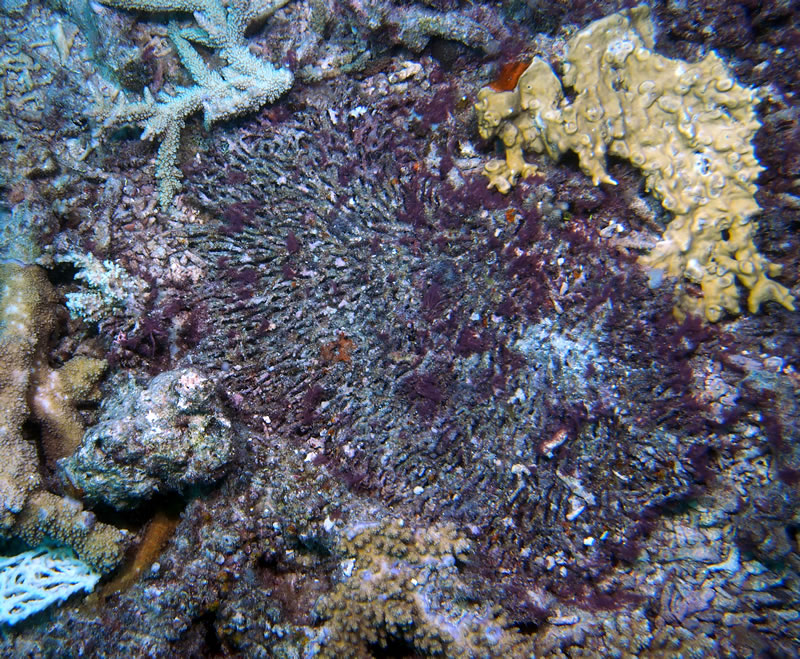
Small table acroporids with a coral diseaseDead table acroporids that was detached during a storm
Small table acroporids with a coral disease. (Left) / Dead table acroporids that was detached during a storm. (Right)
(Click thru on images for more detail.)

When a colony dies, its skeleton goes through as number of successional changes, starting with diatoms and filamentous algae, and eventually providing substrate for the settlement of new corals.  We often see dead thickets of staghorn coral and table acroporids in growth position, and these can support  dozens of new corals.  In some cases we’ve even found table acroporids that settled on top of a dead acroporids.  Coral reefs are a mix of live and dead corals, and when one colony is lost, it is usually quickly replaced by another.

Dead table acroporids in growth position with small massive corals (Astreopora, Porites, and favia) and branching corals (Acropora and Seriatopora).A long dead table acroporid colonized by two table acroporids, Pocillopora, Montipora, branching Acropora and several soft corals.
Dead table acroporids in growth position with small massive corals (Astreopora, Porites, and favia) and branching corals (Acropora and Seriatopora) (Left) / A long dead table acroporid colonized by two table acroporids, Pocillopora, Montipora, branching Acropora and several soft corals. (Right)
(Click thru on images for more detail.)

Photos by Andrew Bruckner.
 

Related Posts

Introducing Our New Website: A Fresh Look for the Foundation’s Future

As we celebrate the Khaled bin Sultan Living Oceans Foundation’s 25th anniversary, we are proud to unveil our newly redesigned website—a modern home for our science, conservation work, and educational programs. This launch marks an important moment for the Foundation as we honor our long history and look toward the future of ocean conservation.

For more than two decades, the Foundation has worked tirelessly to improve the health of our living oceans. We have advanced ocean science, led one of the largest coral reef research missions in history, restored mangrove forests with local communities, created award-winning education programs, and shared the wonders of the ocean with people around the world. Our new website reflects the organization we are today—focused on conserving coral reefs, restoring mangrove forests, and improving ocean literacy—while still highlighting the legacy of work that brought us here.

The redesigned site…

Read More

Connecting People, Art, and Oceans: Championing Conservation at the 2025 IUCN Congress

The IUCN World Conservation Congress brings together thousands of leaders and decision-makers from governments, non-profit organizations, civil society, Indigenous groups, and the private sector to shape global conservation policy and action. This influential gathering serves as a platform to share knowledge, build partnerships, and advance initiatives that protect our planet’s biodiversity.

As a member of the International Union for Conservation of Nature (IUCN), the Khaled bin Sultan Living Oceans Foundation was honored to take part in the Congress, joining a global community of leaders, organizations, and changemakers committed to protecting nature and advancing sustainable futures.

Read More
Privacy Overview

This website uses cookies so that we can provide you with the best user experience possible. Cookie information is stored in your browser and performs functions such as recognising you when you return to our website and helping our team to understand which sections of the website you find most interesting and useful.  You can view our complete Privacy Policy here.

Strictly Necessary Cookies

Most of our cookies are used to improve website security and reduce spam. These cookies should be enabled at all times. They also enable us to save your preferences for cookie settings.

3rd Party Cookies

This website uses Google Analytics to collect anonymous information such as the number of visitors to the site, and the most popular pages. Keeping this cookie enabled helps us to improve our website.