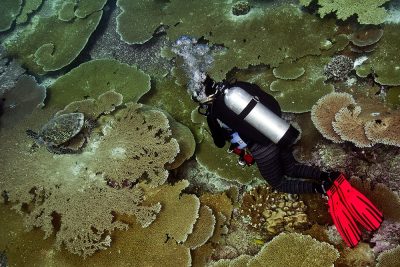
 As a marine ecologist, being able to survey the reefs of the Chagos Archipelago, considered the last frontier of coral reefs, was a very exciting prospect. After many hours flying, and even more on the ship transiting to our first destination, we finally arrived in the British Indian Ocean Territory Marine Protected Area where the Chagos reefs are found. From our first dive, I knew this would be a trip to remember. Prior to this, I had participated on many of the GRE expeditions, but this one felt different. I was awestruck by the beautiful reefs with large, healthy assemblages of corals and incredible fish communities. We came across unique reefs with monospecific stands of corals unlike seen in other parts of the world. The benthic communities appeared to be thriving with a balance of coral, CCA, other algae that supported the flourishing invertebrate and fish populations.
However, later in our trip, things started to change right before our eyes. We later discovered we were the first to observe what would be one of the most catastrophic global bleaching events on record. The water was exceptionally warm, causing the beautiful coral we had been observing to show signs of stress.
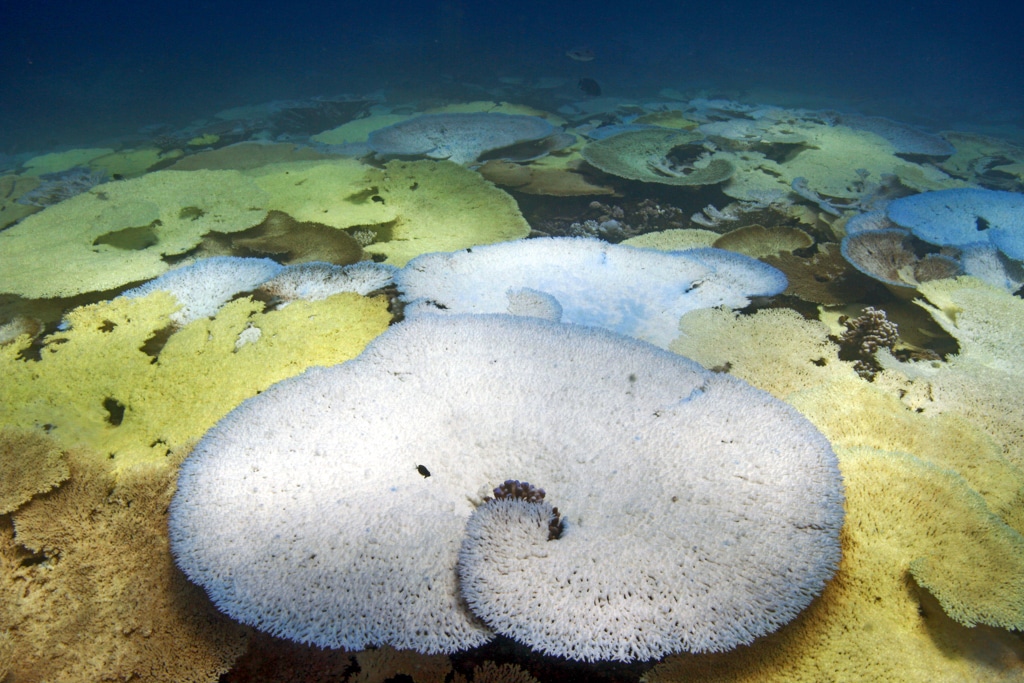
When corals are subjected to warmer water temperatures for extended periods of time, it causes them to release the symbiotic algae found in their tissues as a stress response. This causes the corals to appear pale, and with too much stress, can cause the coral to turn completely white and become what we would consider a bleached coral. Sometimes, if the water temperature goes down, the coral can recover from the bleaching or paling and reabsorb the algae into their tissues. If the water temperature doesn’t go down, eventually the coral will die as they are not able to survive in these conditions.
The bleaching event that we observed ended up causing mass coral mortality throughout the Chagos Archipelago. During our trip, we observed live coral cover ranging from 31-52%. By 2016, other studies found the live coral cover had been reduced to just 5-10%. This drastic decline in live coral cover is devastating, not only to the reef of the Chagos Archipelago, but to coral reefs throughout the Indian Ocean and rest of the world.
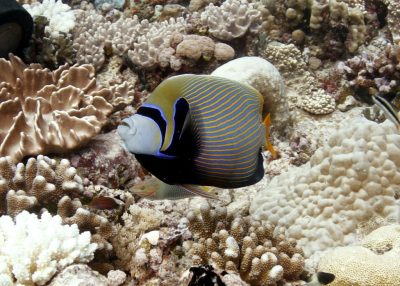 The mission to the Chagos Archipelago started out as an exciting new expedition, studying an area of the world where the impacts of humans should have been minimal. However, it also reminded me that regardless of where in the world you are, climate change can negatively impact even the most remote and pristine reefs and ecosystems of the world.
Photos taken by Ken Marks and Derek Manzello before and after the bleaching event on the Global Reef Expedition mission to the Chagos Archipelago.
 The Study
To learn more about our findings from the Global Reef Expedition mission to the Chagos Archipelago, read our latest publication: Global Reef Expedition: Chagos Archipelago Final Report.