Expedition Log: Maldives – Day 12
“In the end we will conserve only what we love, we will love only what we understand, and we will understand only what we are taught.”
Baba Dioum
This beautiful statement was spoken in 1968 to the General Assembly of the International Union for Conservation of Nature. Almost 50 years later, these words still ring true. Conservation of coral reefs cannot be achieved by scientists alone. Instead it will be the joint efforts of conservationists, scientists, governments, the private sector and the general public that will enable a true difference to be made. What we as scientists can do is to educate and raise awareness on issues, threats and the importance for conserving vital ecosystems such as coral reefs.
During our stay at Anantara Dhigu Resort on South Malé Atoll, we were overwhelmed by the level of interest, support and enthusiasm we were shown. We would continuously be asked questions by staff members, management and guests on our project and research. Staff would come diving with us to assist in crown of thorns starfish (COTS) removal on their only day off, chefs would grill us about coral reef and COTS ecology as they prepared our chicken tandoori and guests would look in awe at the buckets of COTS we collected each day.
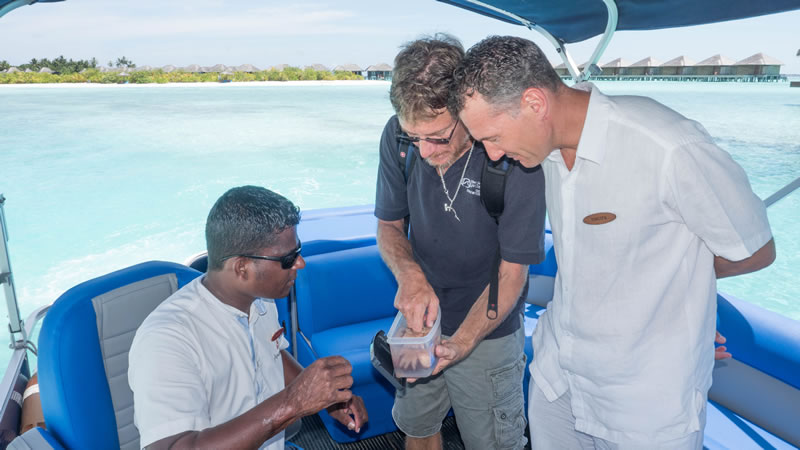
Andy showing a COTS to the ferry driver and General manager.
This overwhelming interest in our work led us to conduct three presentations during our stay; two for the staff and one for the guests. Each presentation, given by the Chief Scientist Dr. Andrew Bruckner, was well attended with 70 guests, both adults and children attending the Friday evening talk and over 80 staff members joining the staff presentations. The chef even prepared popcorn for the late evening presentation!
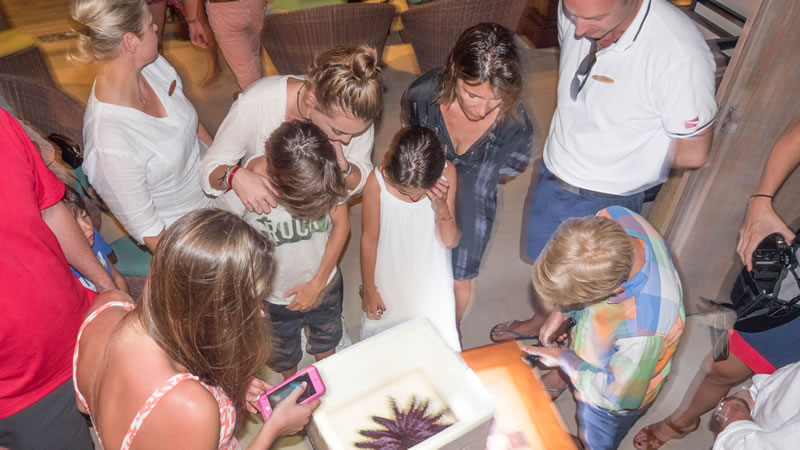
A captive audience.
For each presentation, we took a COTS in with us to show our avid audience what they looked like and how they walk. Dr. Bruckner would spend between 45-60 minutes describing the work of the Starfish Control and Removal (SCAR) Program, where we had been working in the Maldives, the numbers of COTS removed and the importance of removing them both in terms of conservation and safety. After this, the floor was opened to questions and guests and staff were able to come and get a closer look at the starfish. The children were most excited by the starfish, and took dozens of photos to show their friends at home. We had children, adults and staff members from nearby local islands describing when they had first seen COTS and where they had seen them. Having these information sessions provided an excellent opportunity for our team to gather information on COTS outbreaks in surrounding reefs.
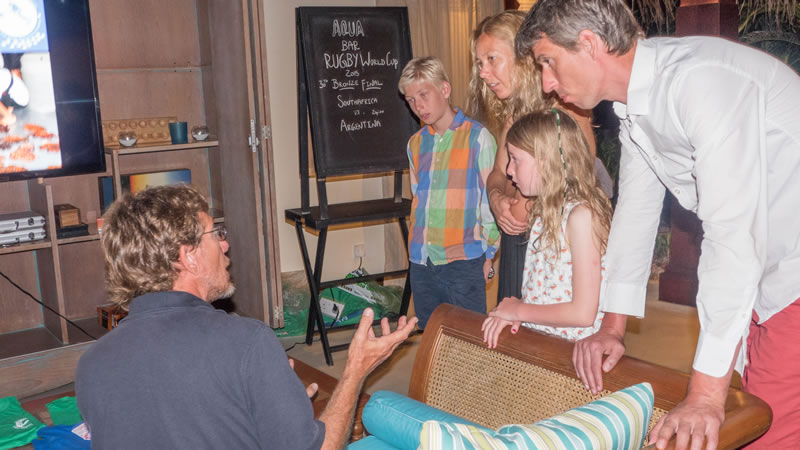
Andy teaching a family.
These presentations and interactions with both guests and staff offered our team the chance to discuss something we are all interested in and passionate about, and to spread awareness amongst a large number of people concerned about the health of the coral reefs in the Maldives.
Photos by Stefan Andrews