
search-icon
Scenes from Above

Written by Dr. Andy Bruckner, Chief Scientist

Society Islands from 1000 feet offers a unique perspective of the beauty of French Polynesia as well as some of the challenges we face on the upcoming research mission.  We overflew the eight atolls, most which were roughly circular or elliptical in shape – some with a few low-lying islets covered in coconut palms and scrub forest and others built around rugged, steeply-sloping volcanoes.

Aerial reconnaissance flight path over the Society Islands


Complex reef systems typically enclose deep water lagoons, only a few that are easily accessible, several that connect to the open ocean by a narrow, treacherous channel with a constant strong current, and others that are completely inaccessible and surrounded by a razor-sharp barrier reef.
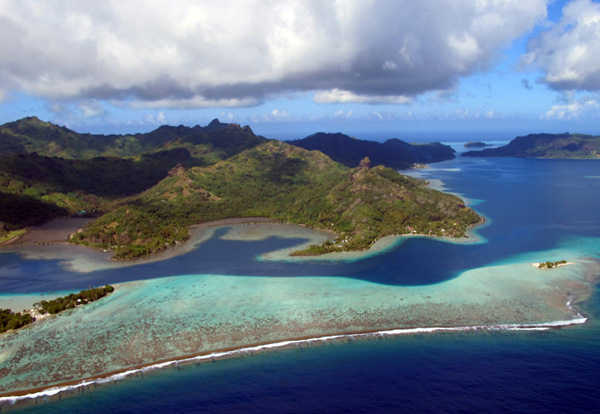
Huahine Island
Huahine Island

Low-lying areas typically have groves of coconut palms extending to the shoreline, broad stretches of untouched sandy beaches, isolated coves,  and crystal-clear, turquoise-colored deep-water lagoons carpeted with coral bommies that extend to just below the water’s surface.  All of the atolls have a reef flat and reef crest that forms a barrier between the calm, protected lagoonal environment and the wave-exposed outer reefs, and are surrounded by complex spur and groove formations that extend into deep blue open ocean.

Spur and groove reef formation off Huahine


Only a few of the islands are populated.  Usually just a handful of inhabitants live on the more remote atolls, coexisting in small villages lining the coast or tucked into the base of the mountainside.  A common sight is small, isolated wooden bungalows, perched on stilts over the lagoon,  often adjacent to a pearl farm. Besides the sheer beauty of the landscape, the coastal areas and surrounding sea were teaming with life.  Large schools of fishes, flocks of tropic birds, frigate birds and boobies, turtles, and humpback whales were frequently seen from the air.
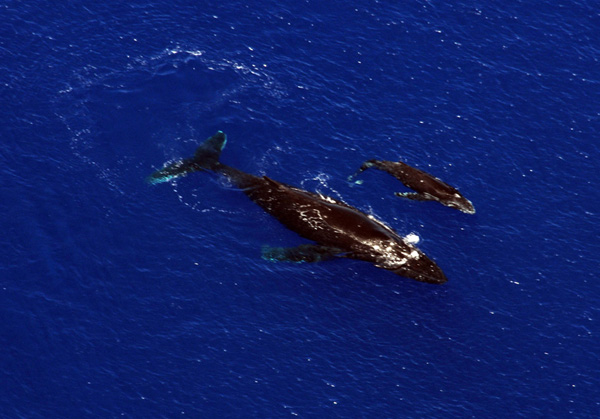
Humpback whale mother and calf off Scilly Island (Ile Manuae)
Pennant bannerfish (Heniochus chrysostomus) amongst sea urchins


Interestingly, the surface of the water surrounding many of the islands was streaked with spawning slicks – accumulations of coral spawn with a pinkish, orange or white tinge that were tens of meters in length.
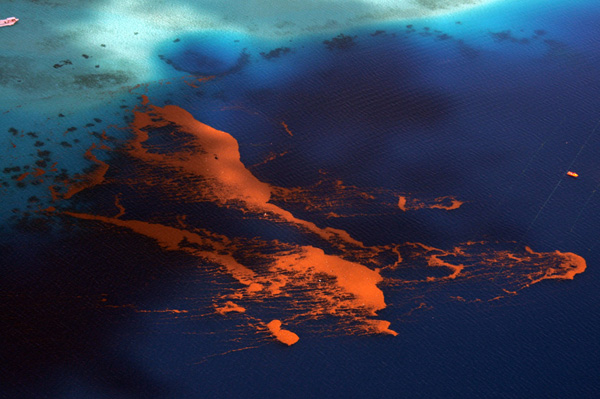
Coral spawning slick in the lagoon off Tahaa


After a successful aerial reconnaissance of Society Islands, we were joined on the M/Y Golden Shadow by the rest of the science team, preparing for our departure to the first research site, Mopelia (Maupihaa), about 15 hours by water from Tahiti.

(Photos/Images by: 1 Amanda Williams, 2-6 Dr. Andy Bruckner)

To follow along and see more photos, please visit us on Facebook! You can also follow the expedition on our Global Reef Expedition page, where there is more information about our research and team members.
Related Posts

Introducing Our New Website: A Fresh Look for the Foundation’s Future

As we celebrate the Khaled bin Sultan Living Oceans Foundation’s 25th anniversary, we are proud to unveil our newly redesigned website—a modern home for our science, conservation work, and educational programs. This launch marks an important moment for the Foundation as we honor our long history and look toward the future of ocean conservation.

For more than two decades, the Foundation has worked tirelessly to improve the health of our living oceans. We have advanced ocean science, led one of the largest coral reef research missions in history, restored mangrove forests with local communities, created award-winning education programs, and shared the wonders of the ocean with people around the world. Our new website reflects the organization we are today—focused on conserving coral reefs, restoring mangrove forests, and improving ocean literacy—while still highlighting the legacy of work that brought us here.

The redesigned site…

Read More

Connecting People, Art, and Oceans: Championing Conservation at the 2025 IUCN Congress

The IUCN World Conservation Congress brings together thousands of leaders and decision-makers from governments, non-profit organizations, civil society, Indigenous groups, and the private sector to shape global conservation policy and action. This influential gathering serves as a platform to share knowledge, build partnerships, and advance initiatives that protect our planet’s biodiversity.

As a member of the International Union for Conservation of Nature (IUCN), the Khaled bin Sultan Living Oceans Foundation was honored to take part in the Congress, joining a global community of leaders, organizations, and changemakers committed to protecting nature and advancing sustainable futures.

Read More
Privacy Overview

This website uses cookies so that we can provide you with the best user experience possible. Cookie information is stored in your browser and performs functions such as recognising you when you return to our website and helping our team to understand which sections of the website you find most interesting and useful.  You can view our complete Privacy Policy here.

Strictly Necessary Cookies

Most of our cookies are used to improve website security and reduce spam. These cookies should be enabled at all times. They also enable us to save your preferences for cookie settings.

3rd Party Cookies

This website uses Google Analytics to collect anonymous information such as the number of visitors to the site, and the most popular pages. Keeping this cookie enabled helps us to improve our website.