Expedition Log: Cook Islands – Day 5
If you asked me if I thought we’d see a lot of turtles during our mission to Aitutaki, I’d have said no. There are very few sponges, which is an important food source of the hawksbill turtle. There is also a complete absence of sea grasses, one of the primary foods of green turtles.
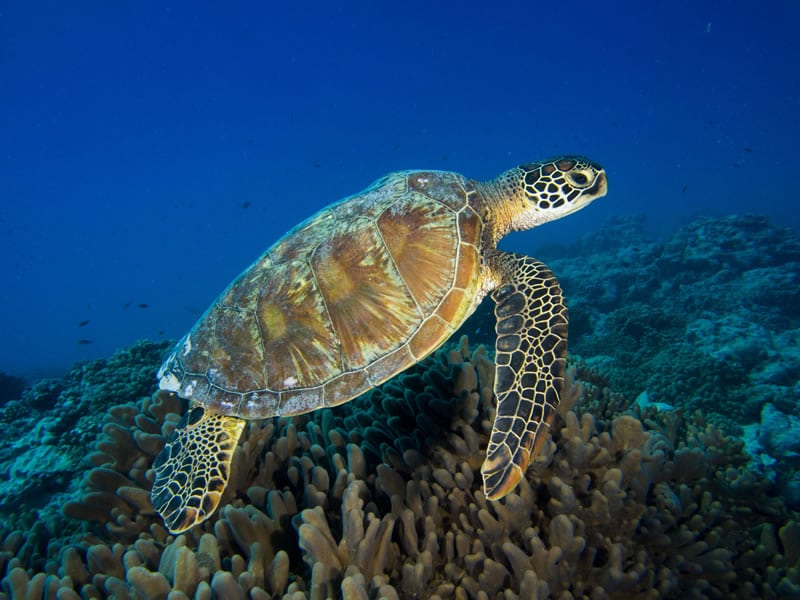
Green turtle.
To our surprise, we saw at least one green turtle on every dive, dozens on the water surface as the boat motored between sites, and several within the lagoon. They appeared to be most common on the leeward side of the atoll (the west coast), fairly close to the channel. On one dive we saw 12 turtles, including four that were resting on the bottom in one location.
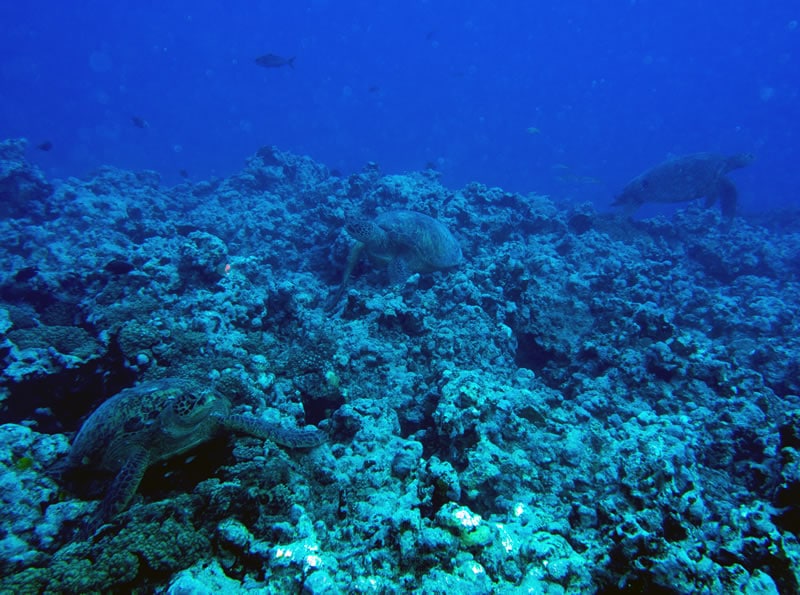
Three green turtles.
What surprised us even more was that our boat operator Onu could tell us where to find a turtle on many of the dives. At one of his regular dive spots he anchored the boat and said “swim to the south over two spurs and you’ll find a large green turtle sleeping next to the large coral head. Then head towards the reef crest about 30m until you come to a large sand patch. If you wait a few minutes you’ll see a school of spotted eagle rays in the shallows”.
I entered the water in disbelief, but we followed his directions regardless.
In both cases he was right on the money. We first found the green turtle and later observed close to two dozen spotted eagle rays.
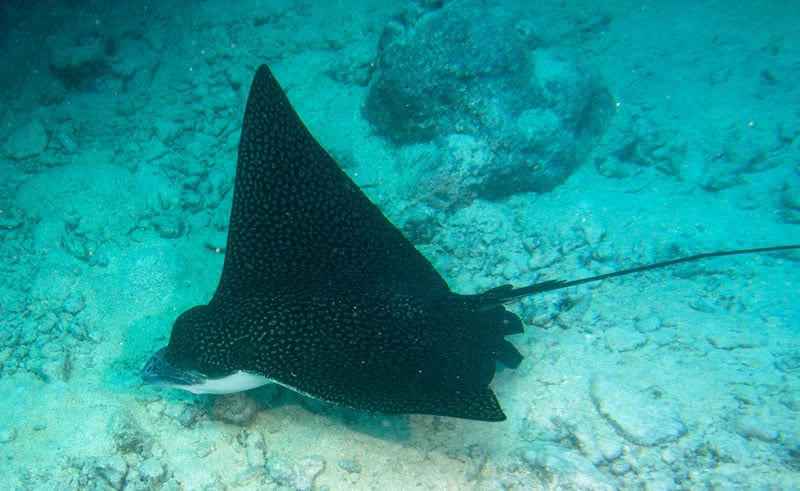
Spotted eagle ray.
How was this possible?
Upon closer examination of the green turtle, we may have resolved this mystery. The turtle had an unusual looking hump-shaped shell. A similar deformity had been reported from a hunchback green turtle captured in a fishermen’s net off Taiwan. According to a professor at National Taiwan Ocean University, this turtle was thought to have been raised in captivity within a pen that was too small for the turtle, causing the shell to grow upward, giving it a hunchbacked appearance.
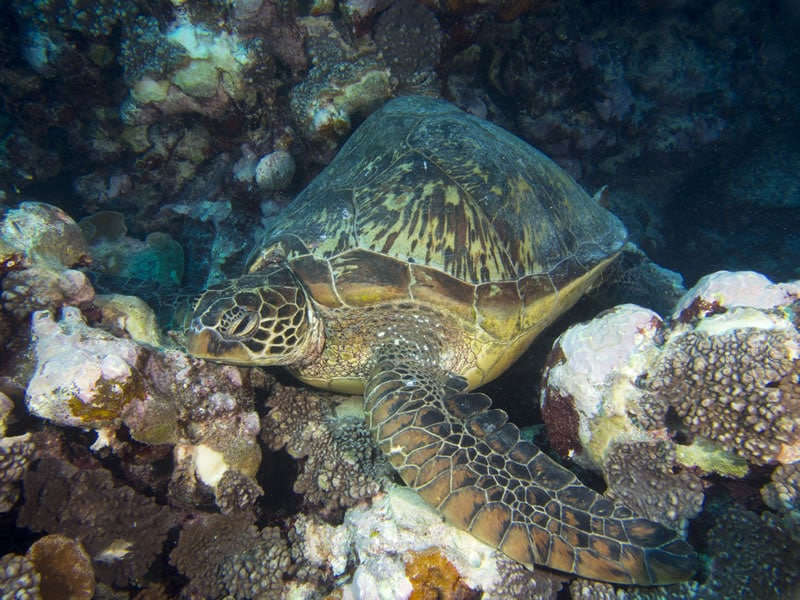
The Hunchback of Aitutaki.
It is likely that this also happened in Aitutaki. Onu told us that a number of injured and young turtles that were accidently captured were rehabilitated on shore and later released back into the wild.
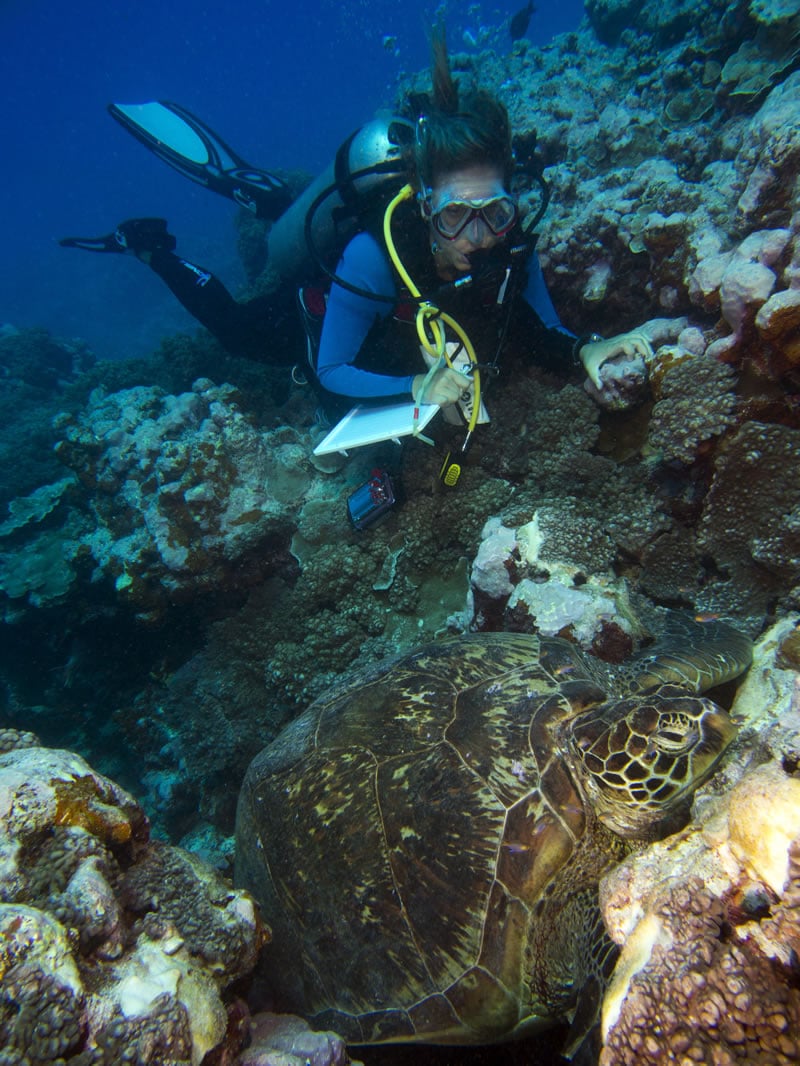
Our hunchback green turtle and Georgia.
Onu’s hunchback green turtle was no exception. The turtle appeared to be accustomed to divers and we later learned that the dive operators routinely fed it, possibly explaining why the turtle stays on the same location.
Photos: Andy Bruckner