
search-icon
A Conversation with Science Without Borders® Challenge Winner Zeno Park

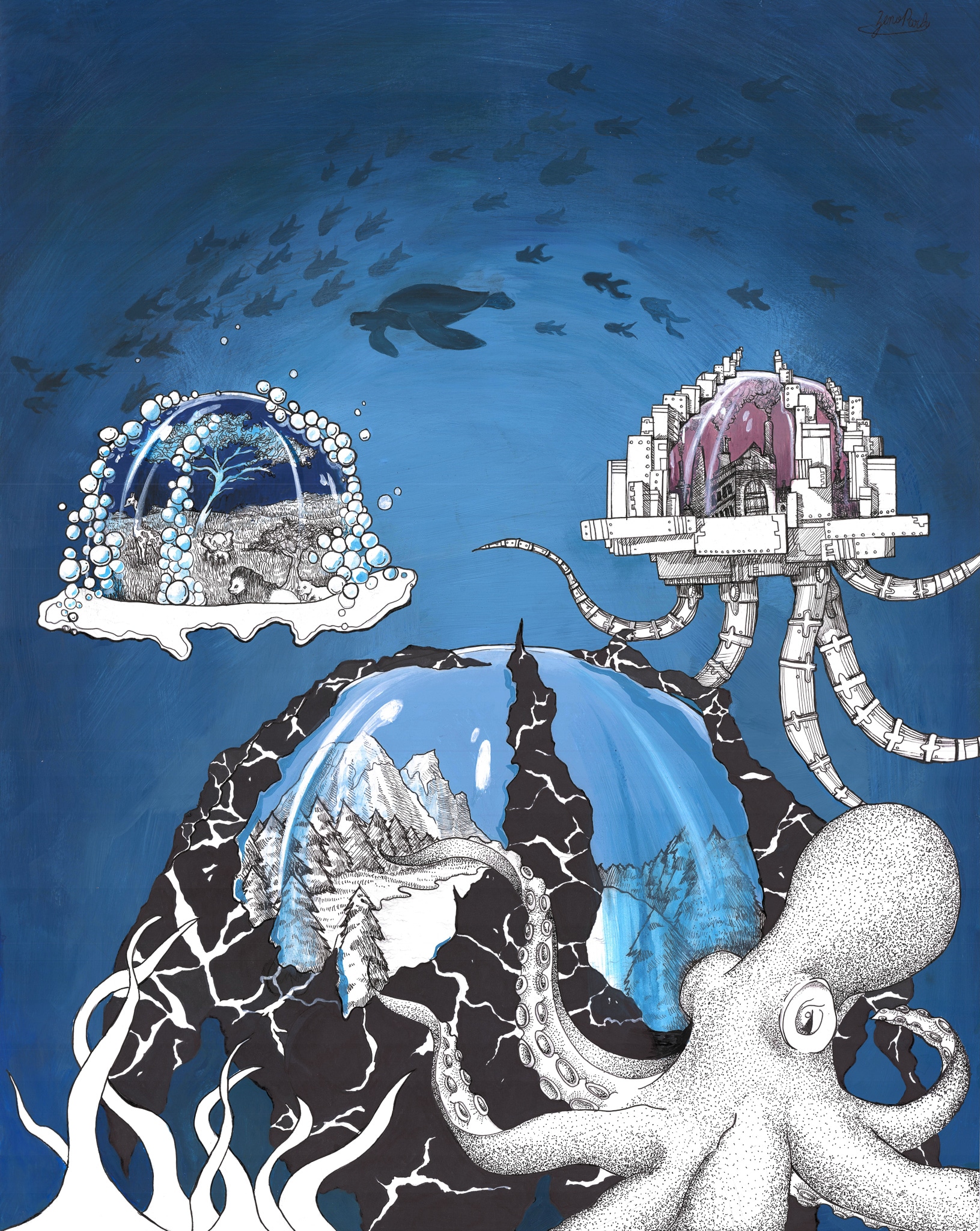
At only 12 years old, Zeno Park won first place in the middle school category of our international student art contest, the Science Without Borders® Challenge. Zeno lives in New Jersey, where he studies art after school at Studio YM in Tenafly. His winning artwork, “The Place where Fish are Free to Roam” shows underwater islands surrounded by swimming marine life. With this piece, Park said he wanted to show that in the ocean, organisms are “free to go wherever they wish” but that life in his underwater islands is “heavily dependent upon the condition of their habitat.”

Hear we talk to Zeno about his work, his connection with the ocean, and the advice he has for students applying for the Science Without Borders® Challenge. Our conversation has been lightly edited for brevity and clarity. 

Q:Why did you enter the Science Without Borders® Challenge?
A: I entered the Science Without Borders Challenge because I wanted to spread the message about the hardships we will have to encounter if we’re gonna keep on destroying our only home. 

Q:What inspired you to create your art piece?
A: I wanted to show people the dangers of the world of what we are doing and what it might result in. I want people to understand the difficult situations we will face if we don’t stop the harmful actions.

Q:Why is the ocean important to you?
A: The ocean is important to me because of how many of my childhood memories were made at the beach, along with the curiosity the ocean brings with its vastness and depth. 

Q:What are your plans for the future? Do you plan to pursue a career in art or science?
A: My dream is to become a vet. So yes, my plan does purse something with science.

Q:What advice would you give to someone who is considering entering the Science Without Borders® Challenge?
A: My advice to others who are considering entering Science Without Borders Challenge is to think outside the box.

Artist’s Statement

My artwork relates to the theme, “Connected Ocean: No Barriers, No Boundaries, No Borders” because my piece shows that in the ocean, organisms are free, while above ground they are stuck where they are at. The marine life in the background swimming represents that they are able to swim wherever they choose to go. Each fish, shark, turtle, etc. are able to swim as they please to because there is no border in the ocean. On the other hand, as represented by the underwatered islands, the places that organisms above sea level are able to live is heavily dependent on the condition of their habitat, their border. While animals are able to live in the safari, none can be found in the industrial area. In one word, this art piece shows that if there is no border in oceans, the marine life are free to go where ever they wish.
Related Posts

After the Storm: Standing with Our J.A.M.I.N. Family in Jamaica

There are moments in this work that feel heartbreakingly familiar.

Two weeks after we completed our Jamaica Awareness of Mangroves in Nature (J.A.M.I.N.) programming, Hurricane Melissa made landfall. A powerful Category 5 hurricane, Melissa is now tied with Hurricane Allen in 1980 for the strongest winds ever recorded in an Atlantic storm. Like Hurricane Dorian, which devastated The Bahamas in 2019, Melissa will be remembered as one of the strongest hurricanes on record in the region.

For 11 years, the University of the West Indies Discovery Bay Marine Laboratory and William Knibb Memorial High School have been more than program partners. They have welcomed us into their classrooms and labs, shared meals and laughter, and committed themselves to educating their students about mangroves and coastal resilience. These colleagues and students are not distant collaborators. They are family.

And they were hit hard…

Read More

B.A.M. Turns 10: A Year of Milestones, Resilience, and Growth

The 2025–2026 academic year was one of those defining years for our Bahamas Awareness of Mangroves (B.A.M.) and Jamaica Awareness of Mangroves in Nature (J.A.M.I.N.) programs. It was a year marked by celebration, challenge, growth, and powerful full-circle moments, and a reminder of why mangrove education matters.

In The Bahamas, B.A.M. reached a major milestone: ten years of partnership and environmental education in Abaco. Since 2015, in collaboration with Friends of the Environment, we have worked alongside Patrick J. Bethel High School and Forest Heights Academy to bring hands-on mangrove science into classrooms and into the field. This year, we were proud to expand the program to S.C. Bootle High School, increasing access for students who live…

Read More
Privacy Overview

This website uses cookies so that we can provide you with the best user experience possible. Cookie information is stored in your browser and performs functions such as recognising you when you return to our website and helping our team to understand which sections of the website you find most interesting and useful.  You can view our complete Privacy Policy here.

Strictly Necessary Cookies

Most of our cookies are used to improve website security and reduce spam. These cookies should be enabled at all times. They also enable us to save your preferences for cookie settings.

3rd Party Cookies

This website uses Google Analytics to collect anonymous information such as the number of visitors to the site, and the most popular pages. Keeping this cookie enabled helps us to improve our website.