The Khaled bin Sultan Living Oceans Foundation recently hosted a webinar with our partners at the Secretariat of the Pacific Regional Environmental Programme (SPREP). SPREP is an organization established by the governments of Pacific Island nations to protect and manage the environment and natural resources of the Pacific. Their 21 member states (including many we studied on the Global Reef Expedition) work together to achieve healthy and resilient ecosystems and support sustainable development for Pacific communities. Our webinar with SPREP allowed us to share our research findings from the South Pacific directly with people who are actively working to conserve coral reefs and coastal marine ecosystems in the region. This is one of the many ways we are sharing our knowledge and findings from the Global Reef Expedition with the countries and communities in which we worked.
During the webinar, we were able to share information about the work the Foundation completed on the Expedition, including our extensive outreach and education initatives, as well as our scientific findings. We highlighted the programs our education team developed over the course of the Expedition, the many outreach events we held, and provided a comprehensive discussion of the results of our research in the South Pacific as well as our work in the Indian Ocean and Caribbean Sea.
At the end of the presentation, we were able to share our ongoing partnerships and upcoming projects, including our ongoing partnership with the University of Miami to develop a reef resilience model, our partnership with NASA to map the world’s reefs, as well as our numerous education programs such as the Mangrove Education & Restoration Program, Coral Reef Ecology Curriculum, and Science Without Borders® Challenge. Lastly, we shared information about our endorsed UN Ocean Decade Project, Science Without Borders®: Conserving the Tropics, which will use science, outreach, and education to engage local communities to protect their coral reefs, mangrove forests, and seagrass meadows. This project will allow us to build off of our work on the Global Reef Expedition using a co-designed approach to further conservation of tropical coastal marine ecosystems, such as those in the South Pacific.
The webinar was attended by numerous government officials, marine managers, and stakeholders from throughout the South Pacific. Some of the attendees were people we had worked with on the Global Reef Expedition, but many were new and this webinar was a great introduction to the Foundation and our work. There was a great Q&A session at the end where we were able to discuss the findings and share more information about future partnerships.
As we take the work from the Global Reef Expedition to the next level, we are always looking to develop new partnerships to help bring the UN endorsed Science Without Borders® project to communities worldwide. Webinars like this, and partnering with SPREP, are important first steps in the implementation of the Science Without Borders® project and connect us with a network of people who are also working to protect, conserve, and restore ocean health.
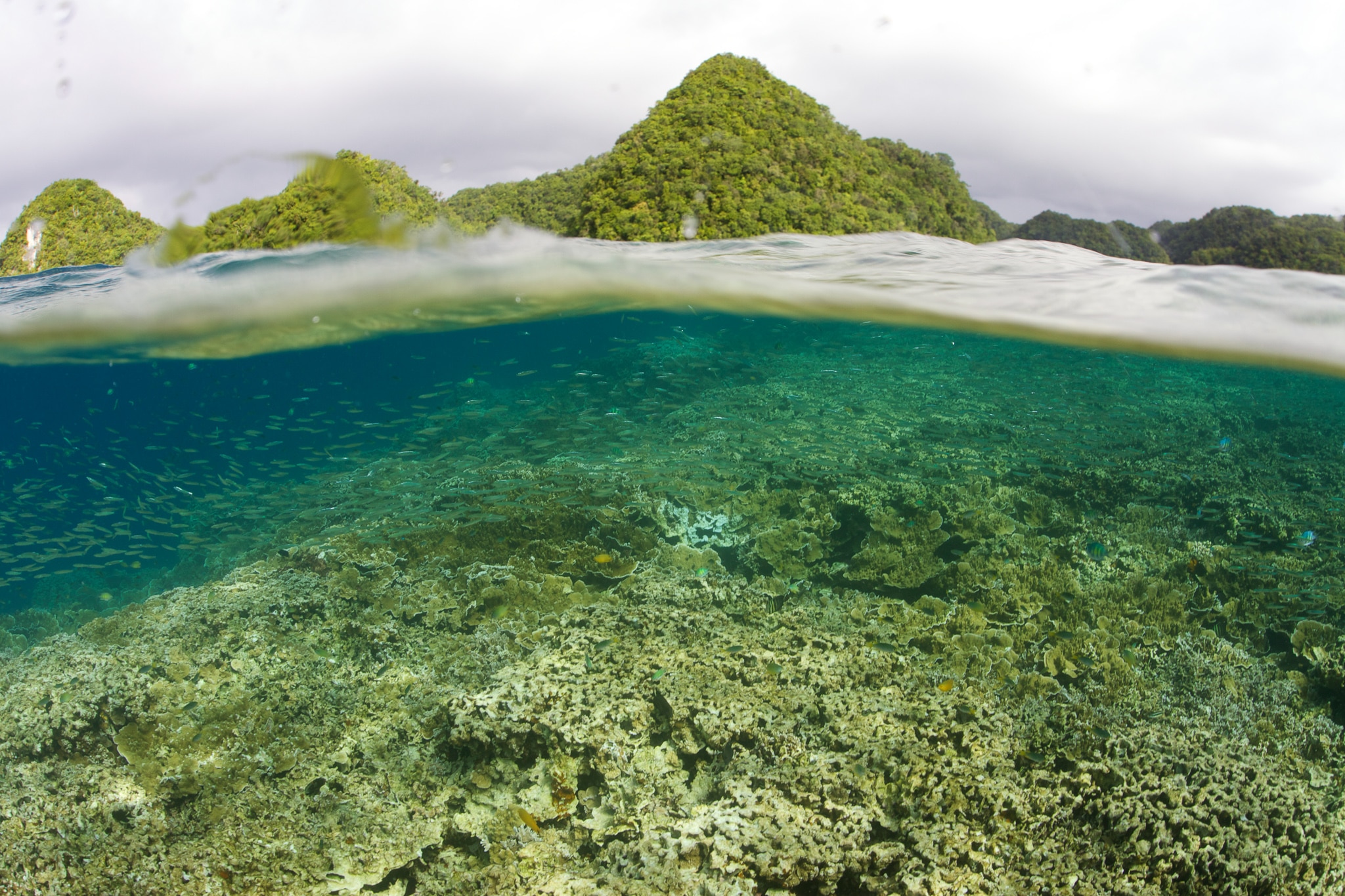
Image: Over/under shot of coral reefs in Palau, ©KeithEllenbogen/iLCP.